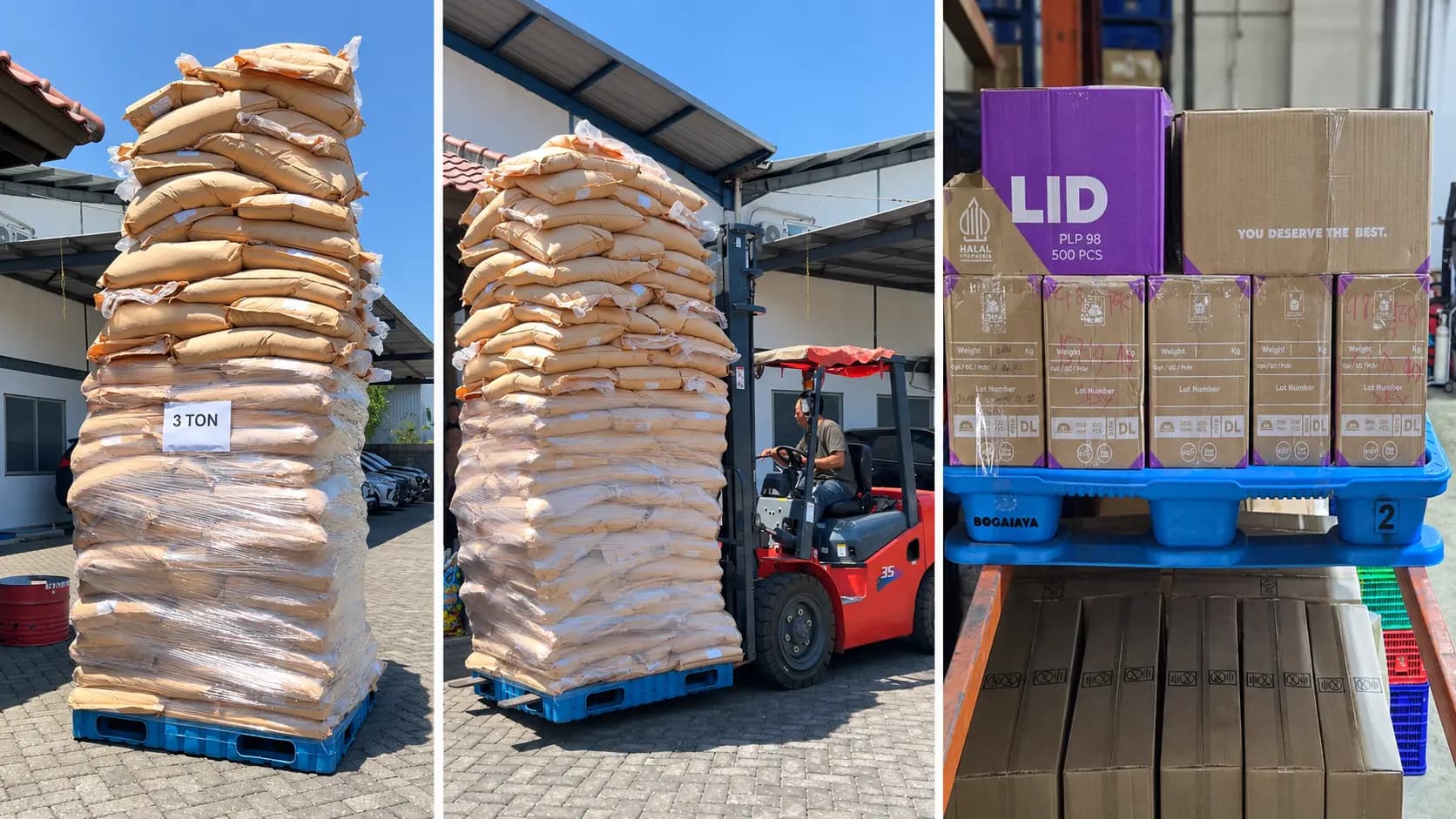
When reviewing pallet specifications, you may come across figures such as static load of 2 tons and dynamic load of 1 ton. For pallets used in certain warehouse storage systems, there is also a term called racking load.
All three indicate the load capacity of a pallet, but they apply to different operating conditions.
A pallet capable of supporting a 2,000 kg load while stationary on the floor may not necessarily be able to carry 2,000 kg when lifted by a forklift. Likewise, a pallet with a high dynamic load capacity is not automatically safe for use in a pallet racking system.
The main differences lie in how the pallet is supported, how the load is distributed, and whether the pallet is stationary, moving, or suspended between rack beams.
Therefore, understanding static, dynamic, and racking load is important before selecting pallets for warehouses, factories, distribution operations, or racking systems.
Why Can One Pallet Have Different Load Capacities?
Pallet capacity is not determined solely by the material or weight of the pallet.
The way a pallet is supported also significantly affects how forces from the goods are transferred through the pallet structure.
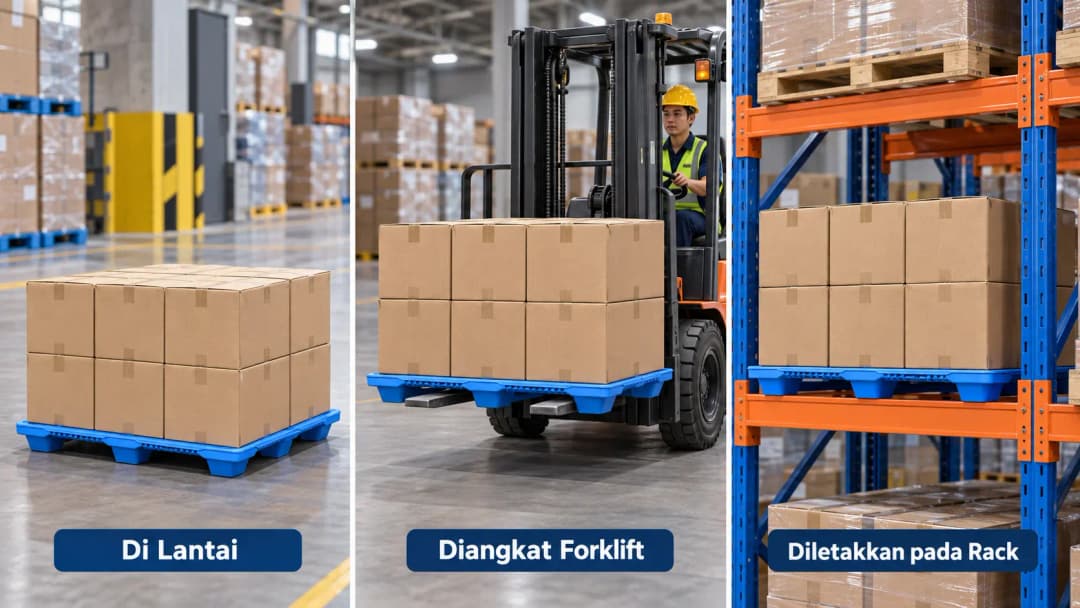
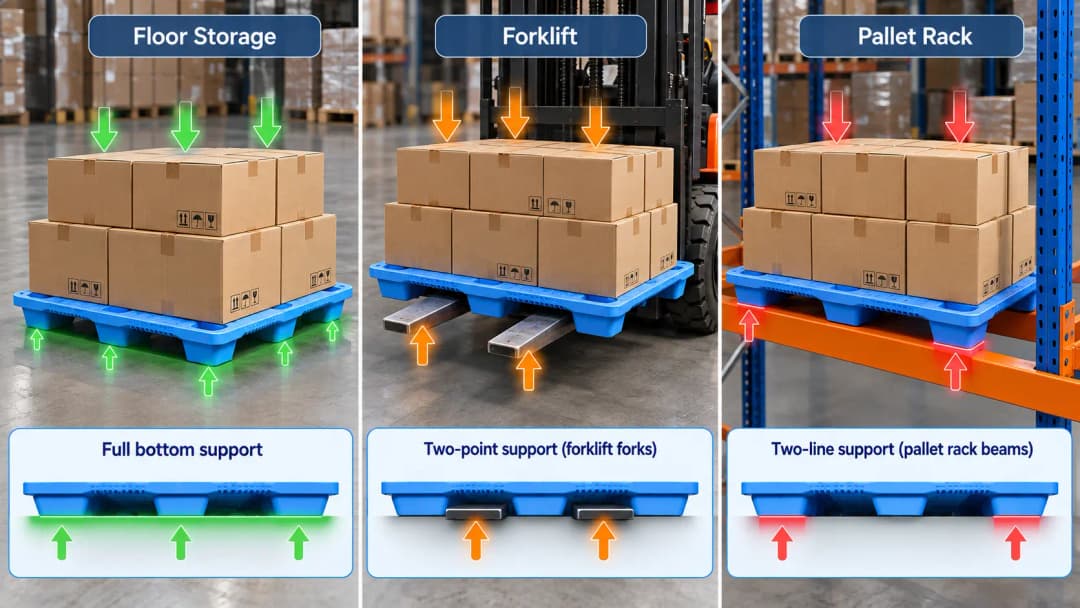
When a pallet is placed on the floor, most of its underside receives support. When the pallet is lifted by a forklift, the support shifts to the areas in contact with the forks. When placed on a rack, the pallet may only be supported by certain beams, meaning its central section must withstand a greater bending moment.
This is why a single pallet can have three different load capacity ratings.
In simple terms:
| Condition | Pallet Support | Relevant Parameter |
|---|---|---|
| Stationary on the floor | The underside receives broad support | Static load |
| Lifted or moved | Supported by forks or handling equipment | Dynamic load |
| Placed on a rack | Supported by specific beams or points | Racking load |
The ISO 8611 standard also distinguishes pallet testing based on loading and handling conditions. ISO 8611-1:2025 covers test methods for nominal load, maximum working load, and durability, while ISO 8611-3 addresses maximum working load in different handling environments.
What Is Static Load on a Pallet?
Static load is the load capacity of a pallet when it is stationary and supported on a suitable surface, such as a warehouse floor.
For example, a pallet loaded with cartons or raw materials is placed directly on the floor without being lifted or moved.
Because the underside of the pallet receives relatively broad support, static load is usually the highest capacity listed in pallet specifications.
However, the static load rating must still be interpreted according to the conditions in which the pallet is used.
For example:
Static load: 2,000 kg
This does not mean the pallet can automatically carry 2,000 kg using a forklift or be placed on a rack with the same load.
That rating applies to static conditions according to the pallet's design and testing conditions.
Load distribution is also important. A 1,500 kg load distributed evenly across the entire deck does not create the same loading conditions as a 1,500 kg machine supported by only a few small contact points.

When Should Static Load Be Used as a Reference?
Static load is particularly relevant for floor storage, staging areas, or situations where a pallet holds goods while stationary on a flat surface.
However, if the pallet will later be lifted for inbound handling, production, picking, or outbound operations, the dynamic load capacity must also be checked.
What Is Dynamic Load on a Pallet?
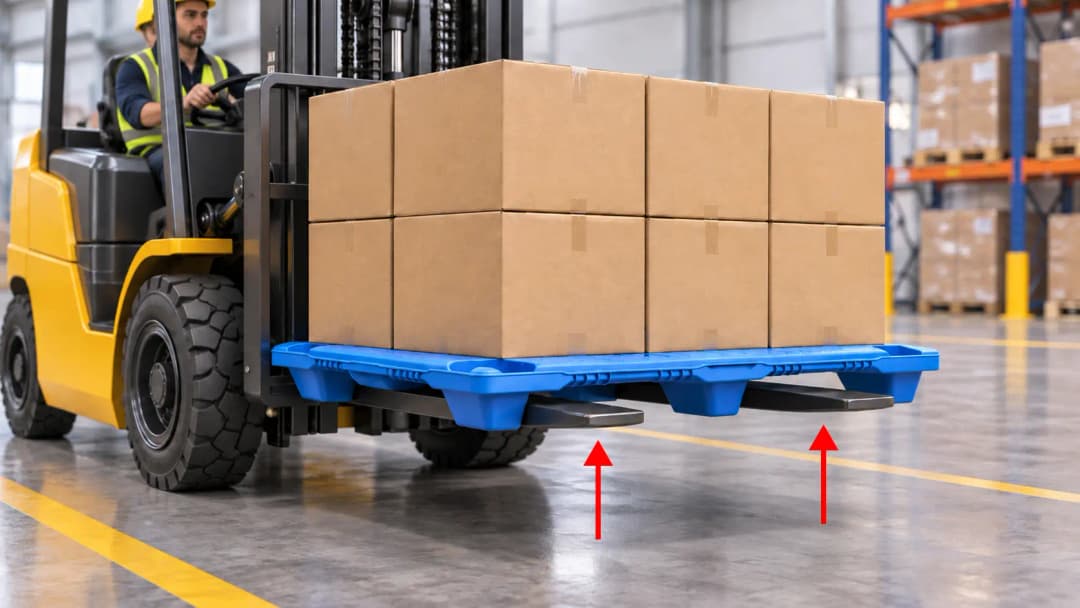
Dynamic load is the load capacity of a pallet when carrying goods while being lifted or moved using material handling equipment, such as a forklift, hand pallet truck, or stacker.
When a pallet is lifted off the floor, its support system changes.
The pallet no longer receives support across its entire underside. The weight of the goods must be transferred through the pallet structure to the points or areas in contact with the forks.
In addition to the weight of the goods, operational conditions may involve changes in direction, vibration, acceleration, braking, floor surface conditions, and load distribution.
Therefore, in many pallet designs, the dynamic load capacity is lower than the static load capacity.
As a simple example:
Static load: 2,000 kg
Dynamic load: 1,000 kg
When the pallet is stationary on the floor, static load is the relevant parameter.
However, when the pallet is lifted by a forklift, the rating that must be considered is the 1,000 kg dynamic load, not the 2,000 kg static load.
What Is Racking Load on a Pallet?
Racking load is the load capacity of a pallet when it is placed in a racking system with a specific support configuration.
This condition differs significantly from a pallet placed directly on the floor.
In a pallet rack, the pallet may rest on two beams, leaving the area between the beams without direct support.
The section of the pallet between these support points must maintain its structural rigidity while supporting the goods placed on top.
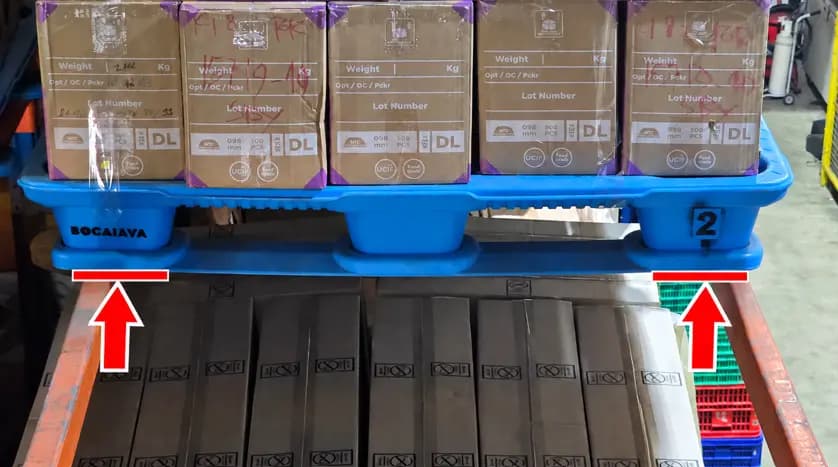
Therefore, a pallet with a high static load capacity does not automatically have a high racking load capacity.
Racking load can be influenced by several factors, including the distance between supports, pallet orientation within the rack, runner structure, reinforcement, temperature, storage duration, weight of the goods, and load distribution.
For plastic pallets, deformation under long-term loading must also be considered. ISO even provides ISO/TS 8611-4, which specifically addresses the prediction of creep response in plastic pallet stiffness testing.
This means the correct question is not simply:
"How many tons can this pallet support?"
But also:
"What is the load capacity of this pallet under the configuration in which I intend to use it?"
Static vs Dynamic vs Racking Load: What Are the Differences?
The differences between the three can be summarized as follows.
| Parameter | Static Load | Dynamic Load | Racking Load |
|---|---|---|---|
| Pallet condition | Stationary | Moving/lifted | Placed on a rack |
| Example of use | Floor storage | Forklift, hand pallet truck | Pallet racking |
| Support | Relatively broad | Forks / handling points | Rack beams |
| Load in motion | No | Yes | No |
| Bending risk | Relatively lower | Depends on fork positions | Can be high due to the span between beams |
| Can the ratings be treated as equivalent? | No | No | No |
One of the most common mistakes is focusing only on the highest load capacity listed in the specifications.
If a pallet has a static load of 4 tons and a dynamic load of 1.5 tons, it does not mean the pallet has a "4-ton capacity" under all operating conditions.
Load capacity must always be matched to how the pallet will be used.
Example of How to Read Pallet Specifications
Suppose a warehouse handles goods with a total weight of 900 kg per pallet.
The pallet being considered has the following specifications:
Static load: 2,000 kg
Dynamic load: 1,000 kg
If the goods are only stored on the floor, the 900 kg load remains below the static load capacity based on these specifications.
However, the pallet will also be moved using a forklift.
At this stage, the relevant parameter changes to dynamic load. A 900 kg load means the margin relative to the 1,000 kg dynamic load capacity becomes much smaller than if the user only considered the 2,000 kg static load.
If the pallet will then be placed on a rack, these two ratings are not sufficient.
Racking load must be confirmed separately based on the pallet and the rack configuration being used.
This is why purchasing teams and warehouse managers should avoid specifying requirements simply as:
"Find a pallet with a 2-ton capacity."
More useful information would be:
"The pallet carries a maximum unit load of 900 kg, is moved using a forklift, and is then stored on a selective pallet rack with a specific configuration."
With this information, the pallet can be evaluated based on its actual operating conditions.
What About the Load Capacity of Karpinus HDPE Pallets?
The Karpinus HDPE Pallet product line is currently available in several sizes and structural configurations.
For example, the PT Karya Pilar Nusantara product page lists the KPN 1080 Light, measuring 80 × 100 cm, in several weight options, with a static load capacity of approximately 2–3 tons and a dynamic load capacity of approximately 1.5–2.5 tons.
The KPN 1210 Standard series, measuring 100 × 120 cm, offers several structural options with a static load capacity of up to 3 tons and a dynamic load capacity of up to 2.5 tons.
For higher load capacities, the KPN 1214 Heavy Duty and KPN 1212 Double Side are also available, with different load configurations depending on the pallet type or weight.
These differences show that even pallets with similar shapes or dimensions do not necessarily have the same load capacity.
Pallet weight, structure, deck, runners, reinforcement, and overall design must still be considered.
For use in racking systems, the racking load capacity should be confirmed according to the pallet model and rack configuration being used. The Karya Pilar Nusantara product page also offers Strip Pallets, which are installed on the underside of pallets to provide additional support when used in racking systems.
Why Is Load Distribution Just as Important as Weight?
Two loads with the same total weight do not necessarily create the same loading conditions on a pallet.
Imagine two pallets, each carrying goods weighing 1,000 kg.
On the first pallet, the goods consist of cartons, with the weight distributed across almost the entire deck surface.
On the second pallet, the load consists of a machine supported by four small feet.
Although the total weight is the same, the second pallet receives a more concentrated load at several points.
Therefore, the capacity listed in a datasheet should not be interpreted as a guarantee that all types of goods weighing less than the specified rating are automatically safe.
ISO 8611-1:2025 also emphasizes that certain capacity tests do not replace the value of field testing for specific pallet designs and applications.
For heavy industrial applications or critical systems, actual operating conditions must still be evaluated.
Factors That Affect Actual Pallet Load Capacity
In addition to the total weight of the goods, several variables must be considered.
Load distribution determines whether forces are spread evenly or concentrated at specific points.
Fork position determines how the load is transferred when the pallet is lifted.
Rack beam spacing affects the length of the pallet section that does not receive direct support.
Pallet design, including runners, decks, single-side and double-side construction, and reinforcement, affects structural rigidity.
Ambient temperature can also be relevant for plastic pallets, especially during long-term use or in environments with temperatures different from the testing conditions.
Finally, the physical condition of the pallet must be inspected. A pallet that is cracked, deformed, or has been subjected to repeated impacts should not be assumed to be in the same condition as a new pallet.
How to Determine Which Load Capacity to Use
The easiest approach is to follow the pallet's journey throughout the operation.
If the pallet remains stationary on the floor, check the static load.
If the pallet is lifted or moved using a forklift, hand pallet truck, or stacker, check the dynamic load.
If the pallet is placed in a pallet rack, check the racking load and the rack support configuration.
If the pallet experiences all three conditions during a single operating cycle, do not simply choose the highest capacity rating.
Each stage must meet the load capacity requirements appropriate to that condition.
For example:
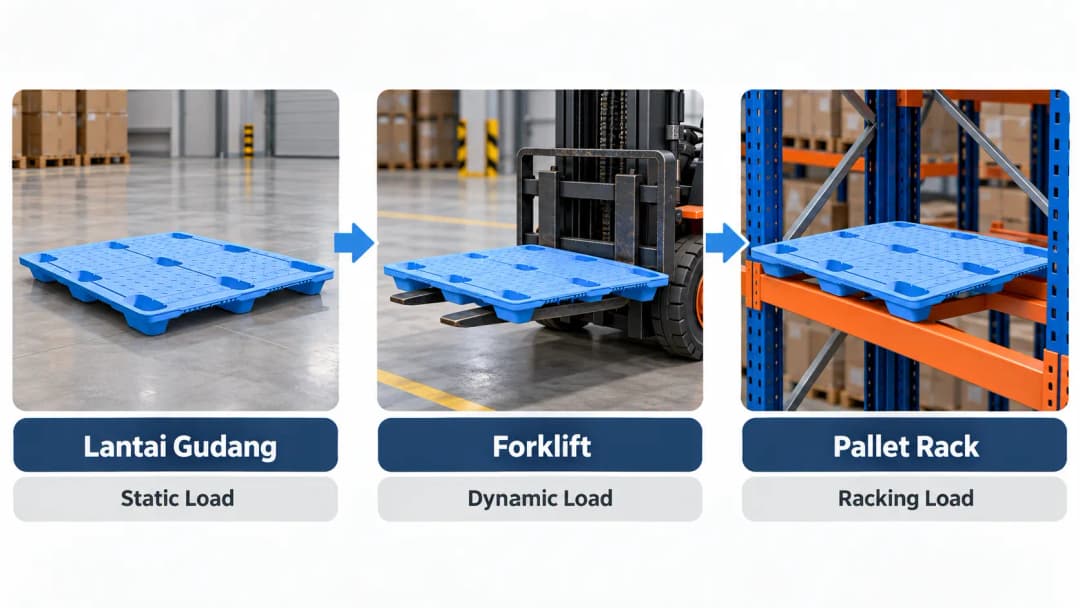
Floor storage → Static load
Forklift handling → Dynamic load
Rack storage → Racking load
Operational load capacity is not determined by a single highest rating, but by the suitability of the pallet across all intended usage scenarios.
Common Mistakes When Reading Pallet Load Ratings
One of the most common mistakes is assuming that static load represents the pallet's overall load capacity.
Another mistake is assuming that dynamic load and racking load are the same because, in both conditions, the pallet is not resting on the floor.
However, the support points and the patterns of forces acting on the pallet are different.
Another mistake is selecting a pallet for racking solely based on its dimensions. A pallet that fits the available rack space does not necessarily have a structure suitable for racking loads.
Finally, users sometimes calculate only the average weight of the goods. When selecting a pallet, the more relevant consideration is the maximum unit load weight that may occur during normal operations, along with an understanding of how that load is distributed.
So, Which Load Capacity Should You Pay Attention To?
No single type of load capacity is always the most important.
The most relevant parameter depends on how the pallet is used.
For floor storage, static load is the primary parameter.
For distribution and forklift operations, dynamic load becomes more relevant.
For warehouses that use pallet racks, racking load must be checked specifically.
If a pallet is used during production, moved by forklift, transferred to a warehouse, and then placed on a rack, all three load ratings must be understood as part of a single material handling system.
Therefore, before selecting a pallet, the information that should be identified includes the maximum weight of the goods, product dimensions, load distribution, handling equipment, storage type, and rack configuration if applicable.
With this information, pallet selection is no longer simply about finding the highest load capacity, but about identifying specifications that match actual operating conditions.
To explore the available size and load capacity options, you can compare the specifications of Karpinus HDPE Pallets based on your warehouse, logistics, or industrial requirements.