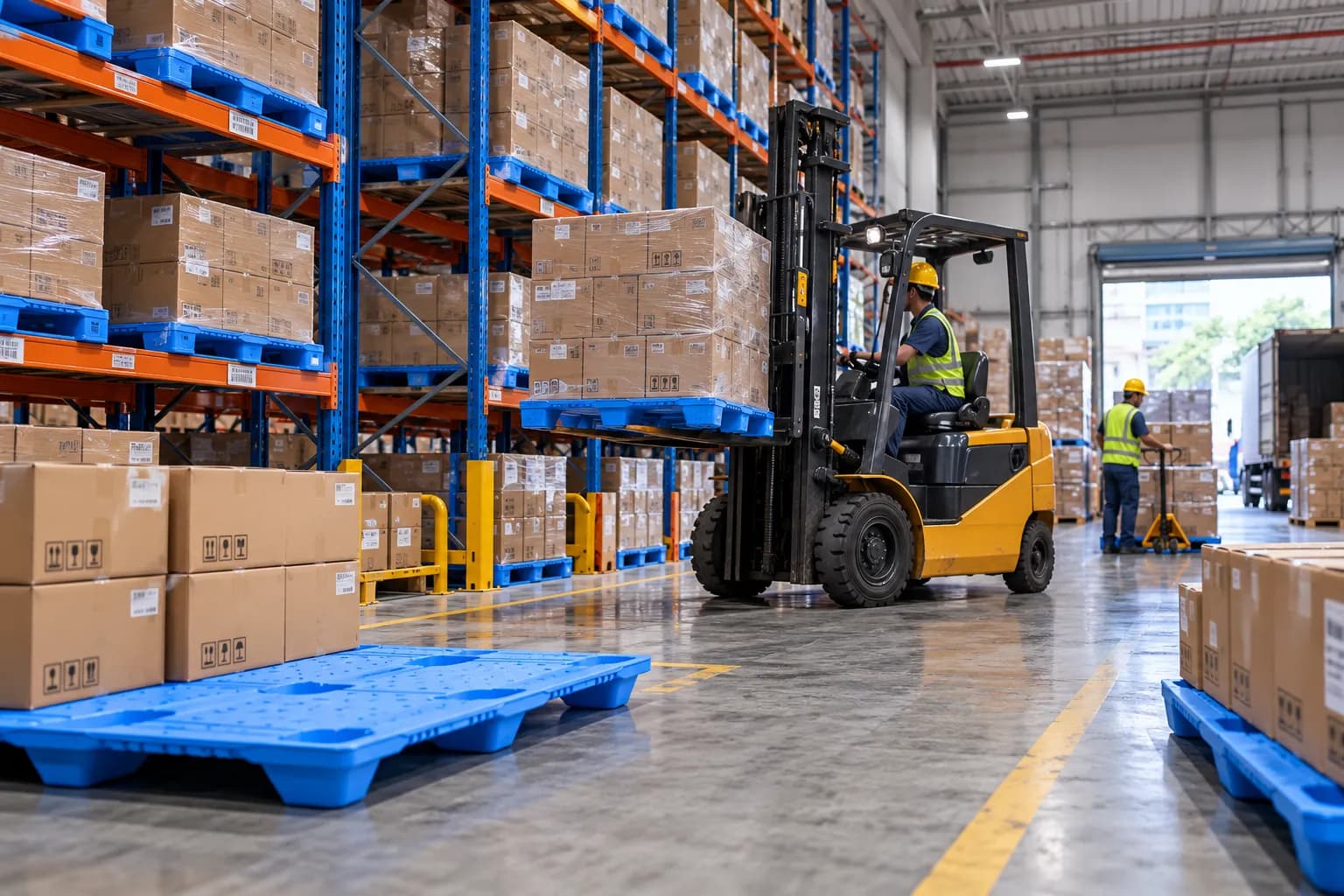
Plastic pallets are widely used in warehouses to support the storage and movement of goods. With pallets, goods can be arranged more neatly and moved using forklifts or hand pallet trucks without having to lift each item individually.
However, not all plastic pallets have the same fork opening design. Some pallets can be lifted from two directions, while others provide access from all four sides. These differences are important because they directly affect how goods are handled in warehouses.
When choosing plastic pallets for forklifts, size and load capacity are important considerations. However, the position of the fork openings, the design of the supporting feet, and the type of handling equipment used must also be checked.
A suitable pallet makes it easier for operators to pick up, lift, and move goods. On the other hand, a pallet with incompatible fork access can make loading and unloading more difficult.
Why Are Pallet Fork Openings Important?
Fork openings are spaces or gaps underneath a pallet that allow the forks of handling equipment to enter.
These openings allow forklifts or hand pallet trucks to reach the pallet from certain sides before lifting the goods placed on top.
Although they may seem simple, the position of fork openings has a significant impact on warehouse operations.
For example, pallets arranged close to a wall must have accessible fork entry sides. If the fork openings face a blocked side, the pallet may need to be repositioned before it can be moved.
Similar situations can occur when pallets are placed inside trucks, containers, or storage areas with limited maneuvering space.
Therefore, choosing warehouse pallets should also involve considering the direction from which goods will be picked up, especially when handling activities take place every day.
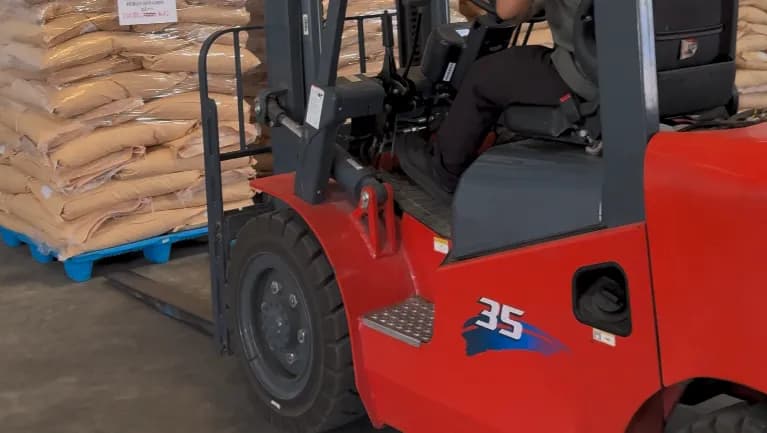
Differences Between Pallets for Forklifts and Hand Pallet Trucks
Forklifts and hand pallet trucks are both used to move goods placed on pallets. However, they operate differently.
These differences affect which pallet designs can be used.
Pallets for Forklifts
A forklift is a material handling vehicle that uses two forks to lift and move goods.
During pickup, the forks are inserted through the openings underneath the pallet. Once positioned correctly, the forklift can lift the pallet together with its load.
Because a forklift lifts directly using its forks, it can handle various pallet designs as long as the opening dimensions, supporting structure, load capacity, and load positioning are suitable.
Plastic pallets for forklifts are generally available with either two-way or four-way entry options.
Pallets for Hand Pallet Trucks
Hand pallet trucks are commonly used to move goods over short distances on suitable floor surfaces.
This equipment has two forks with small wheels underneath. These wheels help the hand pallet truck move and slightly raise the pallet above the floor.
Because there are wheels near the ends of the forks, using a hand pallet truck requires additional attention to the underside of the pallet.
The entry openings must have sufficient clearance, while the wheel paths must not be obstructed by supporting feet or other structures underneath the pallet.
For example, a pallet may have openings large enough for forklift forks. However, when a hand pallet truck is inserted, its wheels may become blocked by the supporting structure.
In this situation, the pallet may not be compatible with a hand pallet truck from the same direction.
Therefore, a pallet that can be used with a forklift is not necessarily compatible with a hand pallet truck. Compatibility must be determined by the pallet design and the dimensions of the equipment being used.
Understanding Fork Entry Directions: 2-Way and 4-Way
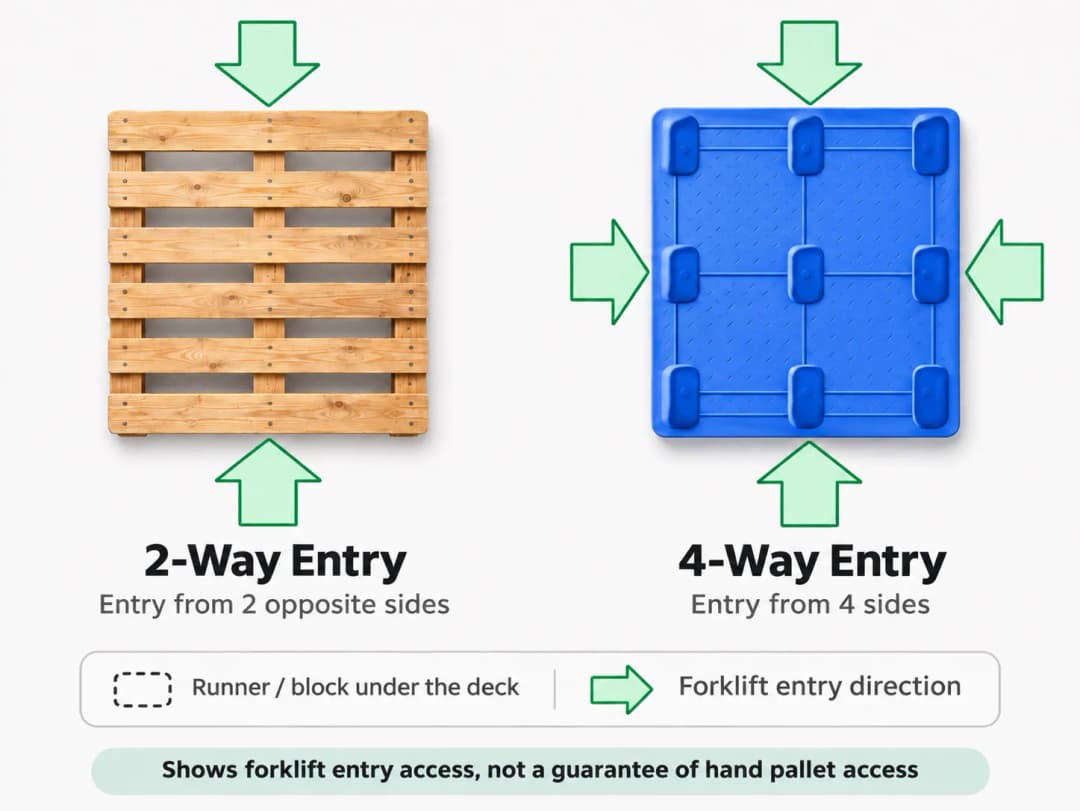
The terms 2-way entry and 4-way entry are commonly found in plastic pallet specifications.
These terms indicate the number of sides from which the forks of handling equipment can enter.
2-Way Entry Pallets
A 2-way pallet provides fork entry access from two opposite sides.
This means operators can only pick up the pallet from certain directions.
In warehouses with fixed handling routes, 2-way pallets can still be used effectively as long as the fork entry directions match the storage layout.
For example, if operators always pick up goods from the front or back, two-way access may be sufficient.
However, if pallet positions frequently change, operators may need to adjust their approach before moving the goods.
4-Way Entry Pallets
A 4-way pallet provides fork entry access from all four sides: front, back, left, and right, for the types of equipment specified as compatible.
This access provides more options when a forklift needs to pick up a pallet.
For example, in a relatively crowded storage area, a forklift can approach the pallet from another side if the original pickup direction is inaccessible.
This can reduce the need to reposition a pallet simply because its fork openings are not facing the operator.
However, a 4-way pallet does not always mean that a hand pallet truck can access it from all four sides. Hand pallet truck compatibility still depends on the underside design and the clearance available for its wheels.
Comparison of 2-Way and 4-Way Pallets
| Aspect | 2-Way Pallet | 4-Way Pallet |
|---|---|---|
| Fork entry directions | Two opposite sides | Four sides |
| Forklift pickup | Limited to available sides | More entry direction options |
| Pallet arrangement | Orientation must be considered | More flexible |
| Use in confined areas | Depends on pallet positioning | May make pickup easier |
| Hand pallet truck access | Must be checked | Must still be checked |
| Common applications | Organized handling routes | Warehouses requiring more varied access |
The Design of Pallet Feet and the Underside Also Matters
In addition to the number of fork entry directions, the underside design of a pallet is another important factor to check.
Plastic pallets generally have supporting feet or underside structures that support the pallet surface and its load.
These designs can differ from one model to another.
Pallets with Supporting Feet
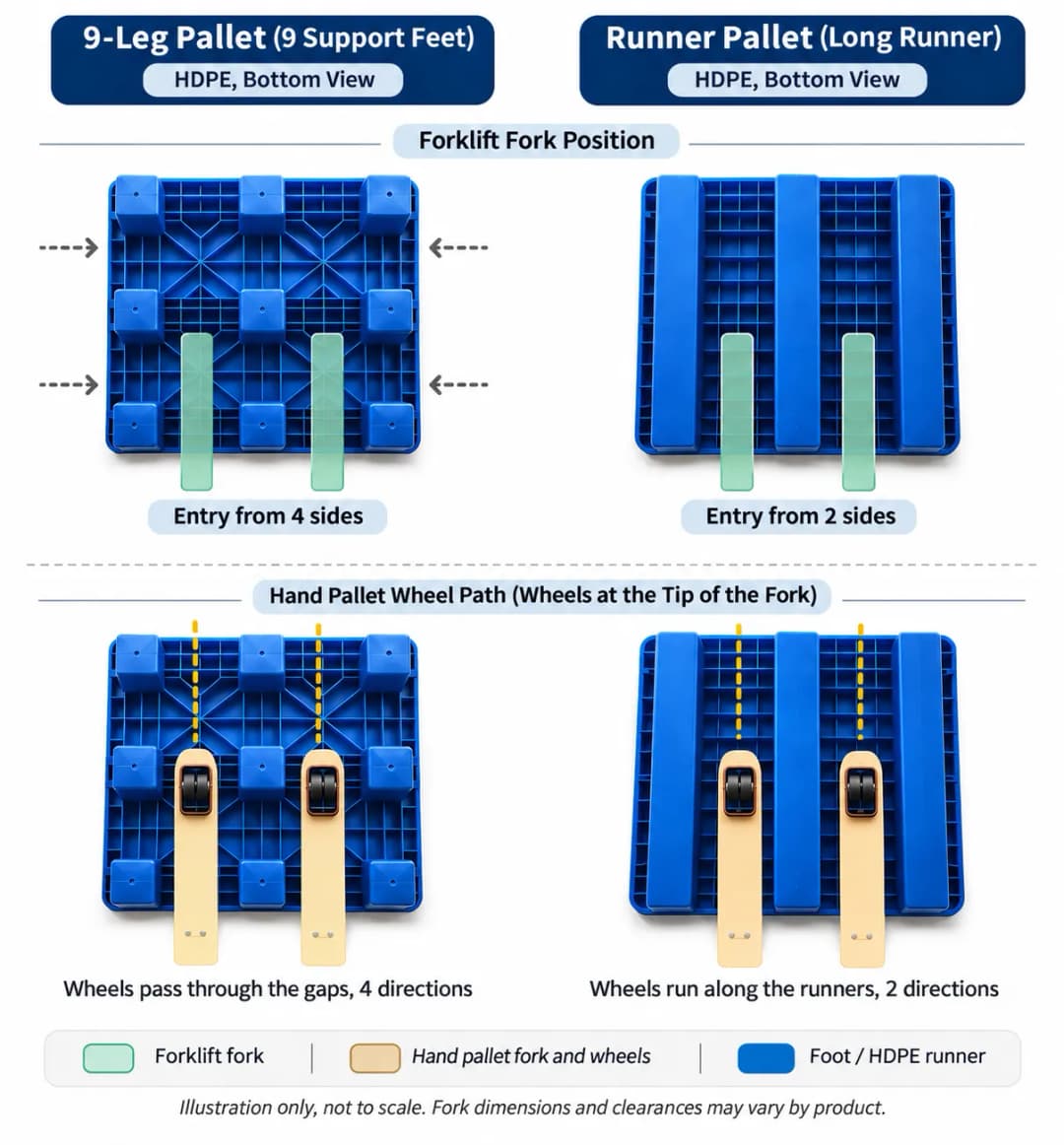
One commonly found design is a pallet with nine supporting feet.
These feet are positioned at several points underneath the pallet, leaving spaces between them for handling equipment access.
This design can provide different fork entry directions, depending on the size of the feet and the distances between them.
However, the number of feet alone is not enough to confirm that a pallet is compatible with every type of hand pallet truck.
The opening dimensions and wheel paths must still be checked.
Pallets with Runners or Longitudinal Supports
Another type uses elongated supporting structures, known as runners, underneath the pallet.
Runners form part of the supporting structure and can affect load distribution depending on their design.
In certain models, runner designs provide sufficient space for forklift forks but may restrict access for hand pallet truck wheels.
Therefore, pallets with runners should be inspected from several sides before use.
Single-Sided and Double-Sided Pallets
Single-sided pallets have one main surface for placing goods, while certain double-sided pallets are designed with two surfaces that can be used alternately.
This difference relates to pallet construction and does not directly indicate the number of fork entry directions.
Double-sided pallets are also not automatically compatible with all hand pallet trucks. Their underside design may affect wheel movement and lifting operations.
Therefore, buyers should examine the overall pallet design rather than only looking at its top surface.
How to Choose Plastic Pallets That Match Warehouse Equipment
Before purchasing pallets in large quantities, it is advisable to identify the handling equipment and operating conditions first.
The following checks can help in selecting suitable pallets.
1. Identify the Type of Handling Equipment Used
Determine whether the warehouse uses forklifts, manual hand pallet trucks, electric pallet trucks, or stackers.
If several types of equipment are used interchangeably, the pallet must have a design that is compatible with all of them.
Do not rely solely on a statement that a pallet is suitable for forklifts if it will also be used with hand pallet trucks.
2. Check Fork Opening Dimensions
Pay attention to the width and height of the pallet's entry openings.
These dimensions must be compatible with the fork width, lowered fork height, distance between forks, and fork length of the handling equipment.
For hand pallet trucks, also check the position of the small wheels located underneath the forks.
The wheels must be able to move along the available paths without being blocked by pallet feet or underside structures.
3. Determine the Direction of Goods Pickup
Observe how goods are arranged and from which directions operators usually pick up pallets.
If pickup always takes place from two opposite sides, a suitable 2-way pallet may be sufficient.
However, if pallets are frequently moved from different sides, 4-way forklift access can provide additional flexibility.
The selection must still consider operator maneuvering space, rack positions, and vehicle routes.
4. Match the Pallet to the Load Capacity
Plastic pallets are available with various load capacities.
In warehouse operations, two important terms must be distinguished:
Static load: The load capacity when a pallet remains stationary with support conditions that comply with its specifications.
Dynamic load: The load capacity when a pallet is moved using handling equipment under the specified testing conditions.
If the pallet will be placed on racking systems, also check its racking load capacity and rack support requirements.
A pallet that can support a heavy load on the floor may not have the same capacity when lifted by a forklift or placed on a rack.
5. Check Compatibility Before Placing Large Orders
For large-volume pallet procurement, checking a sample unit is an important step.
Try inserting the forks from the directions that will be used during operations.
Make sure the forks can enter and exit without getting stuck. For hand pallet trucks, also check whether the wheels can move and lift the pallet as intended.
Once initial compatibility has been confirmed, load testing must follow the equipment capacity, safety procedures, and manufacturer's instructions.
This step helps prevent purchasing pallets that have the correct dimensions but are difficult to use with the warehouse's existing handling equipment.
Examples of Pallet Use in Warehouse Operations
Not every warehouse has the same requirements. Therefore, pallet selection should also be based on the activities being carried out.
Warehouses with Fixed Forklift Routes
In warehouses with organized pickup routes, pallets can be arranged in the same orientation.
If forklifts always pick up goods from two specific sides, compatible 2-way pallets can be used without disrupting operations.
The important point is to keep the fork entry sides accessible and not obstructed by goods or storage arrangements.
Warehouses with High Loading and Unloading Activity
In loading and unloading areas, the position of goods may change according to receiving and shipping requirements.
Under these conditions, 4-way forklift access can help operators pick up pallets from more sides.
However, aisle width, vehicle dimensions, and maneuvering space must still be considered.
Warehouses Using Hand Pallet Trucks
In warehouses that rely more heavily on hand pallet trucks, the main considerations should be fork entry clearance and wheel paths.
Pallets with suitable openings make it easier to pick up goods from the warehouse floor.
Conversely, an underside design that obstructs the wheels can prevent a hand pallet truck from functioning properly, even if its forks appear able to enter.
Warehouses with Racking Systems
For storage using pallet racks, pallet selection must consider the position of the supporting points on the racks.
Check whether the pallet's underside structure is suitable for the rack type and whether its racking capacity has been specified for that configuration.
In this situation, suitable fork access remains important, but the pallet's ability to support goods on the rack must not be overlooked.
HDPE Pallet Options for Industrial Needs
Pallets made from High-Density Polyethylene (HDPE) are widely used to support the storage and distribution of goods.
HDPE is resistant to moisture, does not corrode like metal, and can be cleaned according to operational requirements.
However, pallet strength still depends on the design, construction, and load capacity of each product.
PT Karya Pilar Nusantara provides several HDPE pallet options for warehouses, industries, and logistics operations.
Some available sizes include:
|
|---|
For use with forklifts or hand pallet trucks, the fork entry compatibility of each model must be confirmed based on the design and dimensions of the selected product.
More detailed product information is available on the PT Karya Pilar Nusantara HDPE Pallets page.
By identifying the handling equipment, goods dimensions, load capacity, and number of pallets required, the selection process can be carried out more accurately.
Mistakes to Avoid Before Buying Pallets
When purchasing plastic pallets, several important details are often overlooked.
One common mistake is choosing a pallet based only on its top surface dimensions. In fact, two pallets with the same dimensions may have different supporting feet and fork opening designs.
Another mistake is assuming that all pallets suitable for forklifts are also compatible with hand pallet trucks.
In reality, the underside structure and wheel clearance of a hand pallet truck can determine whether the pallet can be lifted using that equipment.
In addition, purchasing pallets without considering fork entry directions can cause difficulties once goods have been arranged in the warehouse.
The pallet may still be usable, but operators might have to change their pickup approach or move the goods first.
To avoid these situations, it is advisable to request information about the underside design, fork entry directions, and handling equipment compatibility before placing an order.
Frequently Asked Questions About Forklift Pallets
Can all plastic pallets be used with forklifts?
Not all pallets have designs suitable for every forklift. Compatibility depends on fork dimensions, entry clearance, load capacity, and pallet construction.
What is the difference between 2-way and 4-way pallets?
A 2-way pallet provides fork access from two opposite sides, while a 4-way pallet provides access from all four sides for handling equipment specified as compatible.
Can 4-way pallets be used with hand pallet trucks?
Yes, if the design supports it. However, 4-way forklift access does not automatically mean a hand pallet truck can enter from all four sides.
Wheel positioning, opening dimensions, and the underside structure must be checked.
Are HDPE pallets suitable for warehouses?
HDPE pallets can be used for various warehousing, storage, and goods distribution requirements. Their type and capacity must be matched to the load and operating conditions.
How can you tell whether pallet fork openings are suitable?
Check the opening dimensions and compare them with the specifications of the handling equipment forks. For hand pallet trucks, make sure suitable wheel paths are also available.
If possible, carry out a compatibility test using the pallet and handling equipment that will actually be used.
Conclusion: Check Fork Access Before Buying
Choosing plastic pallets for forklifts and hand pallet trucks requires attention to the underside design, fork opening dimensions, and available entry directions.
2-way pallets can be used in warehouses with organized goods pickup directions, while 4-way pallets provide more access options depending on the handling equipment.
However, the number of fork entry directions is not the only consideration. The design of the feet, supporting structure, fork dimensions, hand pallet truck wheel positions, and load capacity must also be taken into account.
By checking these factors, pallets can be selected according to actual operational requirements, helping storage and goods handling activities run more smoothly.
For companies requiring HDPE plastic pallets for forklifts, hand pallet trucks, and other logistics activities, PT Karya Pilar Nusantara provides a range of sizes and capacities for industrial needs.
Consult the team about your handling equipment, pallet dimensions, and required quantities through the Karya Pilar Nusantara HDPE Pallets page to obtain suitable product information and quotations.