Not all project locations have easy land access. Some work must be carried out across rivers, in the middle of pond areas, or in waters located quite far from the shore. Under these conditions, transporting workers and materials can become a challenge in itself.
Building a permanent road may not always be possible. Apart from requiring additional work, the conditions of the waterbed and the temporary nature of the project must also be considered.
One option that can be used is a floating bridge, which is a connecting pathway over water supported by a system of floats or pontoons.
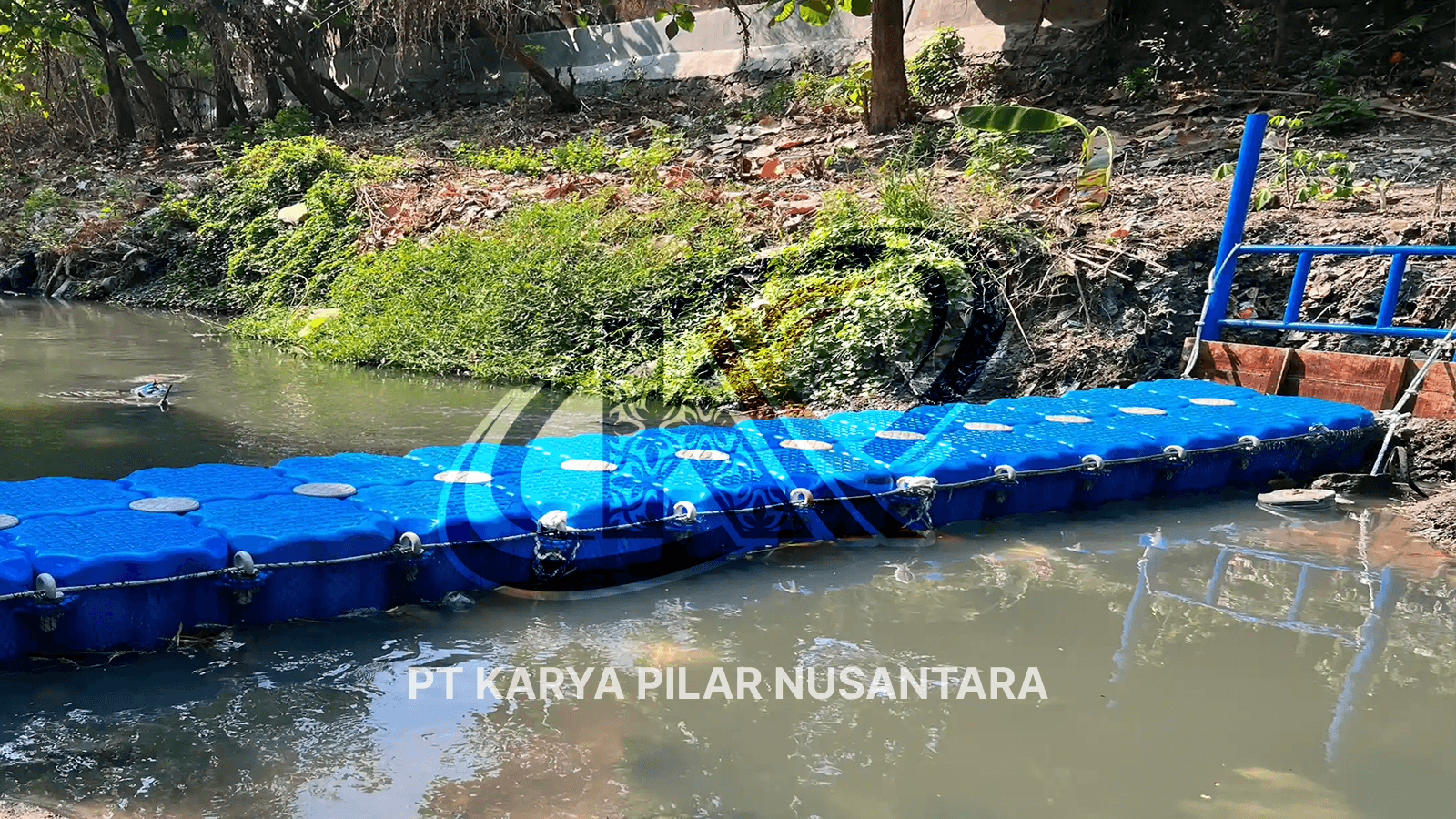
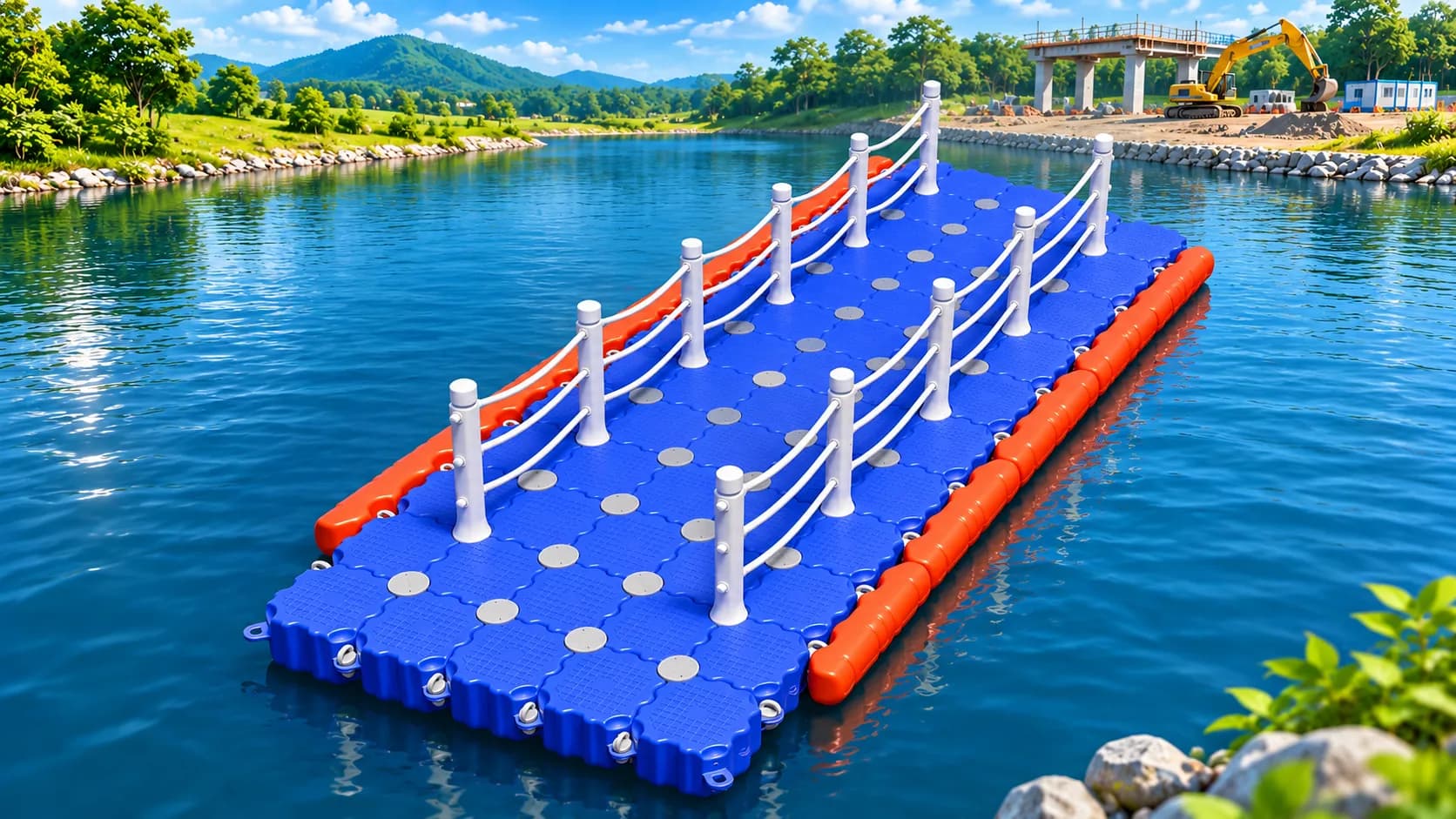
This bridge can be constructed using various types of structures, including interconnected HDPE floating cubes arranged to form a walkway.
However, building a floating bridge involves more than simply determining its length. The width of the pathway, worker activities, materials being transported, water current conditions, and safety systems must all be planned before installation.
Floating Bridges for Projects: When Are They Needed?
Floating bridges are used to connect two points separated by water or to provide access to work locations over water.
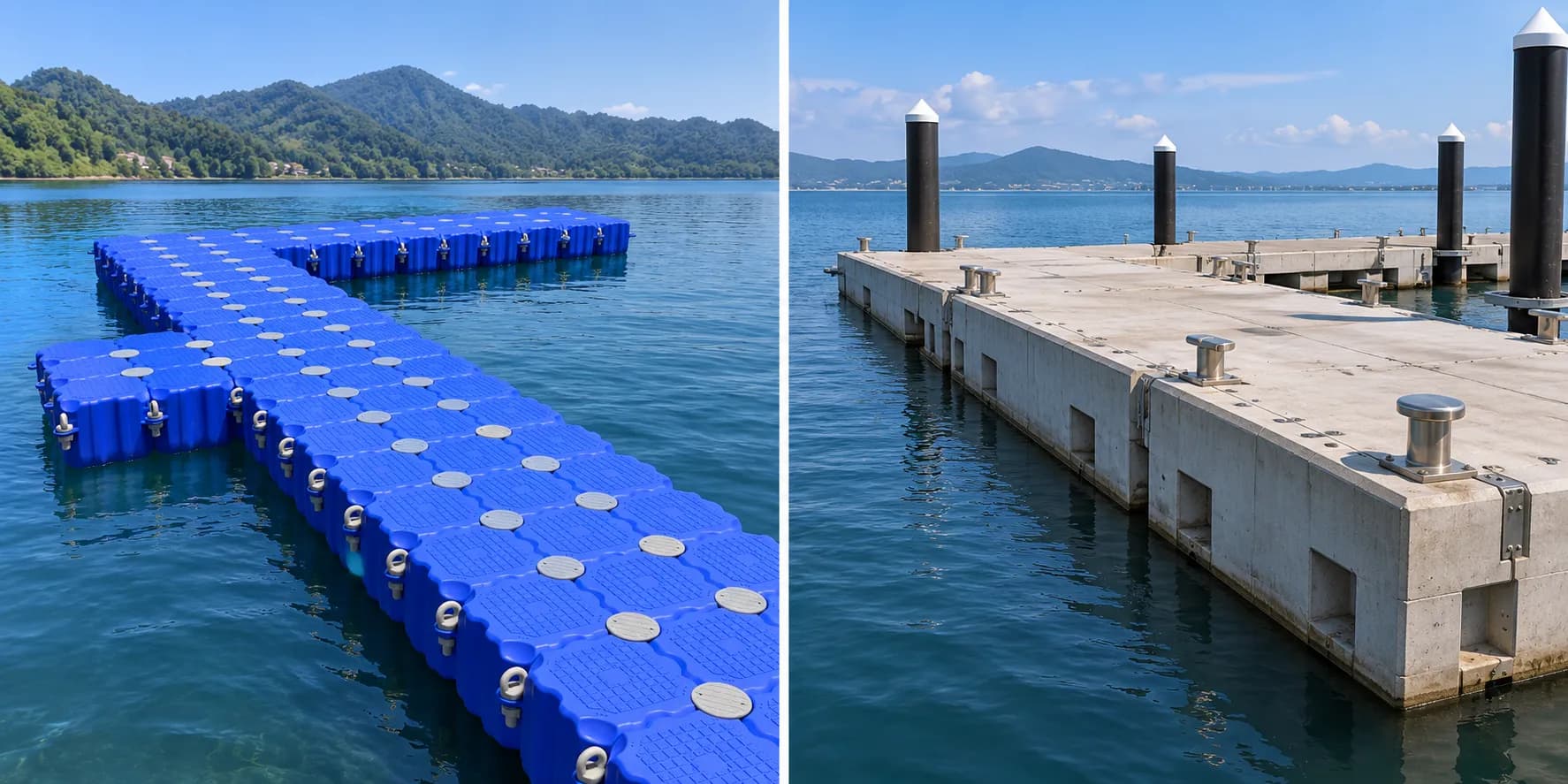
Unlike conventional bridges supported by foundations or supporting pillars, floating bridges rely on the buoyancy of pontoons to support the structure on the water surface.
In construction projects, they can serve various purposes.
For example, they can connect riverbanks to work areas, provide inspection pathways for water installations, or facilitate worker movement toward floating platforms.
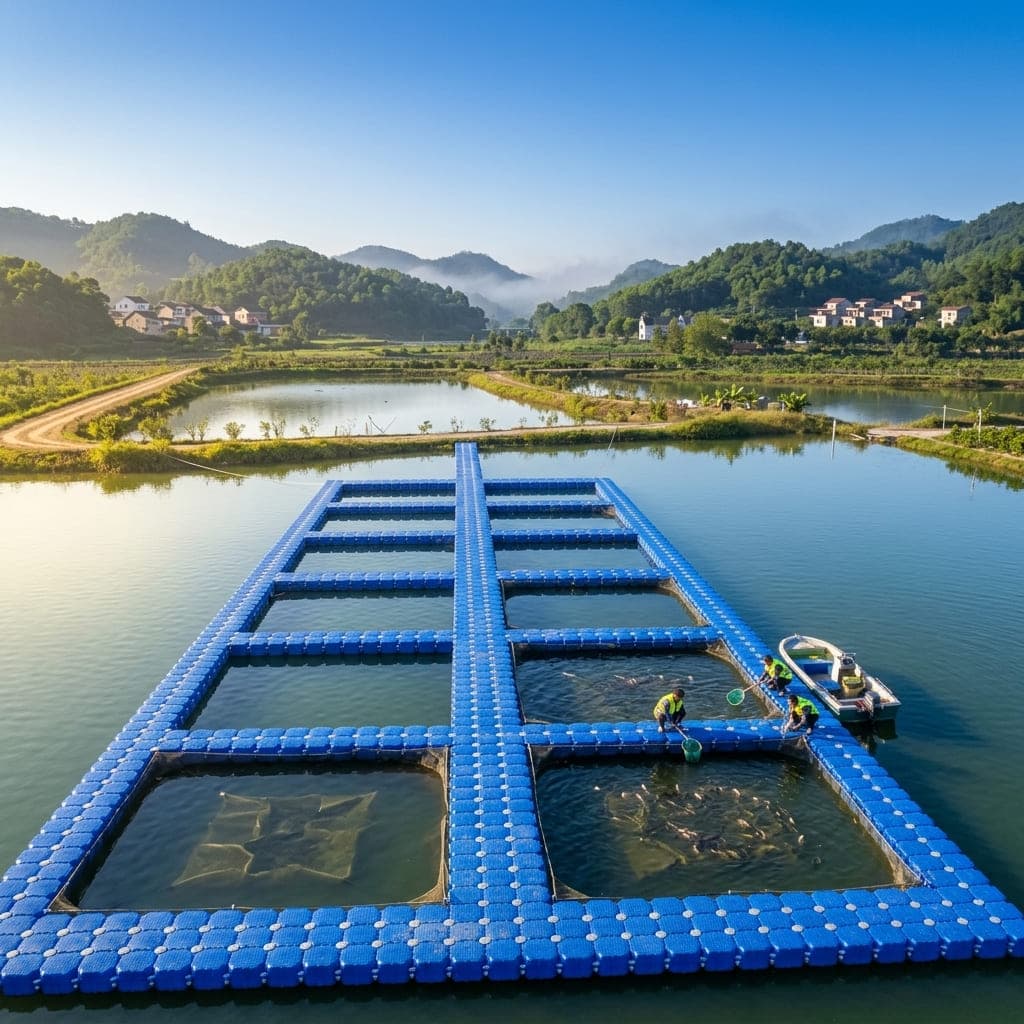
In pond areas and aquaculture facilities, floating pathways can also be used to access cultivation plots without having to use a boat every time someone moves between locations.
The key consideration that must be determined from the beginning is who will use the bridge and for what activities.
A pathway used only by inspection personnel will naturally have different requirements from one used to transport work equipment.
The same applies when loading and unloading activities, trolley use, or heavy worker traffic are involved.
For applications involving vehicles, heavy equipment, or large construction loads, a specially designed bridge with appropriate calculations and testing is required. A floating cube bridge intended for pedestrians must not automatically be assumed capable of supporting vehicles.

Determining Floating Bridge Width Based on Activities
The length of a bridge is usually easier to estimate because it follows the distance between the starting point and the destination. The width of the pathway, however, requires more attention.
A bridge that is too narrow can make it difficult for workers to pass each other or carry equipment. Conversely, making the pathway unnecessarily wide without considering actual needs will increase the amount of material and supporting components required.
Therefore, determining the width should begin by considering the activities that will take place on the bridge.
Pathways for One-Way Movement
If the bridge is only used by workers walking alternately, its space requirements will differ from those of a two-way pathway.
Project managers can plan a one-way system or limit the number of people allowed on the pathway at the same time.
Nevertheless, the bridge width must still account for users' movement space, the equipment they carry, and the presence of railings along the sides of the pathway.
Do not assume that someone can cross safely simply because they can physically fit through the pathway.
Pathways for Workers Passing Each Other
If workers need to walk in opposite directions simultaneously, greater attention must be given to the available pathway space.
In addition to walking width, sufficient space is needed to prevent users from bumping into one another when passing.
If project conditions do not allow the construction of a sufficiently wide pathway, alternating crossing arrangements can become part of the operational plan.
However, such arrangements do not replace the need to evaluate the bridge's width and capacity.
Pathways for Transporting Materials and Equipment
Planning becomes more complex when workers carry pipes, cables, toolboxes, or other materials.
The items being carried may be wider than the workers themselves. Some types of materials may even make it difficult for users to maintain their balance while walking.
If trolleys are used, wheel width, maneuvering space, wheel loads, and surface conditions must be specifically examined.
As a geometric illustration, floating cubes measuring 50 × 50 cm can form several width options as follows.
| Number of cubes across | Nominal width of arrangement |
|---|---|
| 2 cubes | 1 meter |
| 3 cubes | 1.5 meters |
| 4 cubes | 2 meters |
| 5 cubes | 2.5 meters |
The figures in the table represent the geometric dimensions of the cube arrangement, not safe working width standards.
The clear width available for workers may be smaller after railings and accessories are installed. The final width must still be determined based on risk analysis, operational requirements, and technical design.

Managing Worker Movement and Material Transportation
Once the width has been determined, the next step is to organize how the bridge will be used.
A single pathway may appear sufficient when no activities are taking place. Conditions can be different when several workers cross while carrying equipment.
Therefore, planning must consider movement flow, not merely the number of people who can stand on the bridge.
Separate Movement Where Possible
For pathways with relatively heavy activity, worker movement and material transportation should be organized so they do not interfere with each other.
This can be managed by dividing usage times or providing separate pathways if the design and site conditions allow.
For example, equipment transportation can take place at designated hours, while worker movement occurs outside those times.
This approach can reduce encounters between people walking normally and those carrying large items.
Pay Attention to Entry and Exit Points
The connection between land and a floating bridge is often an area that requires special attention.
The bridge surface can move as water levels change, while access from land remains relatively fixed.
These height differences can affect the slope and position of the entrance pathway.
Therefore, the connecting access or gangway must be planned so that it remains usable within the anticipated range of water levels.
Connections must not create gaps or surface changes that could endanger users.
Provide Space for Specific Activities
If there are inspection points, places where workers stop, or material transfer activities, these areas should ideally not occupy the main pathway.
For certain requirements, the bridge can be connected to a wider platform to accommodate activities.
This allows the main pathway to remain available for worker movement according to operational arrangements.

Choosing HDPE Floating Cubes as Modular Pontoons
One material that can be used to construct floating pathways is HDPE floating cubes.
These cubes are hollow modules arranged and connected to form a floating surface. Their configuration can be adjusted according to the required length, width, and platform shape.
A system like this is often called a modular pontoon, because it uses individual units that can be assembled to form floating facilities.
Unlike large pontoons that require specialized structures, a floating cube system allows arrangements to be created using a number of uniformly sized modules.
Understanding HDPE Floating Cube Dimensions
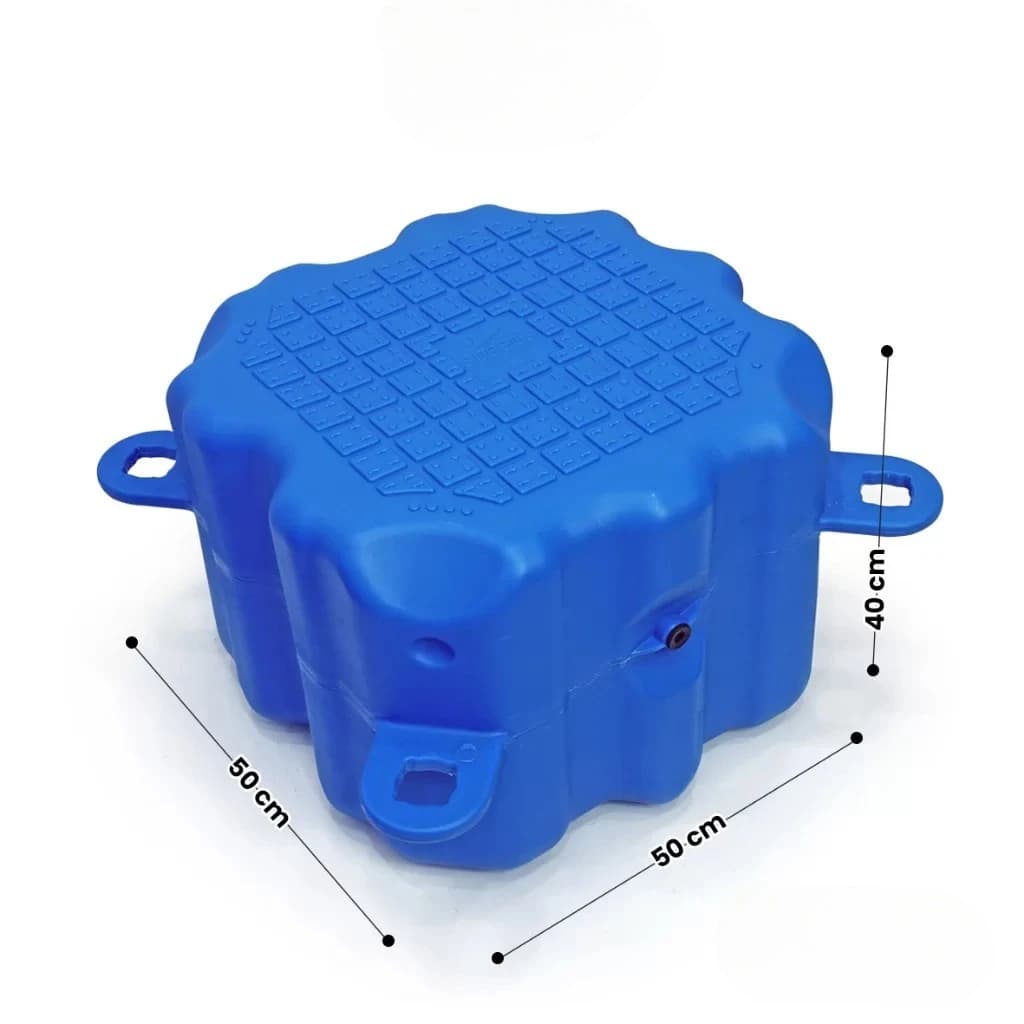
Karpinus floating cubes marketed by PT Karya Pilar Nusantara measure 50 × 50 × 40 cm.
These products use High Density Polyethylene (HDPE) material with an anti-slip patterned surface to help improve grip underfoot.
HDPE material does not corrode like metal. However, the product's long-term durability is still influenced by material quality, environmental conditions, and usage methods.
The cube modules are joined together using locking accessories such as pins and bolts that match the connection configuration.
For certain arrangements, longer connecting components are also available for use in multi-layer configurations according to the design.
In addition to the main cubes, the system includes accessories such as railings, bollards, and other supporting components.
Product and accessory information can be found on the Karpinus HDPE Floating Cubes page.
Why Is a Modular System Worth Considering?
The main advantage of a modular system is that its arrangement can be planned according to the needs of the area.
If a pathway needs to extend lengthwise, the cubes can be arranged along the direction of the route. If additional space is required at the end, the configuration can be expanded into a platform according to the design.
This system also allows disassembly and rearrangement when project requirements change, while still considering component conditions and structural suitability.
However, there is something that must not be overlooked.
The fact that individual cubes can float does not automatically mean that the entire assembled structure is safe for supporting working loads.
Structural capacity must be evaluated based on effective buoyancy, load distribution, connections, stability, and water conditions. The buoyancy value listed in product specifications must not be directly treated as the safe operational load limit.
Calculating Floating Cube Requirements Based on Pathway Dimensions
Once the length and width of the pathway have been planned, the number of floating cubes can be estimated.
Since each unit measures 50 × 50 cm on its upper surface, the nominal surface area of each cube is:
0.5 × 0.5 = 0.25 m².
Therefore, geometrically, four cubes are required to form one square meter of surface area in a single-layer configuration.
Example Calculation for a 12 × 2 Meter Floating Bridge
Suppose a project requires a pathway with a length of 12 meters and a nominal width of 2 meters.
The calculation is as follows:
Pathway length:
12 ÷ 0.5 = 24 cubes.
Pathway width:
2 ÷ 0.5 = 4 cubes.
Total quantity:
24 × 4 = 96 floating cubes.
Therefore, to form a nominal 12 × 2 meter surface using a single-layer system, the basic geometric requirement is 96 floating cube units.
This quantity does not include connection accessories, railings, mooring systems, and other supporting components.
For comparison, if the bridge length remains 12 meters, the number of cubes required for several width options is:
| Nominal pathway dimensions | Number of single-layer cubes |
|---|---|
| 12 × 1 meter | 48 units |
| 12 × 1.5 meters | 72 units |
| 12 × 2 meters | 96 units |
| 12 × 2.5 meters | 120 units |
The table above only shows requirements based on surface area and module dimensions.
These calculations do not determine whether the configuration can support the planned loads. For users carrying heavy equipment or concentrated loads, a separate technical assessment is required.
If the pathway uses a double-layer configuration or a special arrangement, the number of cubes and types of connections must be recalculated.
Further explanations regarding module calculations can be found in the article How to Calculate Floating Cube Requirements for Docks per m².
Mooring Systems to Prevent the Bridge from Shifting Easily
Floating bridges are positioned on water surfaces that continuously undergo changes.
In rivers, currents can affect the position of the structure. In lakes or reservoirs, wind and waves can also cause movement.
This is why the mooring system is an important part of planning.
The mooring system helps maintain the bridge's position according to its design while accommodating the movement that must occur due to changes in water levels.
Determining Anchor Points
The placement of mooring points must be adjusted according to the pathway length, water characteristics, applied loads, and the conditions of the waterbed or shoreline.
Anchor points may use an anchoring system, attachments to structures that meet the requirements, or other methods specified in the design.
No single mooring arrangement is automatically suitable for every location.
A bridge in calm waters does not necessarily require the same arrangement as a pathway located in a flowing river.
Considering Rising and Falling Water Levels
Changes in water levels must be considered from the beginning, particularly in rivers or waters affected by tides.
A mooring system that restricts vertical movement too much can create additional forces on the connections when water levels change.
Conversely, overly loose mooring can cause excessive shifting.
A proper design must maintain the bridge's position without ignoring the natural movement of the floating structure.
Examining Environmental Conditions
In addition to currents and waves, floating debris must also be considered.
Logs, large pieces of waste, or other materials carried by the current can become trapped against the structure and increase the forces acting on it.
Under certain conditions, the installation of a floating bridge may need to be restricted or may even be unsuitable without additional engineering measures.
Therefore, a site survey should be conducted before determining the type and quantity of mooring components.

Floating Bridge Safety Systems That Need to Be Prepared
A surface that workers can walk on is not the only requirement for a bridge to be usable.
For access over water, the risks of slipping, losing balance, falling, and changes in the structure's position must be considered.
Safety systems should be planned together with the main structure, rather than being added only after the bridge has been installed.
Safety Railings Along the Pathway
Railings or handrails can help clearly define the boundaries of the pathway and provide support for users.
For bridges used by workers, railing requirements must be determined based on the results of a risk assessment and applicable safety regulations.
Railings must have a design, height, connections, and load-bearing capacity appropriate for their intended use.
The presence of railing accessories alone does not automatically mean that the entire system meets fall protection requirements.
Slip-Resistant Walking Surfaces
Floating bridges are often exposed to wet conditions caused by water splashes, rain, or work activities.
Therefore, the condition of the walking surface must be considered.
HDPE floating cubes with anti-slip patterns can help provide grip when stepped on. Nevertheless, the surface must still be kept free from moss, mud, material spills, or objects that could interfere with walking.
Connection areas must also be inspected to prevent tripping hazards.
Safety and Rescue Equipment
For work involving the risk of falling into the water and drowning, project managers must provide appropriate safety equipment.
This equipment may include life jackets, lifebuoys, rescue ropes, evacuation facilities, and emergency assistance access.
Users must also understand the procedures to follow in the event of an accident.
Simply providing equipment is not sufficient if there are no personnel who understand how to use it.
Signs and Lighting
Bridges used in low-light conditions require adequate lighting.
Access restriction signs, information on user capacity based on design calculations, and markings for hazardous areas must also be provided as needed.
If the bridge is not designed for vehicles, this restriction must be clearly stated.
Things to Check Before Using a Floating Bridge
Before being used for work activities, a floating bridge must undergo inspection and approval by the responsible parties.
The inspection begins with the condition of the structure. Ensure that the installed modules are in suitable condition, have no damage affecting their function, and that all locking components are installed according to the design.
Next, inspect the mooring system and the condition of the entrance pathway. Changes in water levels must not make access dangerous.
Inspection requirements can be grouped as follows:
Condition of cubes and connections: There is no damage affecting their suitability, and all connections are installed according to the design.
Structural stability: The bridge's behavior under load complies with the required calculation and testing results.
Mooring system: Attachment points, ropes, anchors, or retaining components have been inspected.
Railings and walking surfaces: All safety devices are installed and do not obstruct user movement.
Entry and exit access: The connecting pathway can be used safely within the planned range of water levels.
Operational safety: Usage limits, signs, rescue equipment, and emergency procedures have been prepared.
Testing and inspection by competent personnel must be carried out according to the design, risk level, and project requirements before the bridge is declared suitable for use.
Inspections also do not stop once the bridge begins operating.
Changes in weather conditions, flooding, currents, impacts from floating debris, or configuration changes may be reasons to temporarily close access and conduct another inspection.
Frequently Asked Questions About Floating Bridges for Projects
Can floating bridges be used for worker access?
Yes, provided the structure is designed for that purpose and meets safety requirements. Pathway width, worker loads, equipment being carried, stability, connections, and safety systems must all be taken into account.
How wide should a floating bridge be?
There is no single width that suits every project. The width must be adjusted according to the number of users, movement patterns, types of activities, and the required clear space after railings are installed. Geometric widths of 1, 1.5, or 2 meters can be formed using 50 cm modules, but this does not mean they are automatically safe for every application.
Can HDPE floating cubes be used in rivers?
HDPE floating cubes can be used as part of a floating system in rivers, but their suitability depends on current velocity, changes in water levels, floating debris, the mooring system, and the overall design.
What is the difference between a floating bridge and a modular pontoon?
A floating bridge is a structure or connecting pathway that uses a floating system for support. A modular pontoon is one type of supporting system, consisting of individual units that can be assembled. Not all floating bridges use HDPE cubes.
Can floating cubes be used for vehicle bridges?
This must not be assumed. Vehicle applications involve different loads, dynamic forces, and structural requirements compared to pedestrian pathways. Their use requires a bridge system specifically designed, calculated, and tested for those vehicle loads.
Do floating bridges need regular inspections?
Yes. Inspections are necessary to ensure that the condition of the modules, connections, moorings, access points, and safety devices continues to meet usage requirements. The inspection frequency is determined based on the design, environmental conditions, and risk level.
Conclusion: Prioritize Pathway Requirements and Safety
Floating bridges can be an access solution for work carried out over or across bodies of water, particularly when constructing permanent land access is difficult.
However, planning involves more than simply measuring distances and calculating the number of floats required.
The pathway width must suit user activities. Worker movement and material transportation must be organized to avoid interfering with each other. Meanwhile, mooring systems, railings, connecting access points, and safety equipment must be incorporated into the design from the beginning.
The use of HDPE floating cubes enables the construction of modular pontoon arrangements with lengths and widths that can be adjusted according to the project's geometric requirements.
For material procurement needs, PT Karya Pilar Nusantara provides floating cubes along with supporting accessory options such as pins, locking bolts, and railings.
Explore the product specifications on the Karpinus Floating Cubes page or contact the marketing team to discuss module and accessory requirements based on your project design.
With proper planning, a floating bridge not only serves as a connection between areas but can also support smooth work activities without compromising user safety.