In construction, a delay in one activity can affect several others. Materials that have not arrived, design changes, or an insufficient workforce can disrupt the project schedule. If these problems are not addressed, they can slow down construction and increase overall project costs.
For this reason, completing a construction project requires more than drawings and skilled workers. It also requires a clear plan outlining what needs to be done, who is responsible, how much money is available, and when each activity should be completed.
This is where construction project management comes into play.
Effective project management helps ensure that construction activities are properly planned, carried out, and monitored so that the completed work meets the agreed requirements.
What Is Construction Project Management?
Construction project management is the process of organizing and controlling all activities involved in a construction project, from initial planning and procurement to construction, completion, and final handover.
Its main purpose is to ensure that the work is completed within the approved budget and schedule while meeting quality standards and applicable safety requirements.
Construction project management involves several parties, including the project owner, design consultants, supervising consultants, contractors, subcontractors, and material suppliers.
Each party has different responsibilities, but they must work toward the same objectives and follow an agreed project plan.
For example, when constructing a warehouse, the contractor must ensure that foundation and structural work are completed before the next activities begin. At the same time, material requirements, equipment, labor, and payments must be properly coordinated.
If one part of the process does not go according to plan, other activities may also be affected.
This is why project management is not limited to physical construction work. Administration, procurement, communication between stakeholders, and budget monitoring are equally important.
Why Is Construction Project Management Important?
Every construction project operates within certain limitations. Budgets are not unlimited, completion deadlines must be met, and labor and material resources must be allocated according to actual requirements.
Without proper management, relatively small issues can develop into more serious problems.
For example, concrete work may already be scheduled, but some of the required materials have not arrived. As a result, workers and equipment prepared for the activity cannot be used as planned.
This creates idle time and may lead to additional expenses.
Effective construction project management helps reduce these risks in several ways.
1. Keeping the Project on Schedule
Every activity has a planned starting and completion date. A clear schedule helps the construction team identify which activities should be prioritized.
2. Controlling Project Expenses
Actual spending can be compared with the planned budget. When significant differences occur, the causes can be investigated before they affect the entire project.
3. Maintaining Construction Quality
Completed work must comply with the approved drawings, technical specifications, and contract requirements. Regular supervision helps identify errors and allows corrective actions to be taken early.
4. Managing Project Resources
Materials, workers, heavy equipment, and subcontractors must be available when needed. Procuring resources too early or too late can result in additional costs.
5. Reducing Project Risks
Weather conditions, design changes, material delivery delays, and unexpected site conditions are among the factors that should be considered during planning.
Therefore, the success of a construction project is not measured solely by whether the building is completed, but also by how effectively the entire construction process is managed.
Stages of a Construction Project: From Planning to Completion
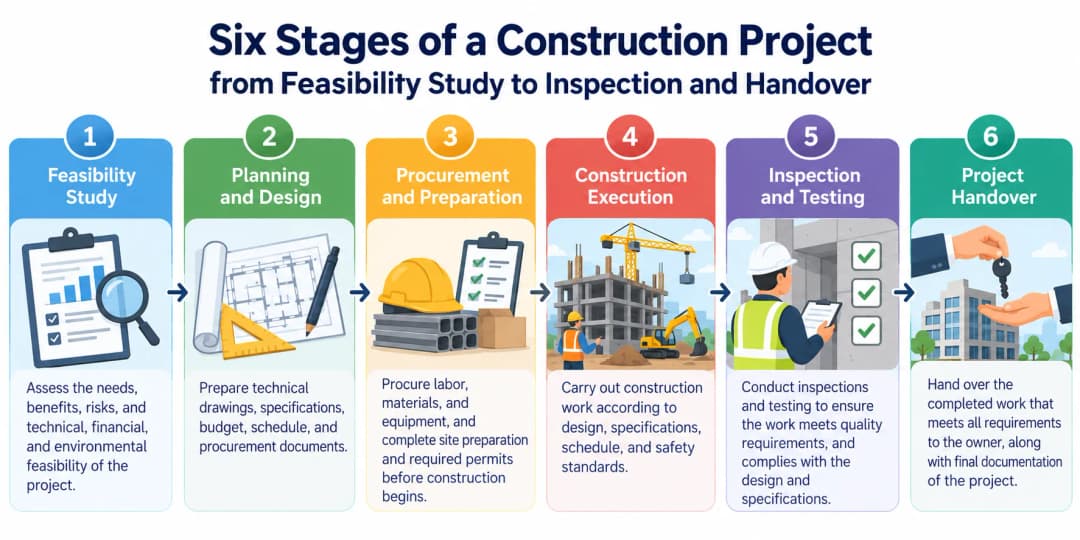
Construction projects generally begin with identifying development requirements, followed by planning, procurement, construction, and final handover.
The stages may vary depending on the type of project and the contractual arrangement. However, the following process provides an overview of the activities commonly involved.
1. Project Initiation and Feasibility Study
The first stage begins when the project owner identifies the need for construction.
For example, a company may plan to build a new warehouse to increase its storage capacity. Before construction begins, several factors must be considered, including building size, location, operational requirements, estimated investment, and land conditions.
This information helps determine whether the proposed project is feasible.
For larger projects, feasibility studies may also cover technical, environmental, economic, and regulatory considerations.
2. Planning and Design
Once the project requirements have been established, the next step is to prepare the design.
This may include architectural drawings, structural designs, mechanical and electrical systems, and material specifications.
An initial cost estimate and construction schedule are also developed during this stage.
Complete and accurate drawings make it easier to calculate the required quantities of work. In contrast, incomplete designs may lead to changes after construction has already started.
Such changes can increase material requirements, extend the schedule, and raise project costs.
3. Procurement and Contractor Selection
The next stage involves selecting the parties responsible for carrying out the construction work and obtaining the resources needed for the project.
For certain projects, contractor selection is conducted through a tender process. Other projects may use different procurement methods depending on the project owner's requirements and applicable regulations.
The procurement documents may include construction drawings, technical specifications, bills of quantities, project schedules, and contractual requirements.
Submitted proposals are then evaluated based on price, technical capability, experience, and compliance with project requirements.
4. Pre-Construction Preparation
Before physical construction begins, the contractor prepares the site and the necessary resources.
Activities may include arranging site access, establishing temporary facilities, procuring equipment, mobilizing workers, and preparing construction methods.
For projects located near vehicle routes, suitable barriers and safety equipment may also be required to separate construction activities from traffic.
Proper preparation helps minimize disruptions when the main construction activities begin.
5. Construction Execution
The execution stage involves carrying out the physical construction work according to the approved drawings and specifications.
The activities depend on the type of project. For building construction, they may include earthworks, foundation work, structural construction, wall installation, roofing, utility installations, and finishing.
Throughout this stage, project progress, material consumption, construction quality, and expenses must be monitored.
Supervision should take place during construction rather than only after the work has been completed.
Any deviations from the approved requirements must be addressed through the agreed corrective procedures.
6. Inspection and Project Handover
Once the physical work has been completed, inspections are conducted to confirm that the construction meets the contractual requirements.
These activities may include final inspections, system testing, correction of outstanding work, and preparation of project documentation.
When the required conditions have been satisfied, the completed work can be handed over according to the contract procedures.
Documents such as as-built drawings, handover certificates, and maintenance instructions may also be required, depending on the project.
Project Planning: From Construction Drawings to Work Schedules
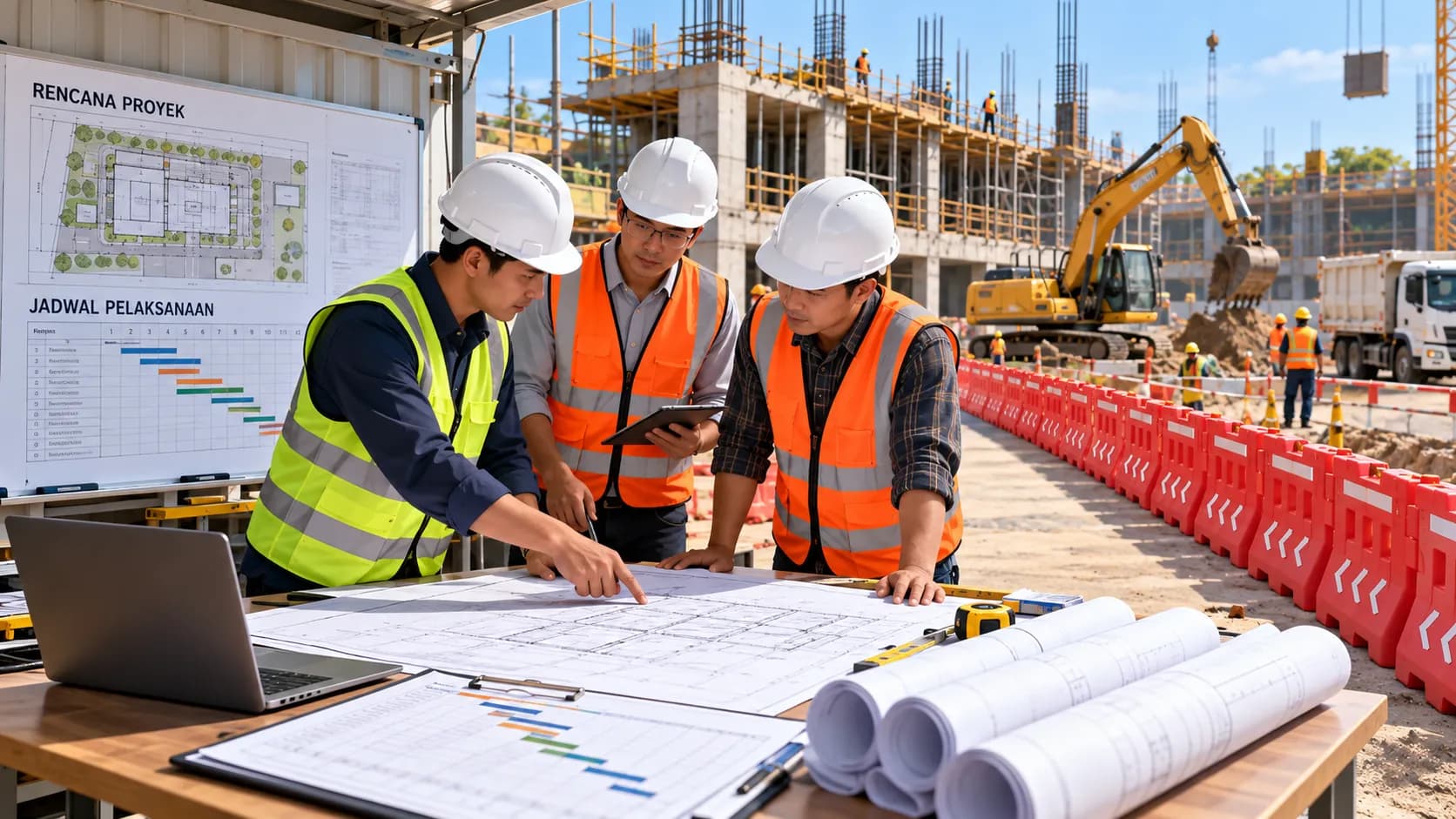
Project planning provides the foundation for determining how construction work will be carried out.
Although construction drawings are essential references, they are not sufficient to manage every activity on site.
The project team must also determine the sequence of work, material requirements, equipment usage, workforce allocation, and completion targets for each activity.
Defining the Scope of Work
The first step is to clearly establish the types and boundaries of the work to be performed.
The scope must be properly documented to prevent misunderstandings between the project owner and contractor.
For example, warehouse construction can be divided into preliminary works, structural works, roofing, flooring, electrical installations, and finishing.
Breaking down the project into smaller activities also makes budgeting and progress monitoring easier.
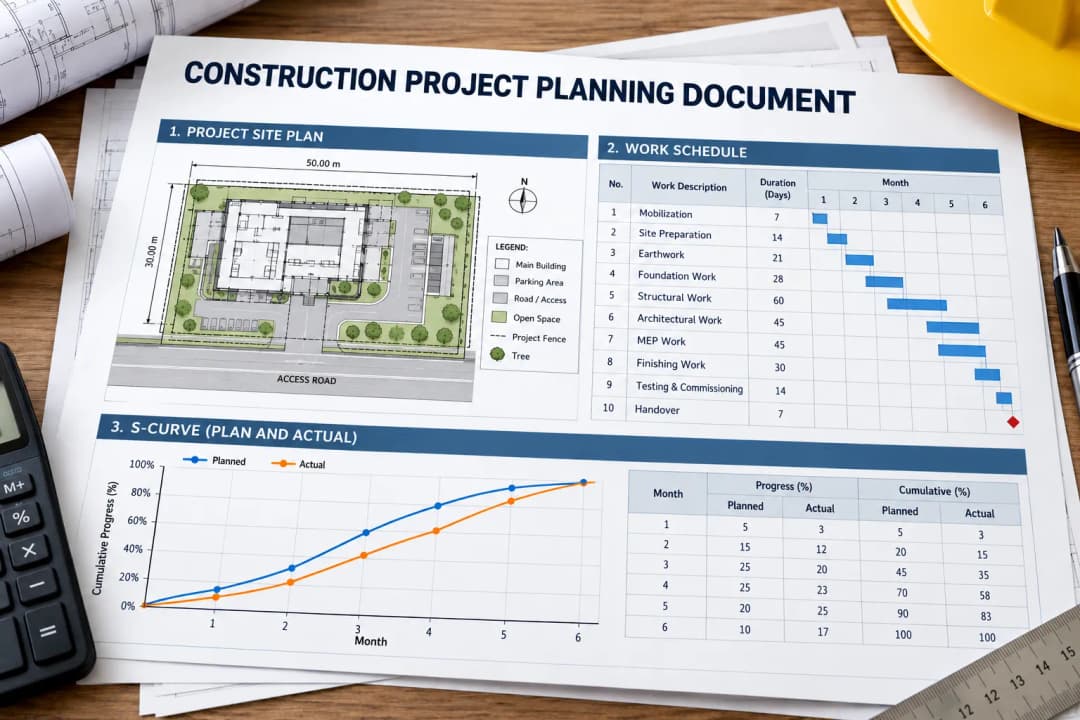
Preparing the Construction Schedule
Once the scope has been defined, activities are arranged according to their sequence and dependencies.
Construction schedules can be prepared using bar charts, Gantt charts, or S-curves.
An S-curve is commonly used to compare planned cumulative progress with actual construction progress.
When actual progress falls behind the planned schedule, the project team must investigate the causes and determine appropriate corrective measures.
However, progress percentages alone do not always provide a complete picture. Delays in critical-path activities may affect the project's completion date even when their contribution to overall progress appears relatively small.
Estimating Resource Requirements
Project planning also involves determining the number of workers, equipment, and materials required during each construction period.
For example, roofing materials should be available before installation begins, taking into account structural readiness, storage capacity, and delivery schedules.
Purchasing materials too early may increase storage requirements. On the other hand, late deliveries can bring construction activities to a halt.
Therefore, procurement schedules should be coordinated with the construction schedule.
Preparing the Construction Budget and Cost Estimates
A construction cost estimate, commonly prepared as a Bill of Quantities (BOQ) with estimated rates or a project budget, outlines the expected expenses required to complete the work according to its scope and specifications.
In Indonesia, this is commonly known as Rencana Anggaran Biaya (RAB).
The budget serves as a reference for financial planning, tender evaluation, and cost control throughout the project.
It is generally prepared by calculating the quantity of each work item and multiplying it by the corresponding unit rate.
The basic formula is:
Work Cost = Work Quantity × Unit Rate
For example, suppose a particular activity covers 100 m² with a unit rate of Rp150,000 per m².
The estimated cost would be:
100 × Rp150,000 = Rp15,000,000
Unit rates should account for the relevant cost components, such as materials, labor, and equipment, based on the construction methods being used.
Main Cost Components in Construction Projects
A construction budget generally needs to account for the following expenses:
Material costs: Purchases of construction materials and necessary supplies.
Labor costs: Wages and payments for workers and technical personnel.
Equipment costs: Heavy equipment rental, fuel, and operational expenses.
Indirect costs: Temporary facilities, administration, supervision, and site operations.
Contingency allowance: Funds allocated, where applicable, to address identified project uncertainties.
Contractor profit, taxes, and other expenses must also be calculated according to the budgeting method and contract requirements.
A contingency allowance should not automatically be treated as money that can be spent without authorization.
Example of a Construction Project Budget
The following table illustrates a simplified budget allocation for a construction project.
These figures are provided for illustration only and should not be considered standard construction costs or current market prices.
| Work Category | Estimated Budget |
|---|---|
| Preliminary works | Rp40,000,000 |
| Structural works | Rp350,000,000 |
| Architectural works | Rp220,000,000 |
| Mechanical and electrical works | Rp140,000,000 |
| Site operations and occupational safety | Rp50,000,000 |
| Contingency allowance | Rp50,000,000 |
| Total | Rp850,000,000 |
In actual construction projects, the budget should be prepared in greater detail based on work categories, quantities, unit rate analyses, and project-specific requirements.
Transportation, unloading, and site accessibility costs must also be considered.
A small price difference per unit may appear insignificant at first. However, when hundreds or thousands of units are required, the difference can have a considerable effect on the overall budget.
Project Cost Control: Preventing Budget Overruns
Project cost control involves monitoring and evaluating expenses to ensure that construction activities remain within the approved budget.
This process continues throughout the construction period.
Even a well-prepared budget requires regular monitoring because actual site conditions do not always match the original plan.
Several practices can help maintain effective cost control.
Comparing Budgeted and Actual Expenses
Every expense should be recorded according to the relevant work category.
These records are then compared with the budget to identify activities where costs are increasing beyond expectations.
Financial records should distinguish between payments already made, expenses that have become financial obligations, and purchase orders that have not yet been fulfilled.
This prevents the project budget from appearing available when part of it has already been committed.
Monitoring Work Quantities
Changes in work quantities can affect material consumption and labor requirements.
When differences arise between design drawings and actual site conditions, they should be reviewed before additional work is carried out.
Changes that affect project costs or schedules must also be documented and approved according to the contract procedures.
Controlling Material Usage
Materials should be managed from purchasing and receiving through storage and actual use.
Checking quantities and specifications helps prevent incorrect deliveries and unnecessary repeat purchases.
Material waste must also be monitored. Poorly controlled consumption can lead to significant losses, particularly when large quantities of materials are involved.
Evaluating Labor and Equipment Costs
Workforce productivity should be measured against the planned output.
A larger workforce does not necessarily lead to faster construction if the work area is not ready or the necessary materials are unavailable.
The same applies to heavy equipment. Idle machinery can still generate expenses, particularly when rental charges are based on time.
Conducting Regular Cost Evaluations
Cost reports should be reviewed alongside construction progress reports.
This allows project managers to determine whether the amount spent is reasonable compared with the work completed.
Evaluations may be conducted weekly or according to project requirements.
When cost deviations are identified, the project team should investigate their causes, estimate their potential impact on the final cost, and prepare corrective actions.
Example of Construction Cost and Progress Control
To better understand how cost control works, consider a construction project with an approved baseline budget of Rp1 billion.
By the end of the eighth week, the project is scheduled to reach 50% completion.
However, a site inspection shows that actual progress has reached only 40%, while Rp450 million has already been spent.
The data can be summarized as follows.
| Indicator | Value |
|---|---|
| Baseline project budget | Rp1,000,000,000 |
| Planned progress | 50% |
| Actual progress | 40% |
| Planned value of work | Rp500,000,000 |
| Earned value of completed work | Rp400,000,000 |
| Actual cost | Rp450,000,000 |
Note: This simplified example assumes that progress percentages represent the corresponding portions of the baseline project budget.
The figures show that the project is 10 percentage points behind its planned progress.
In addition, actual spending exceeds the earned value of completed work by Rp50 million.
Under the Earned Value Management method, this condition can be evaluated using two indicators.
Cost Performance Index (CPI)
CPI = Earned Value ÷ Actual Cost
CPI = Rp400 million ÷ Rp450 million = 0.89
A CPI below 1 indicates that the project is spending more than the budgeted value of the work completed.
Schedule Performance Index (SPI)
SPI = Earned Value ÷ Planned Value
SPI = Rp400 million ÷ Rp500 million = 0.80
An SPI below 1 indicates that the project is progressing behind schedule in earned-value terms.
These indicators provide early warning signs that the project requires further evaluation.
However, they do not explain every cause of the delay or determine the final project cost with certainty.
The project team must still investigate actual site conditions. Possible causes include rework, low productivity, price increases, scope changes, or materials that have not yet been installed.
The findings can then be used to determine the appropriate corrective measures.
Managing Project Time, Quality, and Safety
Construction project management requires a balance between cost, time, quality, and safety.
When a project falls behind schedule, the contractor may need to increase the workforce or extend equipment usage.
These decisions may result in additional expenses.
On the other hand, reducing material quality or ignoring safety procedures to save money can create even greater losses.
Schedule Control
Schedule control involves comparing completed activities with the planned construction schedule.
Delayed activities should be evaluated based on their causes and their potential impact on subsequent work.
Increasing the workforce, changing the sequence of activities, or adopting alternative construction methods may be considered when technically feasible and safe.
Quality Control
Construction quality is evaluated against approved drawings, specifications, construction methods, and applicable standards.
Inspections may be conducted when materials arrive, during installation, and after work has been completed.
Materials that do not meet the required specifications should not be used without proper evaluation and approval.
Early inspections help reduce the risk of demolition, repairs, and unnecessary rework.
Construction Safety Management
Construction work involves risks that must be managed according to the nature of each activity.
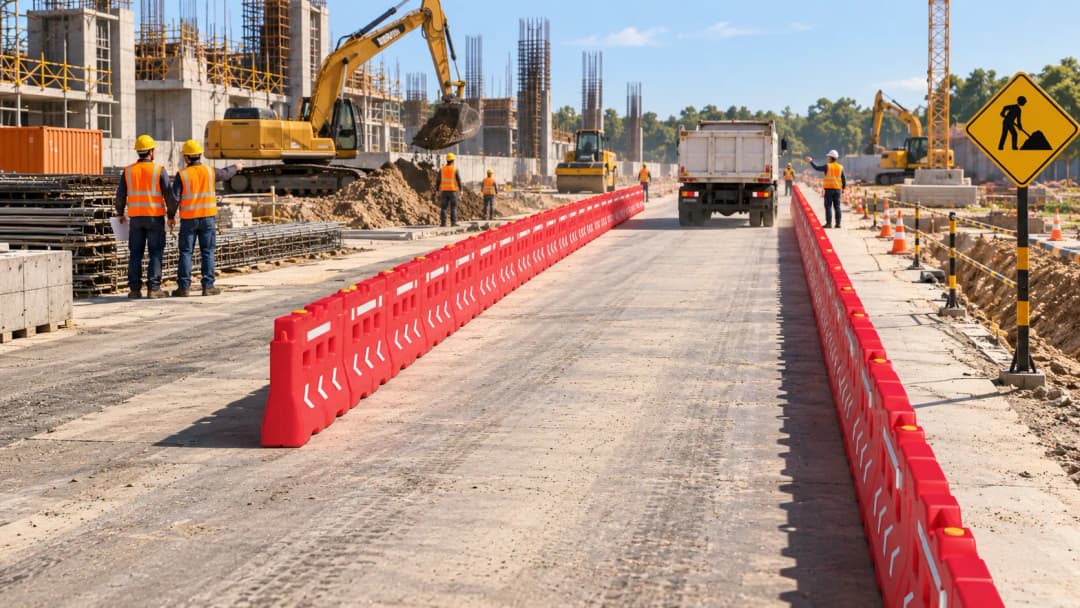
Traffic arrangements, personal protective equipment, equipment inspections, and the separation of hazardous areas are examples of control measures that should be selected based on site risk assessments.
For road construction or locations with operational vehicle movements, HDPE road barriers can help define work zones and vehicle routes.
However, ordinary modular barriers are not automatically designed to withstand vehicle impacts. Safety equipment must be selected according to the level of risk and applicable technical requirements.
Common Challenges in Construction Projects
Even when a construction project has a clear schedule and budget, unexpected challenges may still occur.
Some of the most common issues include the following.
Design Changes During Construction
Design changes may require completed work to be modified.
If these changes increase work quantities or affect construction methods, the project budget and schedule may also need to be revised.
Therefore, changes should be properly evaluated and documented before implementation.
Delays in Material Deliveries
Materials that arrive late can disrupt scheduled construction activities.
The risk is greater for products that require special manufacturing processes or must be shipped from distant locations.
Coordination with suppliers should begin during the planning stage, especially for materials needed for critical-path activities.
Unexpected Site Conditions
Soil conditions, existing utilities, vehicle access, and environmental conditions may differ from the initial assumptions.
If unexpected conditions affect the design or construction method, a technical evaluation should be carried out before the work proceeds.
Poor Expense Recording
Additional work, emergency material purchases, and unplanned equipment usage can increase project expenses.
Without proper financial records, cost overruns may only become apparent when the remaining budget is already limited.
For this reason, purchasing records, material usage, construction progress, and expenses should be reviewed regularly.
The Role of Material Procurement in Construction Projects
Material procurement has a direct influence on construction progress and project cost control.
Materials must meet the required technical specifications, be available in appropriate quantities, and arrive according to the construction schedule.
In practice, procurement decisions should not be based solely on unit prices. Product quality, supply capacity, transportation costs, and delivery lead times must also be considered.
For example, when constructing a warehouse, selecting suitable roof insulation materials requires consideration of the building specifications, roofing system, and indoor heat management requirements.
Meanwhile, road construction, industrial estates, and public infrastructure projects may require HDPE road barriers to help organize vehicle routes and temporarily separate construction work areas.
For waterfront infrastructure, HDPE floating cubes may also be considered as components of modular floating docks or platforms, provided that they meet the project's engineering requirements.
Each application has different technical specifications and quantity requirements. Therefore, coordination between the project team and material suppliers should take place before purchasing begins.
Well-planned procurement helps reduce unnecessary repeat purchases, delivery delays, and the use of materials that do not meet project requirements.
Frequently Asked Questions About Construction Project Management
What is construction project management?
Construction project management is the process of planning, organizing, executing, and controlling construction activities to ensure that work is completed according to the agreed scope, budget, schedule, quality requirements, and safety standards.
What are the main stages of a construction project?
The main stages generally include feasibility studies, planning and design, procurement, pre-construction preparation, construction execution, inspection, and final handover. Monitoring and supervision take place throughout the relevant stages.
What is the difference between a construction budget and project cost control?
A construction budget estimates the expected expenses associated with completing the work. Project cost control involves monitoring, comparing, and evaluating actual costs against the approved budget throughout construction.
What is the purpose of an S-curve in construction?
An S-curve illustrates cumulative project progress over time. It helps project managers compare planned progress with actual performance and identify deviations at an early stage.
What causes construction project cost overruns?
Cost overruns may result from changes in the scope of work, rising material prices, project delays, low productivity, rework, or unexpected site conditions.
Who is responsible for construction project cost control?
Responsibilities depend on the project's organizational structure and contractual arrangements. Generally, project managers work with engineering teams, quantity surveyors or cost control personnel, procurement departments, and project administrators to monitor and evaluate expenses.
Conclusion: The Importance of Construction Planning and Supervision
Construction project management plays an important role in ensuring that development activities proceed according to plan, particularly in terms of schedule, cost, quality, and safety.
Every stage, from design preparation and budgeting to material procurement, construction execution, and supervision, must be properly coordinated.
Cost control should also begin early in the project. Through regular recordkeeping and evaluation, potential deviations can be identified sooner, allowing corrective measures to be taken before they result in greater financial losses.
Material selection and supplier coordination are equally important. Suitable specifications, accurate quantities, and reliable delivery schedules can help construction activities run more efficiently.
Planning material procurement for an upcoming construction project? Consult our team about your required products, technical specifications, and quantities so that your procurement needs can be aligned with your project plan.