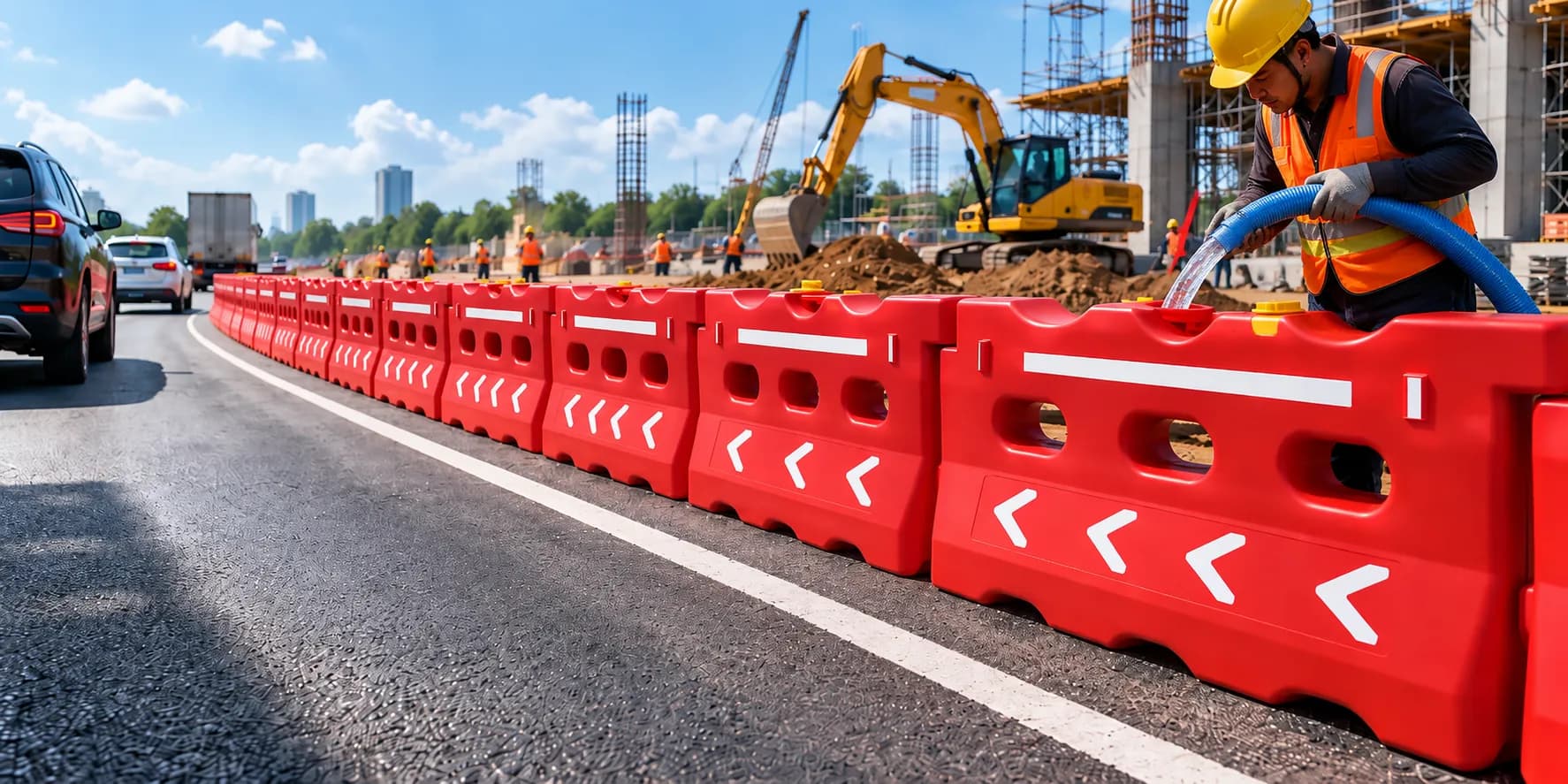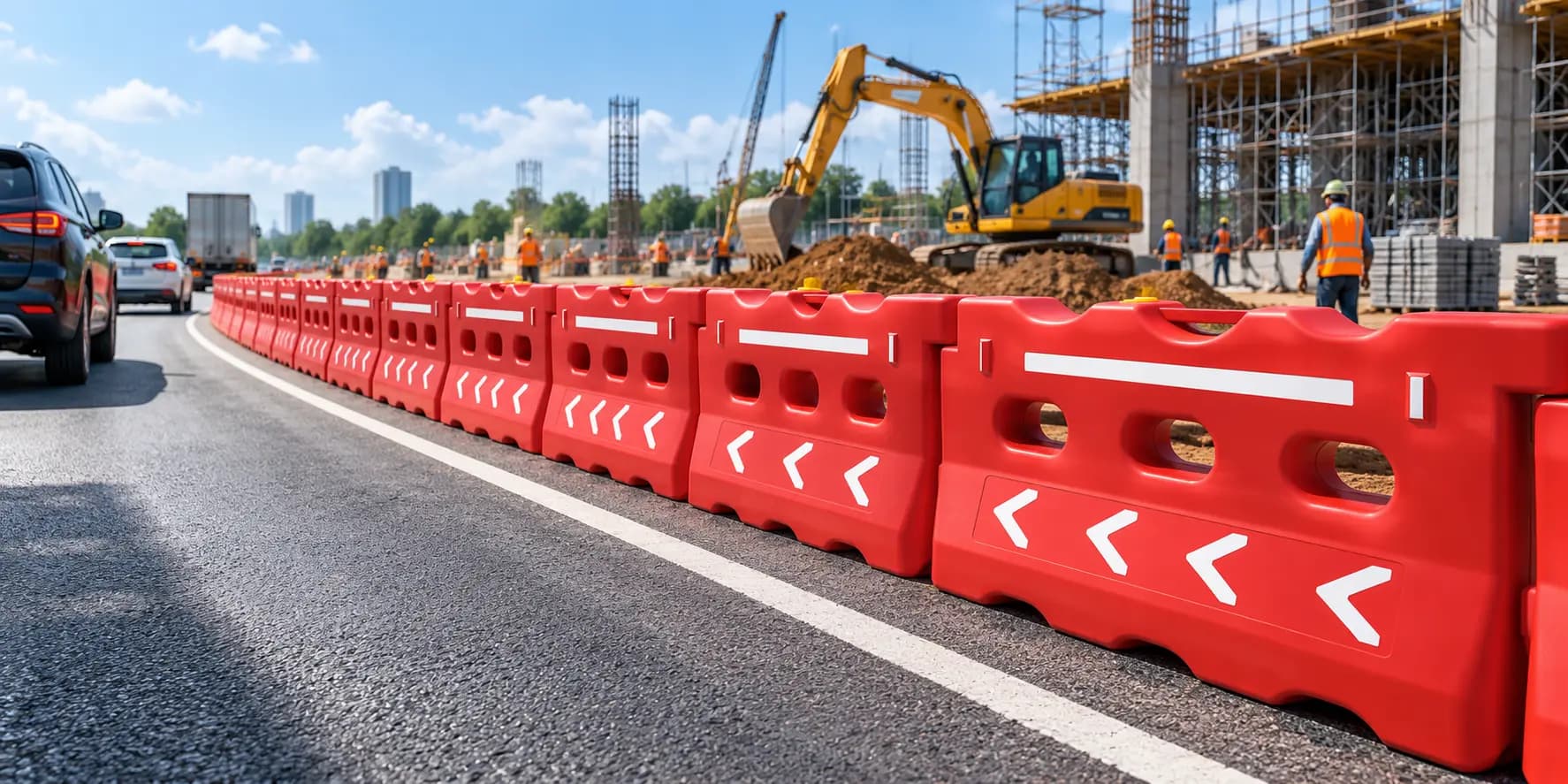
Water barriers are one type of barrier widely used to manage traffic, separate work areas, and help secure locations with vehicle access. They are easily recognizable because they are made of brightly colored plastic materials and have hollow interiors that can be filled with water.
Unlike permanent barriers, water barriers offer flexibility in installation and relocation. When empty, these barriers are relatively lightweight and easy to move. Once filled with water, their weight increases, making them more stable during use.
But how exactly do water barriers work? Why is water used as ballast, and under what conditions should these barriers be installed?
This article discusses the working principles, functions, applications, and important considerations before using water barriers for area safety and security.
What Is a Water Barrier and Why Is It Used?
A water barrier is a modular plastic barrier with a hollow interior designed to hold water as ballast. It is used to help guide vehicle movement, separate specific zones, and mark area boundaries more clearly.
In everyday use, water barriers are often referred to as plastic road barriers or water-filled road barriers.
The materials used may include polyethylene, including High Density Polyethylene (HDPE), which is known for its resistance to various environmental conditions.
The main characteristic of a water barrier is its ability to adjust its weight according to operational needs.
When empty, the barrier is relatively easy to move. After being placed in the desired location, water is added as ballast to increase its stability.
This system makes water barriers suitable for temporary applications, especially in areas where traffic layouts may change during ongoing activities.
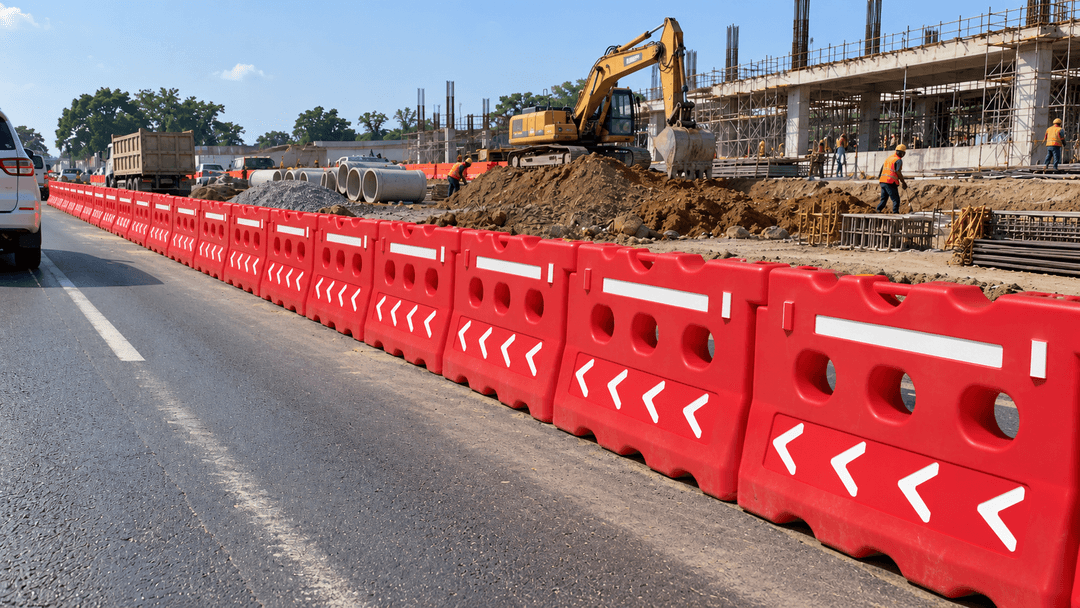
How Water Barriers Work: From Lightweight to Stable
The working principle of a water barrier is actually quite simple: using the mass of water to increase the weight and stability of the barrier.
The process can be understood through the following three conditions.
1. Empty Condition: Easier Transportation and Relocation
Before use, a water barrier is empty and relatively lightweight.
This makes transportation, arrangement, and repositioning easier compared to much heavier concrete structures.
At this stage, the barrier should not yet be used as an operational barrier in situations that require additional ballast.
2. Filling with Water: Increasing Stability
Once the barrier has been placed in its planned position, water is added through the filling opening.
The water functions as ballast or additional weight.
As the water volume increases, the total mass of the barrier also increases. This additional mass helps make the barrier more resistant to shifting or tipping over due to minor disturbances compared to its empty condition.
For reference, every liter of water has a mass of approximately one kilogram. Therefore, the water capacity and filling level affect the overall weight of the barrier.
However, the amount of water must follow the manufacturer's instructions or project specifications rather than being determined by estimation alone.
3. Modular Connections: Creating Area Boundaries
Water barriers generally have a connection system that allows several units to be joined together into a continuous arrangement.
This arrangement helps create continuous visual and physical boundaries.
By changing the arrangement of the barriers, site managers can establish temporary routes, close certain access points, or separate operational zones.

Important: Adding water increases stability, but it does not automatically make a water barrier capable of stopping or redirecting a vehicle that collides with it. Its ability to withstand impacts depends on the system design and relevant testing results.
Functions of Water Barriers: More Than Just Road Dividers
Although commonly found on roads, water barriers actually serve various purposes related to space management and access control.
Guiding Vehicle Movement
Water barriers can help indicate the routes drivers should follow when traffic arrangements change.
Examples include temporary traffic diversions, road repairs, or changes to entry and exit access points.
A connected series of barriers provides clearer visual guidance compared to using separate markers alone.
Separating Work Areas and Operational Routes
In construction environments, water barriers can be used to clearly define the boundaries between vehicle routes and work zones.
These barriers help workers and drivers identify areas that should not be entered.
However, when work activities involve the risk of vehicles colliding with the work area, these barriers must not be considered a replacement for required crash protection systems.
Restricting Temporary Access
Water barriers can also be used to close access points that are temporarily restricted.
Examples include internal roads undergoing repairs, closed parking areas, or vehicle routes redirected during ongoing activities.
Defining Boundaries and Improving Visibility
Contrasting colors make barriers easier for people in the area to recognize.
When used in low-light conditions, appropriate reflective materials can help improve visibility when illuminated by vehicle headlights.
Therefore, the function of water barriers is not limited to their physical structure but also includes their ability to provide visual information about area boundaries.
Where Are Water Barriers Commonly Used?
The use of water barriers is not limited to public roads. These modular barriers can also be applied in various locations that require flexible access management.
Road and Infrastructure Projects
During road construction or repair projects, work area conditions may change according to the stages of the project.
Water barriers can help mark temporarily diverted routes, work area boundaries, and closed access points.
Their placement must follow traffic management plans and safety requirements established by the road authority.
Industrial and Warehousing Areas
In factories and warehouses, operational vehicles often share space with loading and unloading activities and maintenance work.
Water barriers can be used to mark temporary work zone boundaries, guide vehicles toward specific access points, or separate areas that are temporarily not in operation.
For locations where there is a risk of impact from forklifts or heavy vehicles, an assessment is still needed to determine whether the barriers provide adequate protection.
Parking Areas and Commercial Facilities
Water barriers can help establish entrance routes, exit routes, and boundaries around temporarily closed parking areas.
Facility managers can also adjust their arrangement when access requirements change.
Events and Public Activities
Activities involving the movement of vehicles and visitors require clear area management.
Water barriers can help direct vehicles toward parking locations, restrict access for operational vehicles, or mark areas where vehicles are not allowed.
For managing large crowds and the risk of crowd pressure, specialized safety systems are required in accordance with the event safety plan.

Water Barrier, Traffic Barrier, and Road Barrier: What Are the Differences?
The terms water barrier, traffic barrier, and road barrier are often used when discussing road barriers. However, they do not always refer to devices with the same characteristics.
Water Barrier
A water barrier specifically refers to a hollow barrier that uses water as ballast. Its main characteristics are ease of transportation when empty and increased stability after being filled.
Traffic Barrier
Traffic barrier is a broader term for traffic barrier systems. In technical applications, some traffic barriers are designed to contain or redirect vehicles during an impact.
Therefore, the capabilities of a traffic barrier must be evaluated based on its design, function, and testing results.
Road Barrier
Road barrier is a general term for various types of barriers used in road environments, including modular plastic barriers and concrete barriers.
Therefore, a water barrier can be classified as a type of road barrier, but not all road barriers use water as ballast.
This distinction is important because devices that appear similar do not necessarily have the same safety capabilities.
If a project requires vehicle impact containment capabilities, product selection must refer to appropriate testing evidence and the project's technical requirements.
Why Is HDPE Used for Water Barriers?
High Density Polyethylene, or HDPE, is one of the materials used in manufacturing plastic road barriers.
The use of HDPE offers several characteristics that are relevant to modular barriers.
First, HDPE provides a combination of material strength and toughness suitable for various industrial plastic products. This material does not corrode like metal and can be formed into hollow components.
Second, HDPE allows barriers to be manufactured in modular shapes so that multiple units can be arranged according to the area's configuration.
Third, its material properties support outdoor applications when the product formulation has been adapted to environmental exposure requirements, including sunlight.
However, actual durability still depends on material quality, design, manufacturing processes, usage conditions, and maintenance.
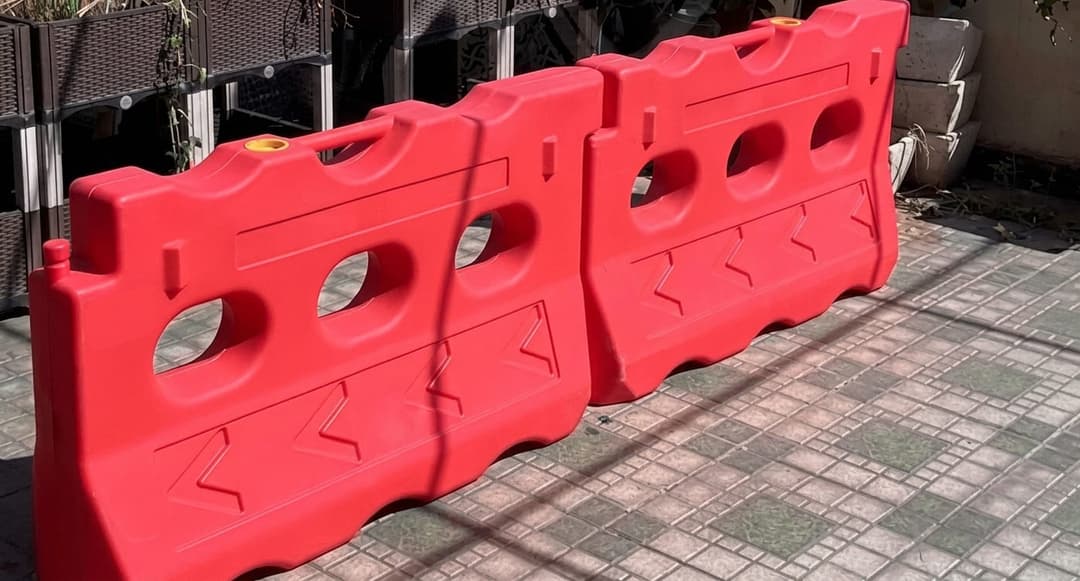
Example of Karpinus HDPE Water Barriers
PT Karya Pilar Nusantara provides modular HDPE road barriers in KPN 115 and KPN 120 models.
Both models are designed for area separation, vehicle traffic management, and temporary barriers in various operational environments.
The different characteristics of each model allow selection according to site requirements and installation plans.
Product information is available on the Karpinus HDPE Road Barrier page.
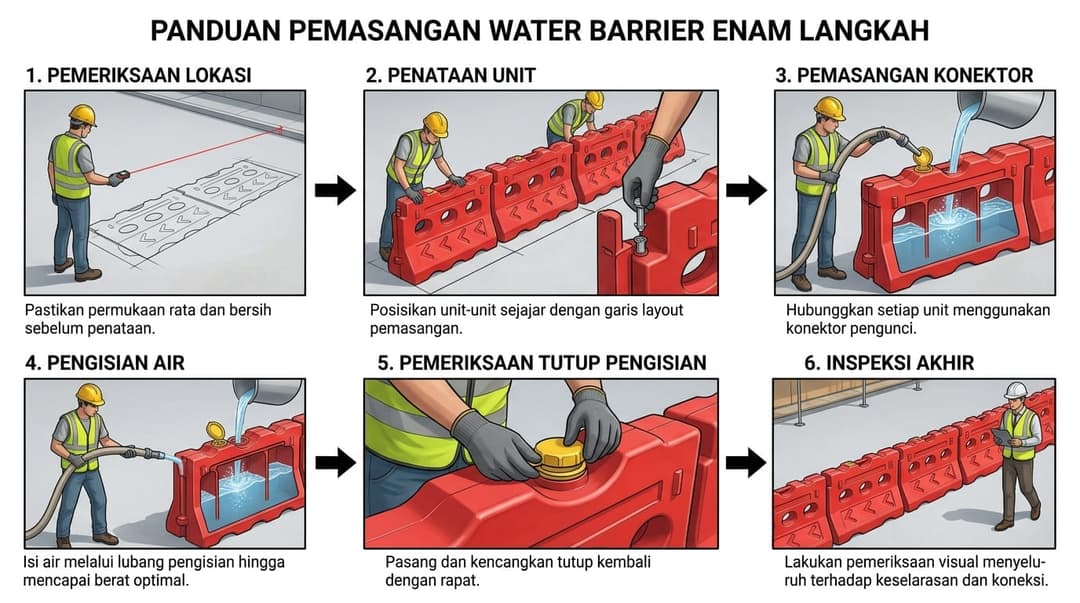
How to Install Water Barriers Properly
Installing water barriers requires planning to ensure that the barriers do not interfere with traffic or operational activities.
The following general steps can be used as a guide.
1. Determine the location and purpose of installation
Make sure the primary function of the barriers is clear, whether to guide vehicles, restrict access, or separate work areas.
On public roads, placement must comply with applicable regulations and obtain approval from the relevant authorities.
2. Check the surface conditions
Pay attention to the condition of the surface where the barriers will be installed.
Uneven, sloped, or potentially unstable surfaces that may cause the barriers to shift should be evaluated before installation.
3. Arrange the barriers while they are still empty
Position the units along the planned route.
Make sure the arrangement does not block emergency access, drainage systems, or operational routes that must remain open.
4. Connect the units
If a connector system is used, connect each unit according to the product instructions.
Check that the connections are properly installed and that the barrier arrangement matches its intended function.
5. Fill with water according to instructions
Once the barriers are in their final positions, fill them with water according to the manufacturer's specifications.
Make sure the filling caps and drainage outlets are properly secured and that there are no leaks.
6. Check visibility and stability
Make sure the barriers are clearly visible, especially along vehicle routes.
Add supporting traffic safety devices, such as signs, warning lights, or reflective materials, if required by the safety management plan.
Conduct periodic inspections during use, particularly after changes to the barrier arrangement or disturbances affecting the barriers.
Common Usage Mistakes and the Limitations of Water Barriers
Improper use of water barriers can reduce their effectiveness, even when the materials and product design meet basic requirements.
One common mistake is placing barriers in an empty condition in areas that actually require additional ballast.
Another mistake is creating a barrier arrangement without considering connectors, surface conditions, and vehicle movement routes.
In addition, water barriers should not be placed carelessly at curves, intersections, or areas with limited visibility.
Such arrangements require technical consideration to ensure that the barriers do not create additional hazards.
Can Water Barriers Withstand Vehicle Collisions?
Not all water barriers are designed as vehicle impact protection systems.
Plastic water barriers used as lane dividers generally function as devices for separating and guiding traffic.
Some specialized water-filled barrier systems may be designed and tested to contain and redirect vehicles. However, these capabilities are not automatically present in every product that uses water as ballast.
Therefore, ordinary water barriers should not be considered substitutes for concrete barriers, guardrails, or other impact protection systems without appropriate technical evidence.
The distinction between traffic guidance barriers and impact protection barriers must be a primary consideration when securing high-risk areas.
FAQ: Frequently Asked Questions About Water Barriers
Do water barriers always need to be filled with water?
Water filling is required when the usage specifications call for additional ballast. For operational installations, follow the filling level specified by the manufacturer and the site safety plan. An empty condition is generally more suitable for transportation and storage.
Are water barriers the same as road barriers?
A water barrier is one type of road barrier. The term road barrier covers a broader category, including plastic barriers, concrete barriers, and various other road barrier systems.
Can water barriers be reused?
Water barriers can be reused as long as their physical condition remains suitable, they have not suffered damage that affects their function, and they meet the requirements of the intended location.
Inspect the body, connectors, filling openings, and potential leaks before reinstalling them.
Are water barriers suitable for nighttime use?
Water barriers can be used at night when appropriate visibility measures are provided.
Reflective materials, signs, and additional warning devices may be required depending on road conditions and local safety requirements.
Can water barriers be used for flood protection?
Water barriers intended for road separation are not automatically designed as flood protection systems. Flood control devices require different connection designs, watertightness, stability, and the ability to withstand water pressure.
Do not use traffic barriers as flood barriers without appropriate technical verification.
Conclusion: Choosing Water Barriers According to Area Requirements
Water barriers are modular barriers that use water as ballast to increase stability during use.
Their main advantages include flexibility in transportation, ease of arrangement, and the ability to establish visual and physical boundaries in various operational environments.
They can be used in construction projects, roads, industrial areas, parking facilities, and public activities that require temporary access management.
However, the effectiveness of water barriers is not determined solely by the material or the amount of water used. Site conditions, connection systems, visibility, installation methods, and the level of vehicle-related risk must also be considered.
To learn more about modular HDPE barrier options that meet your project requirements, explore the product specifications and characteristics on the Karpinus Road Barrier by PT Karya Pilar Nusantara page.