Road barriers are commonly found at construction sites, on highways, in industrial areas, parking facilities, and public event venues. Although they may appear simple, selecting a road barrier should involve more than just considering its shape or color.
Material, dimensions, weight, filling capacity, connector system, and intended use must all be considered to ensure that the selected barrier is suitable for the conditions on site.
In general, road barriers are used to help separate areas, direct vehicle movement, and provide clearer visual boundaries. In traffic management, water barriers are also used as lane dividers or temporary barriers.
This article discusses the functions of road barriers, their types, important dimensions to consider, and how to choose the right road barrier for construction projects and operational needs.
What Is a Road Barrier and Why Is It Widely Used?
A road barrier is a physical barrier used to restrict, separate, or direct movement within an area. On roads and construction sites, barriers can help establish clearer boundaries between vehicle lanes, work zones, pedestrian pathways, and restricted areas.
The term road barrier is actually quite broad. Products found in the field may include water-filled plastic or HDPE barriers, concrete barriers, and road safety systems with different structural designs.
Because their characteristics vary, road barriers should not be selected based solely on size or price.
For example, a barrier needed to manage temporary vehicle routes at a construction site may not necessarily be the same as a safety barrier used in locations with a high risk of vehicle collisions.
Road Barrier Functions: More Than Just Road Dividers
The function of a road barrier largely depends on where it is installed. In general, however, these devices are used to make area boundaries easier to identify and help regulate the movement of vehicles and other area users.
In temporary traffic management, water barriers can be used as lane dividers. Government authorities also use water barriers in various traffic management arrangements and road safety facilities.
Common uses of road barriers include separating vehicle lanes, temporarily closing certain access points, directing vehicles during roadwork, restricting construction zones, establishing perimeters around operational areas, and assisting with vehicle management at events or public facilities.
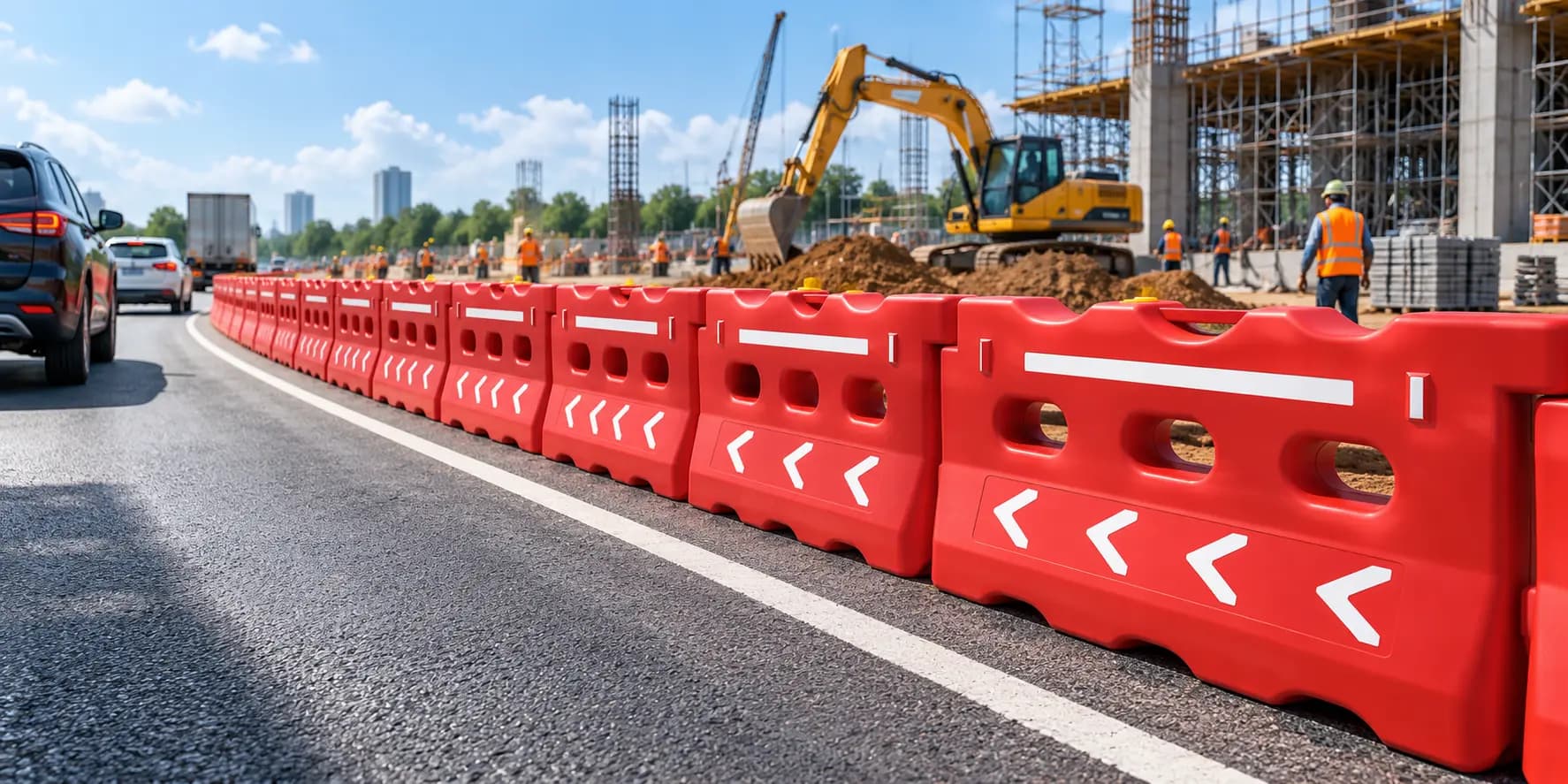
At construction sites, barriers also help distinguish vehicle zones from work zones, making area boundaries more visible to both road users and workers.
Types of Road Barriers Based on Material and Characteristics
Road barriers are available in several forms. Their differences are not limited to materials but also include mobility, weight, and intended installation purposes.
HDPE Road Barrier or Water-Filled Barrier
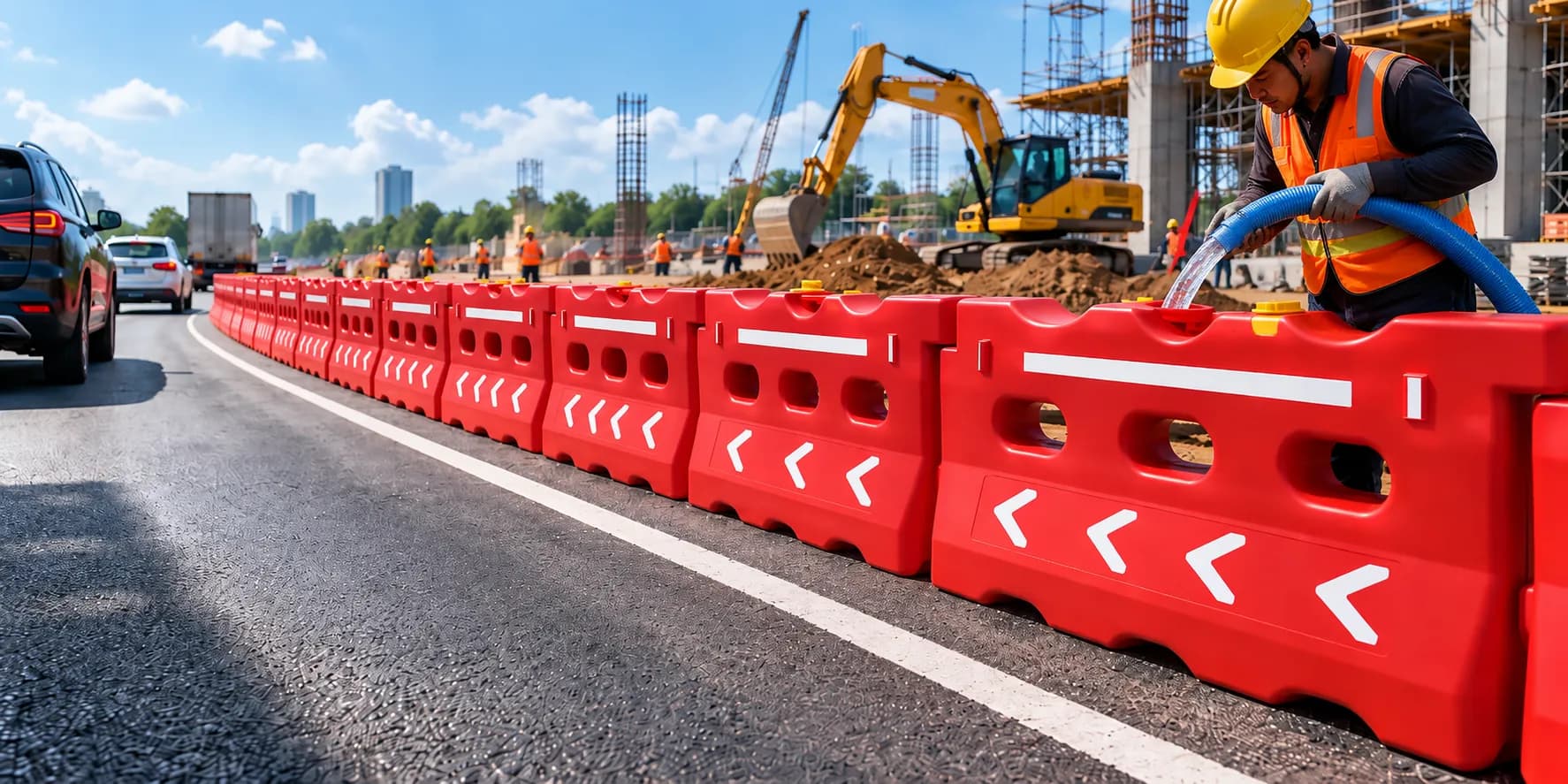
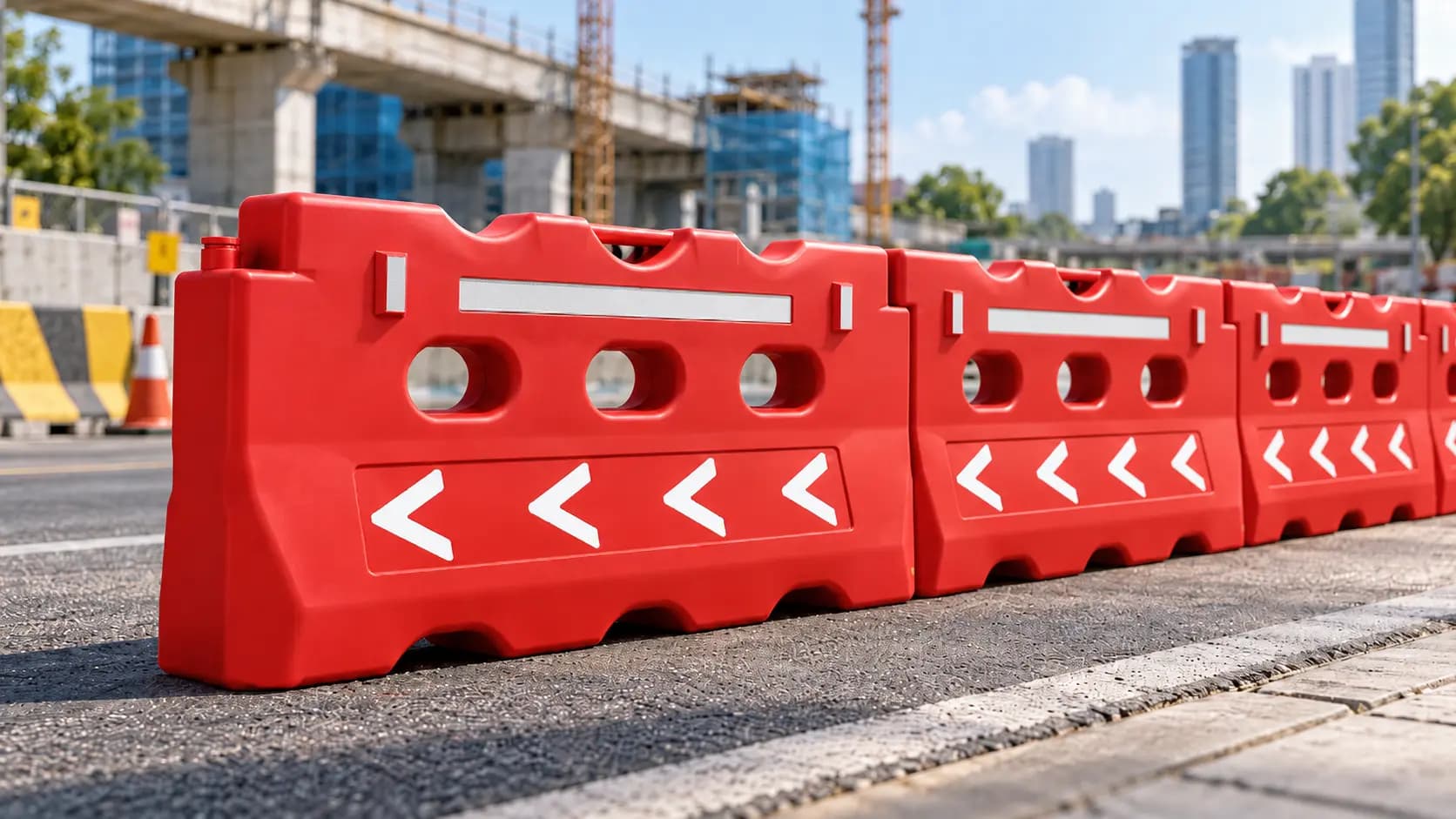
An HDPE road barrier is a plastic barrier with a hollow interior. This cavity allows the barrier to be filled with water, increasing its weight and stability during use.
When empty, it is relatively lightweight, making it more practical to move or arrange during transportation. Once positioned at the intended location, the barrier can be filled according to the product's requirements and instructions.
HDPE is also commonly used as a material for water barriers. Technical documents from the Directorate General of Land Transportation have previously listed HDPE as one of the materials used for water-filled lane dividers.
These characteristics make HDPE road barriers widely used in areas that require adjustable barrier configurations.
Concrete Barrier
Concrete barriers have a significantly greater mass than plastic barriers.
This type is commonly used when a barrier must remain in a relatively fixed position or when infrastructure designs require a barrier system with specific characteristics.
One well-known type of concrete barrier is the Jersey barrier, which features a side profile designed for road applications.
Due to their substantial weight, moving concrete barriers generally requires additional equipment and a more complex handling process compared to HDPE barriers.
Guardrail
Guardrails are often discussed alongside road barriers, but technically, the two should not automatically be considered identical.
A guardrail is a roadside safety barrier system typically installed along road edges, curves, bridges, or areas where vehicles are at risk of leaving the roadway. Bina Marga explains that guardrails are designed to help contain and redirect vehicles when drivers lose control.
Because their safety functions differ, temporary HDPE barriers cannot automatically be considered substitutes for guardrails or vehicle restraint systems designed for specific collision conditions.
Modular Barrier
Modular barriers are designed so that multiple units can be connected to form a continuous barrier system.
This system allows the overall barrier length to be adjusted according to site conditions. Its configuration can also be changed relatively easily when construction site layouts or vehicle routes are modified.
This type of design is commonly found in HDPE road barriers and water barriers.
HDPE Road Barriers vs. Concrete Barriers: What Are the Differences?
The choice between HDPE road barriers and concrete barriers should be based on the required function.
| Aspect | HDPE Road Barrier | Concrete Barrier |
|---|---|---|
| Weight when empty | Relatively lightweight | Very heavy |
| Transportation and handling | Easier | Requires additional equipment |
| Reconfiguration | Relatively flexible | More difficult |
| Ballast | Can use filling material according to product design | Relies on concrete mass |
| Common applications | Temporary barriers, construction projects, operational areas, events | Barriers requiring a more permanent position |
| Storage | Relatively practical | Requires larger storage areas and handling equipment |
This comparison does not mean that one type is always better than the other. Each serves a different purpose.
If barriers need to be moved frequently as work areas change, HDPE road barriers can offer greater flexibility. However, in locations requiring vehicle safety systems with specific impact performance, the project's technical specifications must remain the primary reference.
Road Barrier Dimensions: Don't Just Look at the Length
One of the common searches related to this product is road barrier dimensions.
However, road barrier dimensions refer to more than just the length of each unit.
Several parameters should be compared, including length, height, width or base width, empty weight, filling capacity, base design, connectors between units, and reflector installation areas.
Larger dimensions do not automatically mean a barrier is more suitable for every project. Larger barriers generally provide greater visual coverage and filling capacity, but they also require different storage and transportation arrangements.
Therefore, dimensions must be considered alongside actual site requirements.
Karya Pilar Nusantara HDPE Road Barrier Dimensions
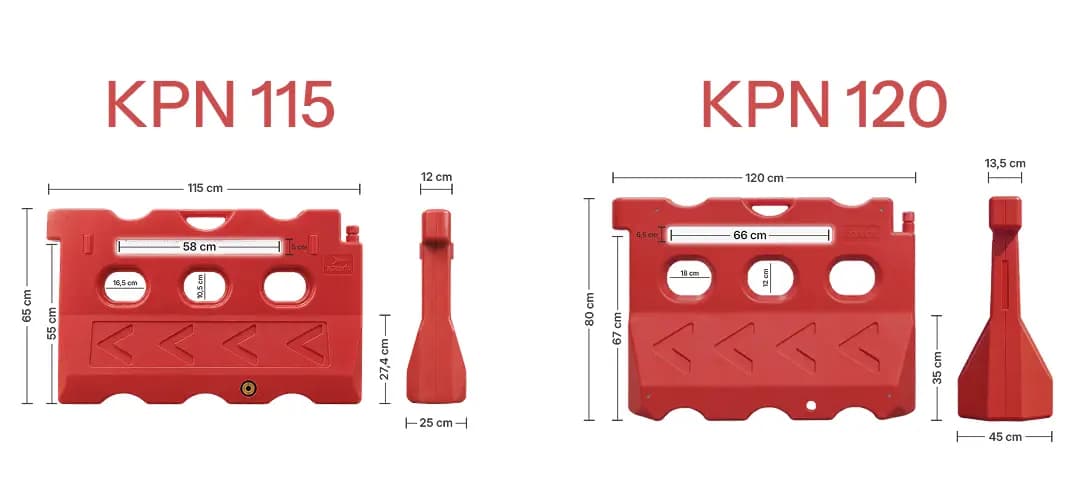
Karya Pilar Nusantara provides two HDPE road barrier variants, namely KPN 115 and KPN 120. Based on KPN's current product page, their specifications are as follows.
| Specification | KPN 115 | KPN 120 |
|---|---|---|
| Length | 115 cm | 120 cm |
| Width | 25 cm | 45 cm |
| Height | 65 cm | 80 cm |
| Capacity | 90 liters | 140 liters |
| Empty weight | 5.5 kg | 9.5 kg |
| Material | HDPE | HDPE |
The KPN 115 has more compact dimensions, while the KPN 120 offers a larger barrier surface and greater filling capacity.
The choice between the two can be adjusted according to available space, required barrier coverage, frequency of relocation, and project specifications.
Are There Standard Road Barrier Dimensions?
It is inaccurate to assume that all road barriers follow one standard size applicable to every use.
Specifications may vary depending on the type of barrier, relevant authority, road function, project design, and procurement documents.
For example, certain technical procurement documents issued by the Directorate General of Land Transportation specify particular requirements for the length, height, width, empty weight, connectors, and retroreflective materials of lane dividers or road separators. These requirements relate to the specific procurement needs and do not mean that every road barrier product on the market must have identical dimensions.
Therefore, for tenders or projects with technical specifications, project documents must be reviewed before selecting a product.
How to Choose the Right Road Barrier
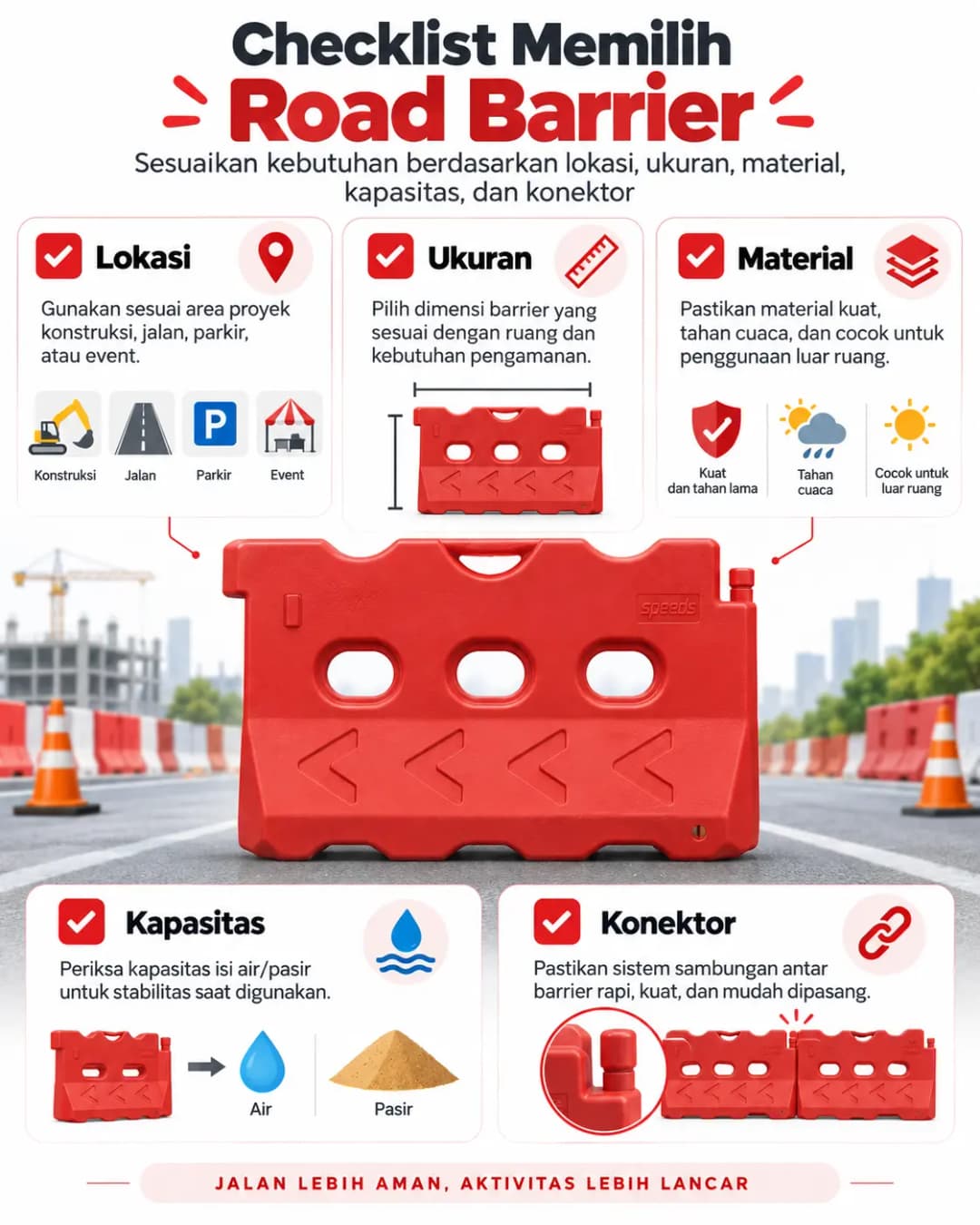
Road barriers should be selected by starting with site requirements rather than the product itself.
First, determine the main purpose. Will the barrier be used to manage vehicle movement, separate work areas, restrict access, establish a perimeter, or direct temporary traffic flow?
Next, consider how frequently the barriers will need to be moved. Construction sites with frequently changing work configurations generally require barriers that are easier to relocate compared to locations with fixed layouts.
The size of the area is also important. Barrier length affects the number of units required, while width and height relate to installation space and barrier visibility.
For hollow barriers, filling capacity must also be considered because it affects stability during use.
Finally, check whether the project has specific requirements regarding material, color, reflectors, connectors, weight, dimensions, or product documentation.
Road Barrier Applications in Construction Projects
At construction sites, working conditions can change according to the different stages of construction.
Today, a particular route may be used for heavy equipment access, but at a later stage, that same area may be converted into a work zone.
Modular road barriers can help establish more flexible boundaries because their arrangement can be adjusted as the project layout changes.
Barriers can be positioned along work area boundaries, construction vehicle access routes, entry and exit lanes, temporary perimeters, and areas that are temporarily closed.
However, barrier placement must still follow the project's safety plan and traffic management arrangements.
Road Barrier Applications on Roads and Infrastructure
In road applications, water barriers can be used for temporary traffic management and as lane dividers. Government authorities also use water barriers for traffic control arrangements, U-turn closures, and securing specific areas.
They can be used during roadwork, lane diversions, temporary closures, and traffic management operations.
However, their use on public roads must take into account the authority of road management agencies and applicable technical regulations.
Do not assume that every plastic barrier can function as a vehicle impact restraint system simply because its appearance resembles a traffic barrier.
Road Barrier Applications in Industrial and Operational Areas
Road barriers can also be used outside public roads.
In industrial estates, warehouses, or operational facilities, barriers can help separate vehicle routes from designated areas.
Examples include loading area boundaries, operational vehicle lanes, temporary work zones, specific entrances, and areas undergoing maintenance.
An advantage of HDPE barriers in these applications is that their configurations can be changed when operational flows are modified.
Road Barrier Applications for Events and Public Areas
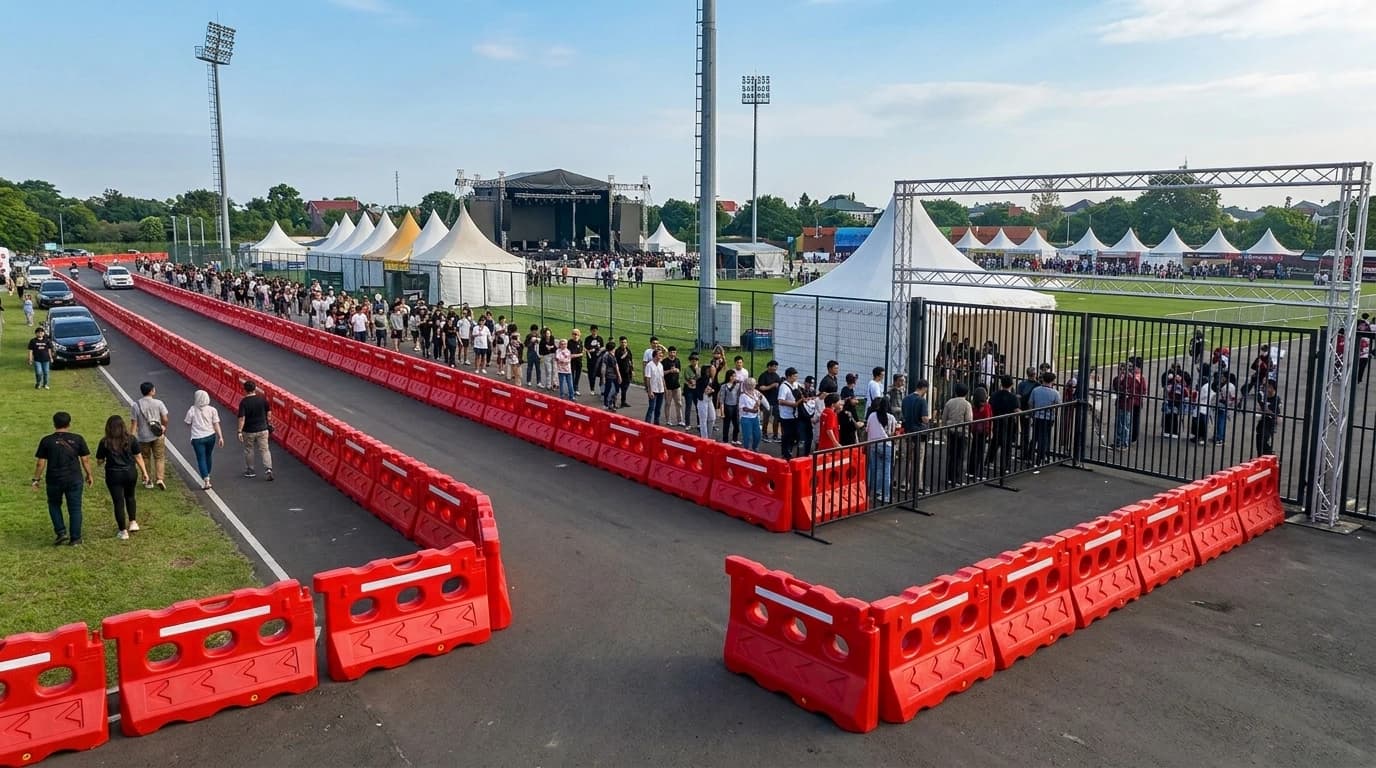
Large events often require vehicle traffic management and area barriers that are only needed for a certain period.
For such requirements, barriers that are easy to move can simplify installation and dismantling.
Road barriers can be used to establish vehicle routes, restrict parking areas, close specific access points, or separate operational zones.
Karya Pilar Nusantara's product page also lists construction, events and public areas, as well as roads and infrastructure, among the applications of its road barriers.
How to Use HDPE Road Barriers More Effectively
HDPE road barriers are generally designed to be easily positioned when empty and then weighted down after being placed at the intended location.
If the product includes a connector system, connect the units so that the barrier arrangement forms a more organized boundary.
Make sure the barriers are placed on a suitable surface and do not obstruct routes that must remain accessible.
For applications involving vehicles, visibility must also be considered. Contrasting colors and reflective devices can help make barriers easier to identify.
For projects with specific safety requirements, installation must follow working drawings, implementation procedures, or instructions from the relevant authorities.
When Is an HDPE Road Barrier the Right Choice?
HDPE road barriers are most relevant when a project requires a combination of physical separation, configuration flexibility, and ease of relocation.
These characteristics make them suitable for many temporary works and operational areas where layouts may change.
However, selection must still consider the risks associated with the location.
For areas requiring safety systems with specific impact containment capabilities, use systems that have been designed and verified for that purpose in accordance with project specifications.
Checklist Before Buying Road Barriers
Before selecting a product, check the intended function, installation location, area length, barrier height and width, empty weight, filling capacity, material, connector system, reflector requirements, relocation frequency, number of units, and project technical requirements.
For large-scale projects or government procurement, specifications should be discussed in advance so that the quantity and type of barriers can be adjusted to actual site conditions.
Frequently Asked Questions About Road Barriers
What is the difference between a road barrier and a water barrier?
Road barrier is a broader term referring to various types of barriers used on roads or within designated areas. A water barrier is a type of hollow road barrier that can be filled with water to provide additional weight.
What materials are road barriers made of?
Materials vary depending on the type of product. Road barriers can be made from HDPE or other plastic materials, concrete, or metal structures used in certain road safety systems.
What are the dimensions of a road barrier?
There is no single standard size that applies to all road barriers. Dimensions depend on the product's design and intended purpose. KPN, for example, offers variants measuring 115 × 25 × 65 cm and 120 × 45 × 80 cm.
Can HDPE road barriers be filled with water?
HDPE road barriers with a water-filled design have hollow cavities that can be filled with water to increase their weight during use. Transportation authorities also recognize water barriers as plastic barriers that use water as ballast.
Where are road barriers used?
They are commonly used in construction projects, roadwork, vehicle lane management, industrial areas, operational facilities, parking areas, events, and public spaces.
Are road barriers the same as guardrails?
Not entirely. A guardrail is a safety barrier system designed to help prevent vehicles from leaving the roadway, while HDPE road barriers or water barriers are commonly used to separate and guide movement within areas or traffic routes.
Conclusion: Choose Road Barriers Based on Function, Not Just Size
Road barriers play an important role in helping manage areas, separate traffic routes, and establish more visible boundaries.
However, each type of barrier has different characteristics.
HDPE barriers offer flexibility and ease of relocation, while concrete barriers and guardrail systems serve different requirements.
Therefore, before selecting a road barrier, consider the intended use, area dimensions, material, filling capacity, connection system, and project technical requirements.
Karya Pilar Nusantara provides several HDPE road barrier variants for construction projects, operational areas, public facilities, and infrastructure applications. For bulk requirements or projects with specific technical specifications, the required quantity, type, and configuration can be discussed before procurement.