Road barriers are used to help separate areas, direct traffic flow, mark work zones, and restrict access to certain areas. In construction projects and traffic management, the two types most frequently compared are plastic road barriers and concrete road barriers.
At first glance, both serve similar functions. However, they differ significantly in terms of materials, weight, mobility, installation, and usage characteristics.
Therefore, the more appropriate question is not simply “which one is stronger?” but rather which road barrier is best suited to the function and conditions of the project?
Understanding Plastic and Concrete Road Barriers
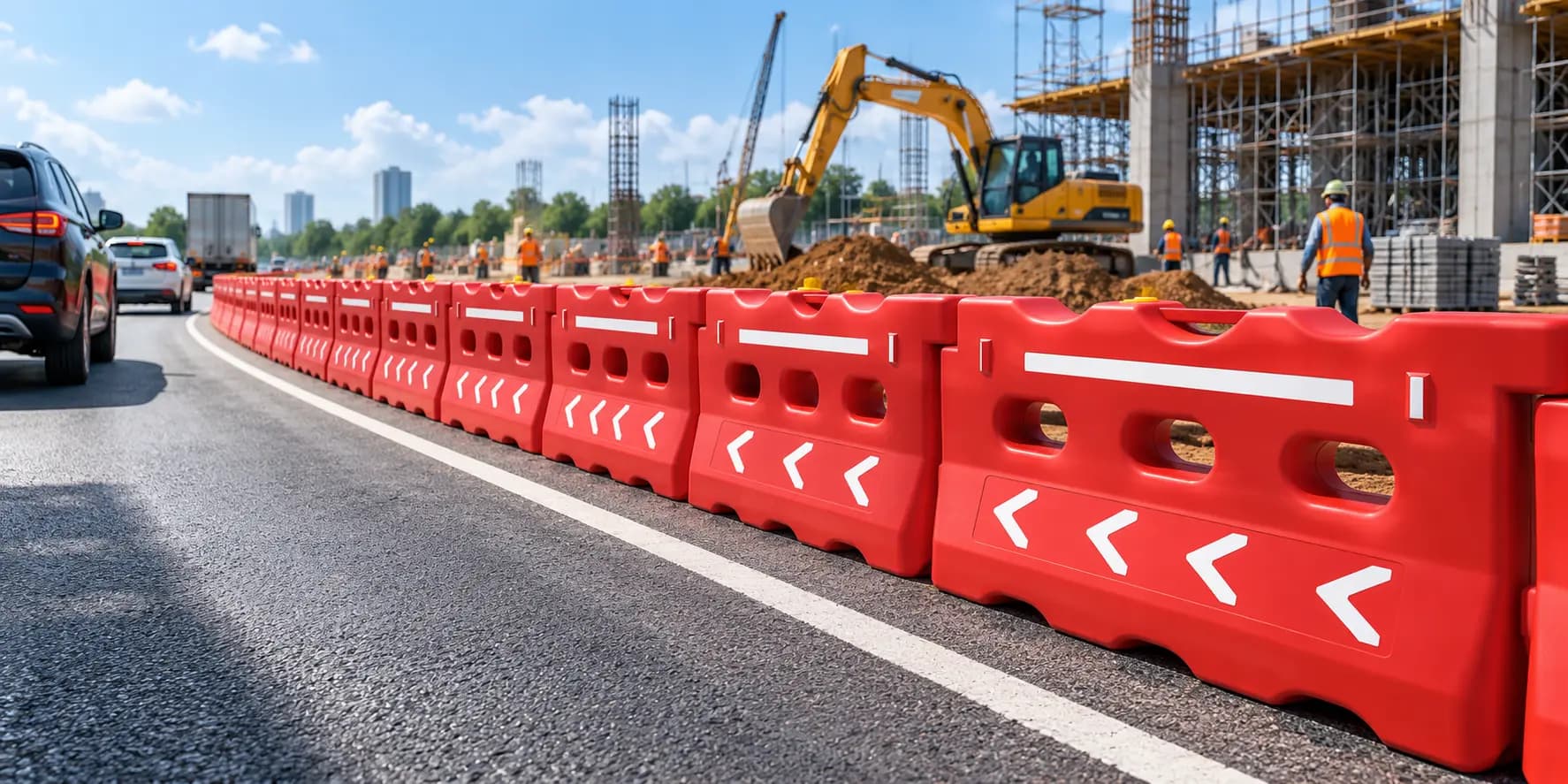
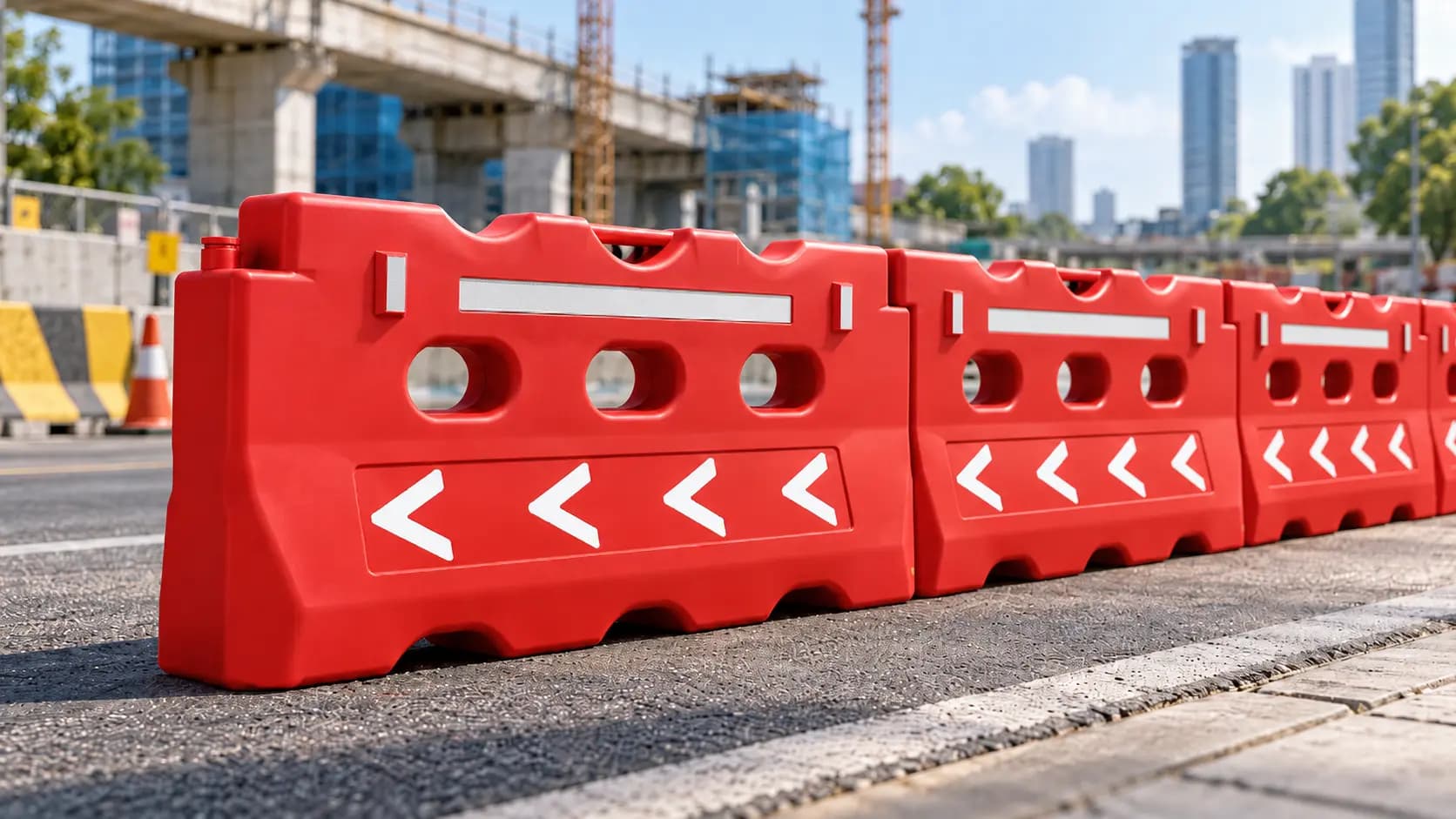
Plastic road barriers are generally made from polyethylene materials such as HDPE and feature a hollow structure. This makes the units relatively lightweight when empty, allowing them to be handled and moved more easily.
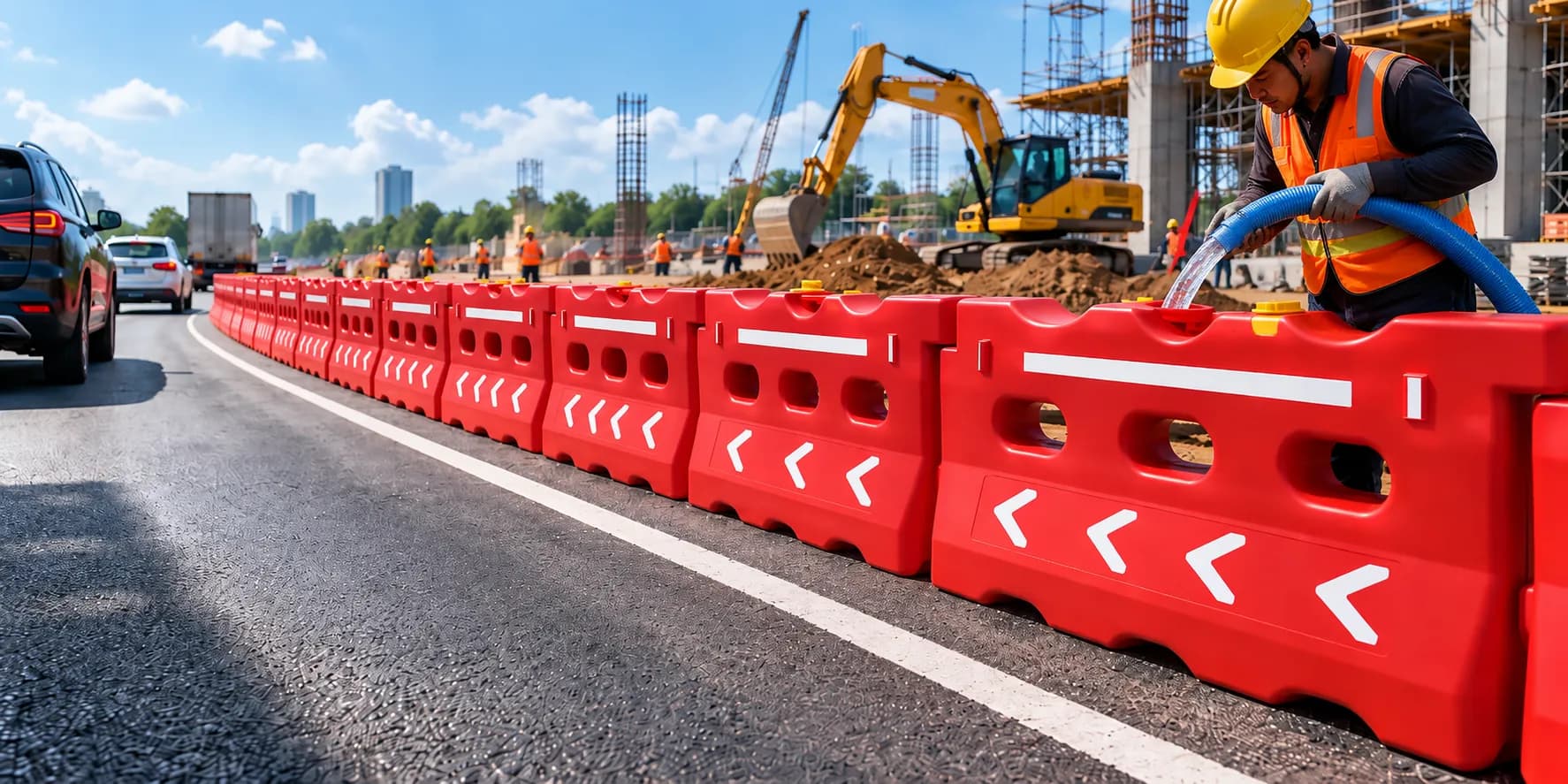
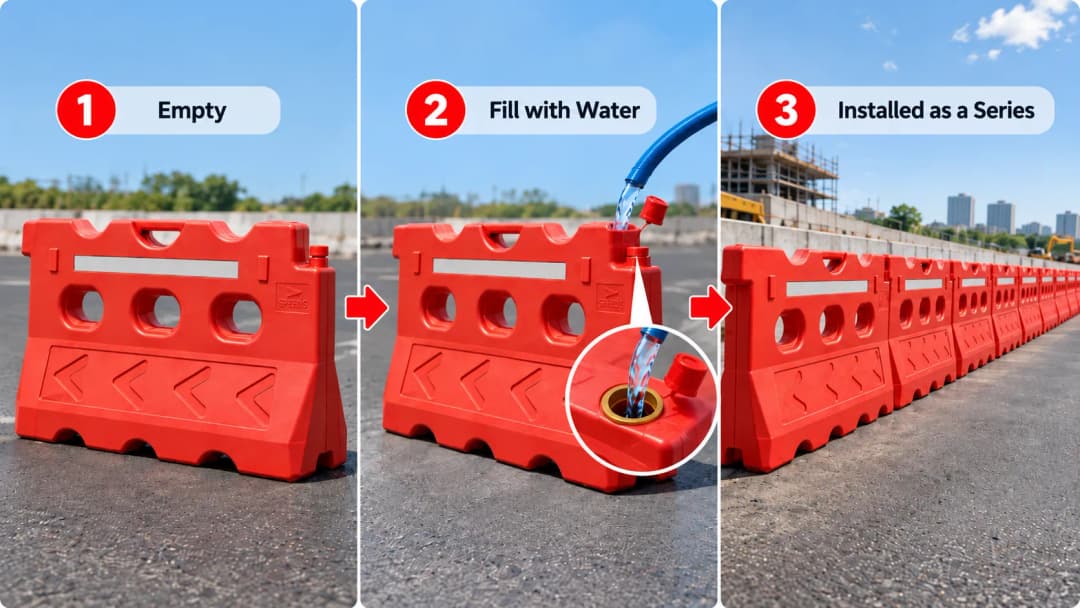
Once positioned at the required location, certain types can be filled with water or other ballast materials according to the product design to increase their weight and stability.
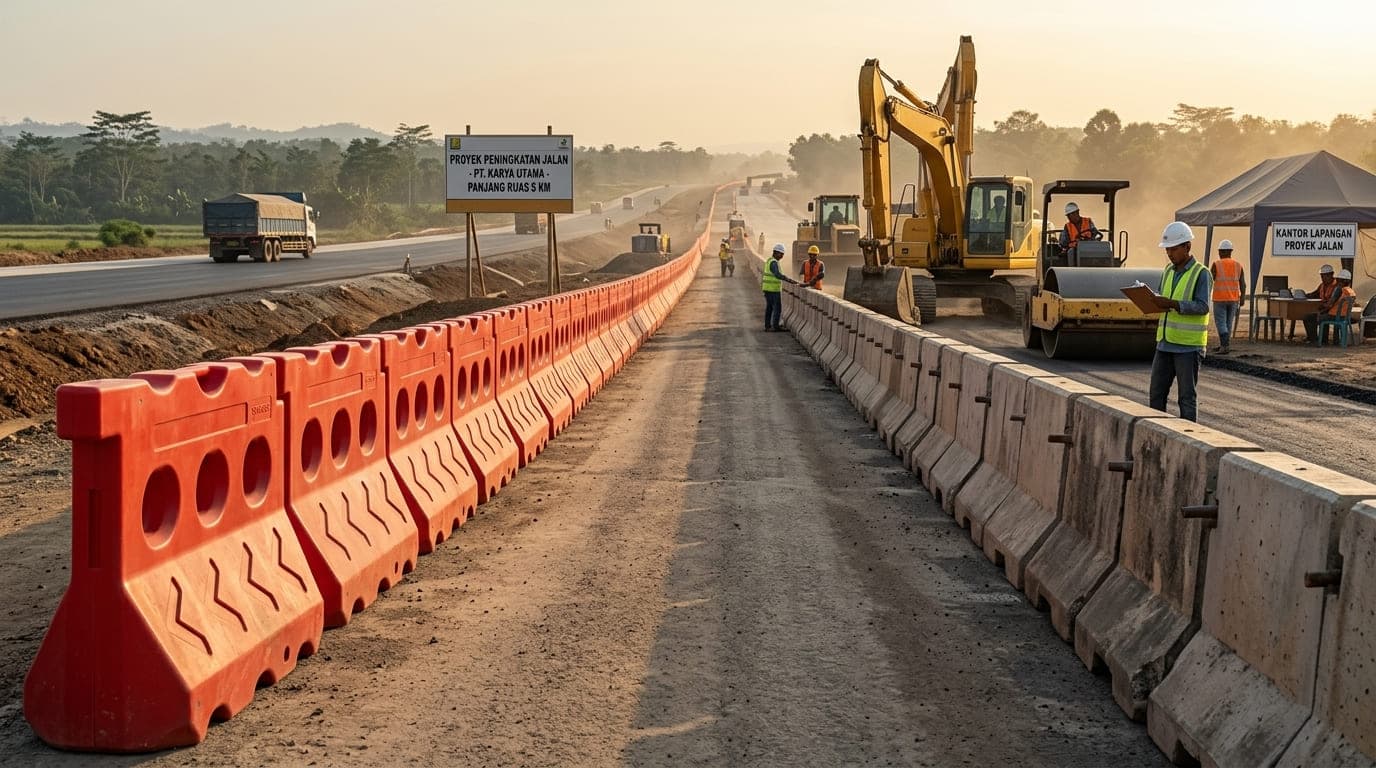
The concept of water barriers is also recognized in temporary lane separation systems in Indonesia. Regulations issued by the Ministry of Transportation distinguish between plastic lane dividers that can be filled with water and those made of concrete.
Meanwhile, concrete road barriers rely on the significantly greater mass of the material itself. Concrete barriers are commonly used when heavier barrier structures, minimal displacement, or safety systems specifically designed for certain traffic conditions are required. Indonesian road construction specifications also recognize concrete barriers as part of road infrastructure works.
Although their shapes and functions may appear similar, these material differences result in distinct usage characteristics.
Differences Between Plastic and Concrete Road Barriers
The following provides a general comparison of their characteristics.
| Aspect | Plastic/HDPE Road Barrier | Concrete Road Barrier |
|---|---|---|
| Material | Plastic, generally HDPE/polyethylene | Concrete, generally reinforced concrete |
| Weight during transportation | Relatively lightweight when empty | Heavy |
| Ballast | Can be filled with water or other weighting materials according to the design | Does not require additional ballast to achieve its basic mass |
| Relocation | Relatively easy | Usually requires handling equipment |
| Layout changes | Flexible | More complex |
| Storage | Practical after being emptied | Requires more space and handling |
| Common applications | Temporary area and traffic management | Barriers requiring greater mass and higher physical protection |
| Temporary installation | Highly suitable | Can be used, but transportation and handling are more demanding |
| Heavy equipment requirements | Lower | Higher, depending on size and design |
| Modular system | Generally available | Depends on the barrier design |
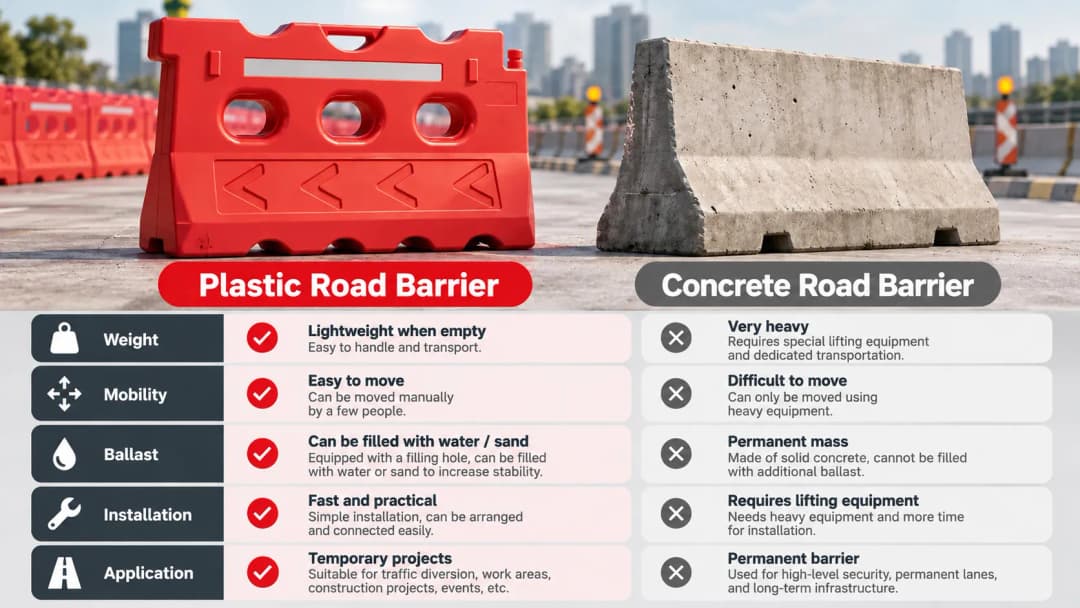
However, this table only describes general characteristics. Not all plastic road barriers or concrete barriers provide the same level of safety performance. The shape, connection system, ballast, installation, and product testing must also be considered.
Mobility: The Main Advantage of Plastic Road Barriers
One of the reasons plastic road barriers are widely used in temporary projects is their mobility.
Hollow HDPE road barriers have a relatively low empty weight compared to concrete. This makes initial arrangement, layout changes, and relocation after project completion more practical.
This characteristic is useful for situations such as phased construction projects, temporary traffic diversions, parking areas, events, project access routes, separation of operational zones, and locations where lane configurations may change.
Karpinus Road Barriers, for example, use HDPE material with a modular design and can be filled with water, making the units easier to handle when empty while providing additional mass during use.
For concrete barriers, their substantial mass is one of their main characteristics. Consequently, transportation and configuration changes require more extensive logistical planning.
If a project's layout changes every few days or weeks, this difference can have a significant impact on field operations.
Stability: Do Not Compare Empty Weight Alone
A common mistake when comparing these two types of barriers is considering only the weight of the units when empty.
For hollow plastic road barriers, the operational weight can change after the units are filled with water or ballast according to product specifications.
Therefore, the evaluation of plastic road barriers should consider:
Ballast capacity, the connection system between units, the shape of the barrier base, installation configuration, surface conditions, and the manufacturer's instructions for use.
Conversely, concrete barriers obtain most of their mass directly from the concrete material, meaning they do not depend on water as ballast.
Plastic Road Barriers Are Not Always the Same as Safety Barriers
This is an important consideration before selecting a product.
The term “road barrier” is often used broadly in the market to describe various types of road dividers. However, technically, devices intended to direct or separate traffic do not always serve the same function as barriers designed to contain or redirect vehicles during an impact.
For example, the FHWA distinguishes plastic longitudinal channelizing devices from crashworthy traffic barriers. Plastic units that function only as channelizers cannot automatically replace concrete barriers when a project requires positive protection against vehicles. Certain water-filled barrier systems may function as crashworthy barriers if they are specifically designed and tested for that purpose.
This means that HDPE material alone does not determine the impact protection level of a road barrier.
Product design, connectors, ballast, reinforcement, installation methods, and system testing results are far more important.
The same principle applies to concrete barriers. Their substantial mass does not mean that every concrete block automatically provides the same safety performance. The connection system and installation method also influence barrier performance.
When Are Plastic Road Barriers More Suitable?
Plastic road barriers are more attractive when a project requires a combination of area separation and operational flexibility.
For example, they are suitable for projects where area configurations change frequently. Units can be positioned at specific locations and then relocated when the work zone shifts.
These characteristics also make them suitable for temporary traffic management, parking area separation, event safety arrangements, construction projects, vehicle entry and exit access, and various operational areas.
Their lighter empty weight can also help reduce logistical complexity compared to concrete materials.
HDPE products offer the additional advantage of resistance to moisture and do not experience corrosion like metals. However, outdoor durability is still influenced by material grade, UV formulation, product design, molding quality, and operating conditions.
If your project requires barriers that are relatively easy to install, relocate, and reconfigure, HDPE road barriers are an option worth evaluating.
When Are Concrete Barriers More Suitable?
Concrete barriers are more relevant when a project's primary requirements involve substantial mass, minimal barrier displacement, and use as part of a road safety system specifically designed for those conditions.
Examples may include road medians, certain road construction works, areas with limited deflection space, or locations requiring positive protection.
The FHWA notes that precast concrete barriers have lower deflection than several other barrier systems and can be installed using certain methods to further limit movement when impacted.
However, these advantages come with logistical consequences.
Moving concrete barriers requires vehicles and handling equipment suitable for the weight of the units. Therefore, if a project requires repeated layout changes, the additional costs and complexity of transportation and handling must be considered.
What About Costs?
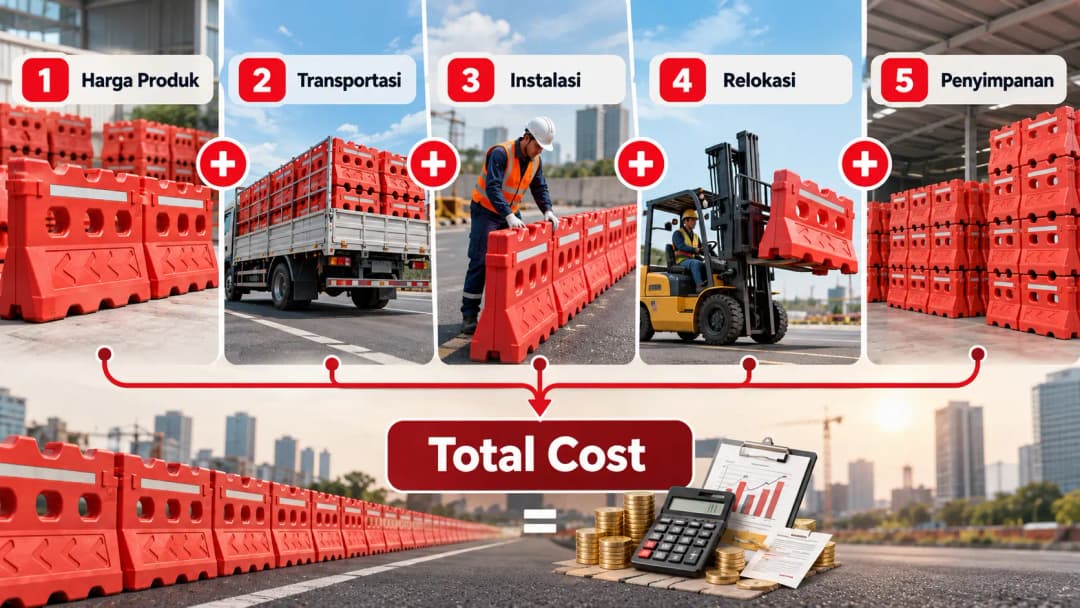
Comparing the prices of plastic and concrete road barriers based solely on the price per unit may provide an incomplete picture.
In a project, several other cost components need to be considered, including transportation, loading and unloading, installation equipment, labor, layout changes during the project, and relocation after work is completed.
For example, concrete barriers may be suitable for relatively fixed installations. However, when area configurations must change frequently, additional transportation and handling costs can become an important factor.
Conversely, plastic road barriers are relatively easy to transport when empty, but require a ballast-filling process after being positioned.
Therefore, a more appropriate comparison is based on the total operational requirements throughout the project, rather than simply the purchase price of a single unit.
Choose Based on Project Conditions, Not Just Material
The simplest way to determine the appropriate road barrier is to start with its intended function.
If the barrier is primarily used for temporary area management, separation, or channeling and needs to be moved frequently, plastic road barriers offer attractive flexibility.
If the project requires positive protection or barriers capable of containing and redirecting vehicles under certain impact conditions, use a barrier system specifically designed and safety-tested for that function.
Do not assume that all water barriers have the same capabilities as concrete traffic barriers simply because they have similar shapes. FHWA guidelines specifically warn that plastic longitudinal channelizers without an appropriate structural system should not be considered substitutes for barriers designed to provide positive protection.
The final decision should consider the project's technical design, traffic conditions, duration of use, mobility requirements, and applicable standards.
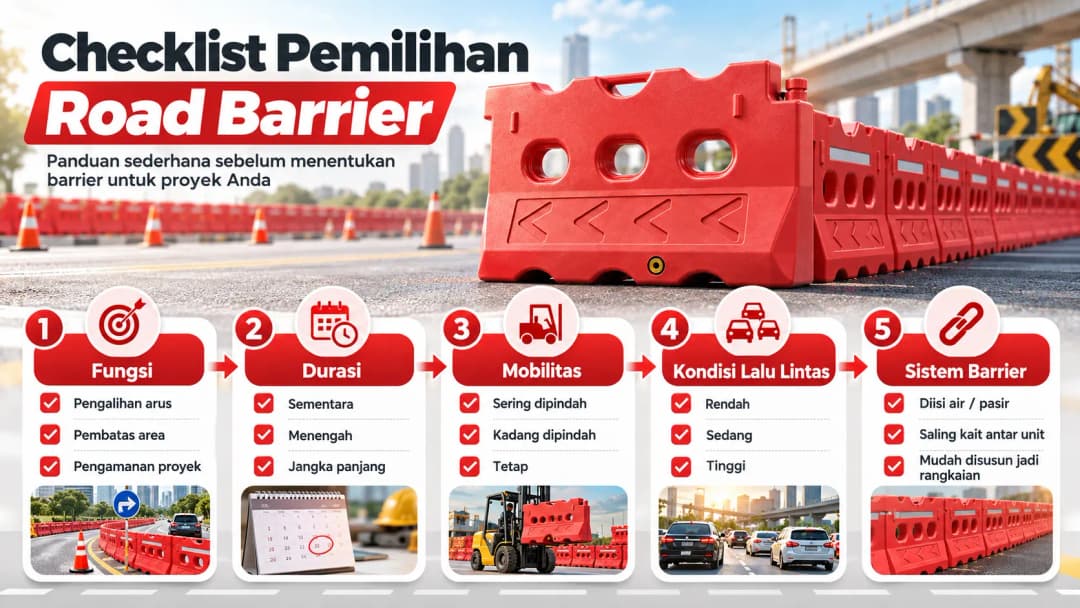
Checklist Before Choosing a Road Barrier
Before selecting a product, review the following questions:
What is its primary function?
Is it only intended to separate lanes and work zones, or does it require impact protection?
Does the project layout change frequently?
The more frequently the configuration changes, the more important barrier mobility becomes.
How long will the barrier be installed?
Requirements for a few days of use are certainly different from installations lasting several months or permanently.
What are the traffic conditions at the location?
Vehicle speed, traffic volume, and the distance between vehicles and work areas need to be considered.
Is equipment available for transportation and handling?
Concrete barriers have different handling requirements compared to empty HDPE barriers.
How does the connection system work?
Road barriers should be evaluated as a complete system, rather than merely as individual units.
Does the project have specific safety requirements?
For road and infrastructure projects, always review technical drawings, project specifications, and applicable regulations before selecting a product.
HDPE Road Barriers for Flexible Project Requirements
For projects requiring a modular barrier system, Karpinus Road Barriers use HDPE material and are designed to be arranged in connected barrier configurations for construction projects, area management, and temporary traffic control.
The units can be filled with water as ballast, allowing them to remain easy to transport and handle before being positioned at the installation site. The modular system also makes it easier to adjust the length of the barrier arrangement according to the area that needs to be restricted.
To explore product options and specifications, visit the Karpinus HDPE Road Barrier page.
The required number of units should be determined based on the length of the area, installation configuration, and project requirements.
Conclusion: Plastic or Concrete Road Barriers?
No single material is automatically the most suitable choice for every project.
HDPE plastic road barriers are more relevant when the main priorities are mobility, modular configuration, ease of installation, and temporary use.
Meanwhile, concrete barriers are more suitable when a project requires substantial mass, minimal displacement, or a barrier system with specific physical protection functions.
However, for traffic safety applications, the selection process should not stop at the material. Barrier design, connection systems, ballast, installation conditions, and testing standards must remain the primary considerations.
By understanding the project's requirements first, road barriers can be selected based on their technical functions—rather than simply whether they are made of plastic or concrete.