Determining the number of road barriers required for a project can actually be done using a simple calculation. However, mistakes often occur because the number of units is estimated based solely on visual judgment, without considering the length of the area, the dimensions of each barrier, the connections between units, or the shape of the area to be restricted.
To obtain a more accurate estimate, road barrier requirements should be calculated based on the total length of the area to be closed off or restricted, then compared with the effective length of a single road barrier unit.
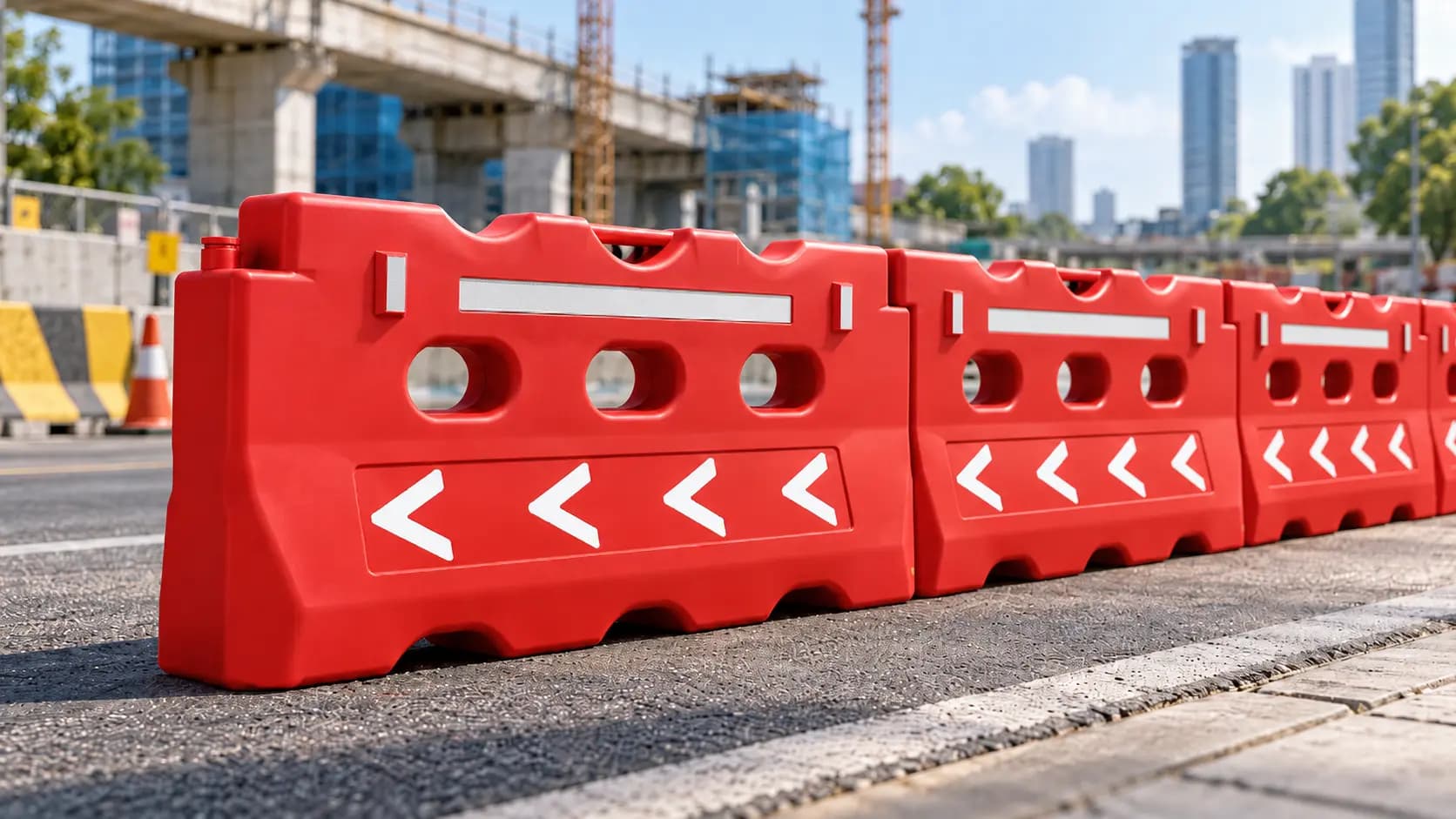
For example, Karya Pilar Nusantara HDPE Road Barriers are currently available in two variants: KPN 115 with a length of 115 cm and KPN 120 with a length of 120 cm.
By knowing these dimensions, the number of units required for areas measuring 10 meters, 50 meters, 100 meters, or more can be estimated before the procurement process begins.
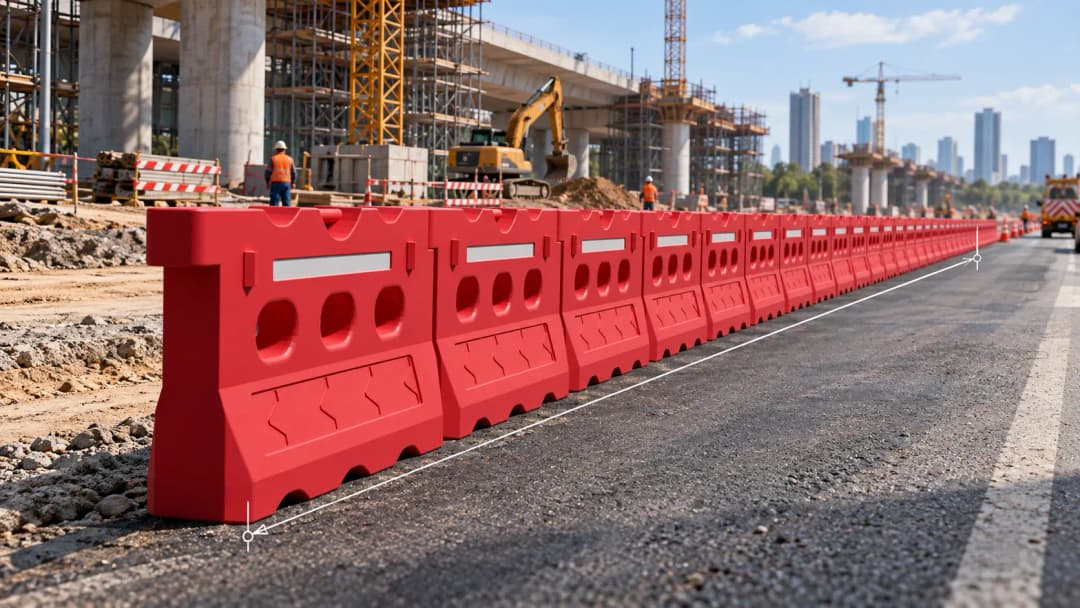
Why Are Road Barrier Requirements Calculated Based on Length?
Road barriers are generally installed in a linear arrangement to separate two areas.
Therefore, the basis for calculation is not the area in square meters, but rather the length of the section to be restricted, measured in linear meters.
For example, a project site has an area of 500 m². This information alone is not sufficient to determine the number of road barriers required.
What needs to be identified is which sections will be equipped with barriers.
If only the front side, measuring 25 meters in length, needs to be closed off, the barrier requirement is calculated based on those 25 meters.
Conversely, if the entire perimeter of the area must be surrounded by road barriers, the total perimeter should be calculated first.
The basic principle is:
The longer the section to be restricted, the more road barrier units are required.
Data Required Before Calculating Road Barrier Requirements
Before performing the calculation, several key pieces of information must be identified.
The first is the total length of the area where road barriers will be installed.
Measure from the starting point to the endpoint, following the actual installation route. If the barriers must extend along several sides or around turns, calculate all of those segments.
The second is the length of a single road barrier unit.
Road barrier dimensions are not always the same. Even products within the same category may have different lengths. Therefore, calculations should use the specifications of the product that will actually be installed.
KPN Road Barriers are available in two main variants:
| Variant | Unit Length |
|---|---|
| KPN 115 | 115 cm / 1.15 m |
| KPN 120 | 120 cm / 1.20 m |
These specifications refer to the Karya Pilar Nusantara Road Barrier product page.
The next factor to consider is the effective length after the units are connected.
For preliminary calculations, the physical length of the product can be used as a reference. However, for projects requiring high precision, the position of the connections between units should be checked.
If the connection system causes parts of the barriers to overlap or reduces the total length of the arrangement, use the effective installed length, rather than relying solely on the product's nominal length.
Basic Formula for Calculating the Number of Road Barriers
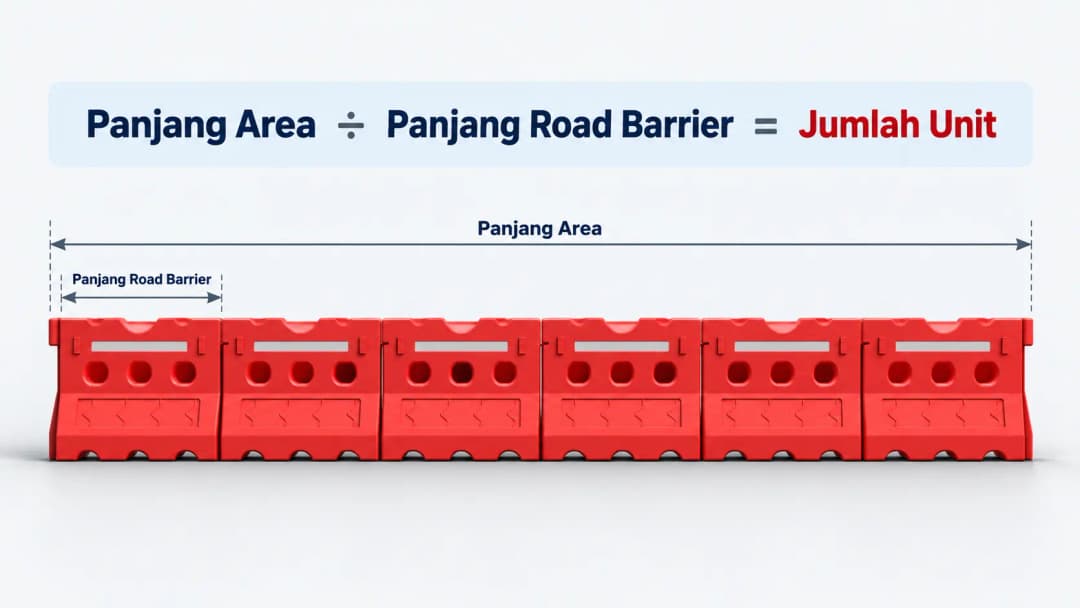
The basic formula is:
Number of Road Barriers = Total Area Length ÷ Effective Length per Unit
The calculation result must always be rounded up.
Why?
Because road barriers cannot be ordered in fractional units.
For example:
Area length = 25 meters
Road barrier length = 1.20 meters
Therefore:
25 ÷ 1.20 = 20.83 units
Since the result is 20.83, the minimum requirement becomes:
21 road barrier units
Not 20 units.
If the result is rounded down to 20 units, the total length that can be covered is only:
20 × 1.20 = 24 meters
This means approximately 1 meter of the area would remain uncovered.
Example of Calculating KPN 115 Road Barrier Requirements
The KPN 115 Road Barrier has a nominal length of 115 cm or 1.15 meters.
For example, a project requires barriers along a 50-meter section.
The calculation is:
50 ÷ 1.15 = 43.48
Since the number of units must be a whole number, the result is rounded up to:
44 units of KPN 115
In terms of nominal length:
44 × 1.15 = 50.6 meters
This means that the quantity is sufficient to cover a 50-meter section based on the product's nominal length.
Example of Calculating KPN 120 Road Barrier Requirements
For the KPN 120 Road Barrier, the nominal length of each unit is 120 cm or 1.20 meters.
If the length of the area to be restricted is 50 meters:
50 ÷ 1.20 = 41.67
Rounded up, the requirement becomes:
42 units of KPN 120
The total nominal length is:
42 × 1.20 = 50.4 meters
Therefore, approximately 42 units of KPN 120 Road Barriers are required for a 50-meter section, before considering the connection configuration and actual on-site conditions.
Quick Reference Table for Road Barrier Requirements Based on Area Length
The following table provides estimated requirements based on the nominal length of each product:
| Area Length | KPN 115 – 1.15 m | KPN 120 – 1.20 m |
|---|---|---|
| 10 m | 9 units | 9 units |
| 20 m | 18 units | 17 units |
| 25 m | 22 units | 21 units |
| 50 m | 44 units | 42 units |
| 75 m | 66 units | 63 units |
| 100 m | 87 units | 84 units |
This table can be used as an initial estimate for procurement requirements.
The final quantity must still be adjusted according to the installation layout and the effective length of each unit after assembly.
Calculating Road Barrier Requirements for Areas with Multiple Sides
Not all road barriers are installed in a single straight line.
In construction projects, industrial areas, parking facilities, or event venues, barriers may surround multiple sides of an area.
For example, consider a rectangular area with the following dimensions:
Length = 20 meters
Width = 10 meters
If the entire area needs to be surrounded by barriers, calculate its perimeter first:
Perimeter = 2 × (Length + Width)
Therefore:
2 × (20 + 10) = 60 meters
If KPN 120 is used:
60 ÷ 1.20 = 50 units
Thus, based on nominal dimensions, approximately 50 units of KPN 120 Road Barriers are required to surround the area.
However, if one side must provide a 5-meter-wide vehicle access point or entrance, this section can be deducted:
60 − 5 = 55 meters
Then:
55 ÷ 1.20 = 45.83
Rounded up, the result becomes:
46 units
This method produces an estimate that is much more consistent with the actual layout than calculating requirements based solely on the total land area.
What If the Installation Route Has Turns?
Turns must be considered because road barrier arrangements do not always provide the same effective length as when installed in a straight line.
On a straight route, the units can be connected along a single line.
However, at turns, each barrier must form a certain angle. This configuration can affect the position of the connections and the actual length of the route being covered.
For projects with multiple turns, it is advisable to divide the layout into several segments.
For example:
Segment A = 20 meters
Segment B = 15 meters
Segment C = 18 meters
Total:
20 + 15 + 18 = 53 meters
Afterward, inspect each change-of-direction point and the connection system being used.
Do Not Rely Solely on the Product's Nominal Length
One important aspect of calculating road barrier requirements is distinguishing between product length and effective installed length.
Nominal length refers to the physical dimensions of a single unit based on its product specifications.
Meanwhile, effective length refers to the actual additional distance covered by the arrangement when one unit is connected to the next.
For preliminary estimates, nominal length is a useful reference.
However, for large-scale procurement, a difference of just a few centimeters at each connection can accumulate into a significant discrepancy after dozens or hundreds of units have been installed.
Therefore, for large projects, use the formula:
Number of Barriers = Total Route Length ÷ Effective Installed Length
Then round the result up.
Is It Necessary to Add Spare Units?
The calculated quantity represents the minimum requirement based on the geometry of the installation route.
Under certain project conditions, additional units may be considered as reserves, particularly when:
There is a possibility of layout changes.
Certain areas require temporary closures.
The installation route contains many turns.
Vehicle access arrangements may change during the work.
Some units need to be relocated during project operations.
The number of spare units does not have to follow the same percentage for every project.
It should be determined based on site conditions, duration of use, and the possibility of configuration changes.
For projects with a permanent and accurately measured layout, spare unit requirements may differ from those of construction projects where layouts frequently change.
Common Mistakes When Calculating Road Barrier Requirements
The first mistake is using the total area as the basis for calculation.
Road barrier requirements are generally calculated based on the length of the section to be restricted.
The second mistake is failing to convert measurement units.
If the road barrier length is specified in centimeters while the area length is measured in meters, convert the units first.
For example:
115 cm = 1.15 meters
120 cm = 1.20 meters
The third mistake is rounding the calculation result down.
If the calculation produces 41.2 units, the requirement must still be rounded up to 42 units.
Another mistake is failing to account for entrances, turns, route changes, or areas intentionally left open during planning.
Finally, avoid assuming that all road barrier models have the same length. Road barrier dimensions vary across the market, so the specifications of the selected product must be used as the basis for calculation.
Checklist Before Determining the Final Quantity
Before placing an order, make sure the following information has been clearly identified:
Total route length where the barriers will be installed.
Type and dimensions of the road barriers to be used.
Effective length between units after connection.
Number of sides of the area to be closed off.
Width of access points that must remain open.
Turns and changes in direction within the layout.
Spare unit requirements based on project conditions.
With this information, road barrier quantity estimates can be prepared more accurately while also simplifying procurement and delivery planning.
Conclusion: How Many Road Barriers Are Required?
The simplest way to calculate road barrier requirements is:
Number of Road Barriers = Area Length ÷ Effective Road Barrier Length
Then round the result up.
For example, for a 50-meter section:
KPN 115 requires approximately 44 units based on a nominal length of 1.15 meters.
KPN 120 requires approximately 42 units based on a nominal length of 1.20 meters.
However, these figures represent geometric estimates. For actual project requirements, it is also necessary to consider connections between units, turns, access gates, layout changes, and spare unit requirements.
If the length of the project area is already known, HDPE Road Barrier requirements can be calculated during the planning stage, making the procurement process more measurable and minimizing the risk of unit shortages during installation.