One of the most common questions when planning a floating dock is: How many floating cubes are needed per square meter?
For floating cubes measuring 50 × 50 × 40 cm, the basic calculation is relatively straightforward. Each unit covers a surface area of approximately 0.25 m², meaning that geometrically, 4 floating cubes are required to form 1 m² in a single-layer configuration.
This means that a 10 m² floating dock generally requires approximately 40 cubes, while a 20 m² dock requires approximately 80 cubes.
However, this formula does not always produce the exact final quantity. The dock's length, width, layout, single-layer or double-layer configuration, and dimensions that are not multiples of 50 cm can affect the actual number of cubes required.
This article explains how to calculate floating cube requirements more accurately based on the surface area and shape of a floating dock.
Why Does 1 m² Require 4 Floating Cubes?
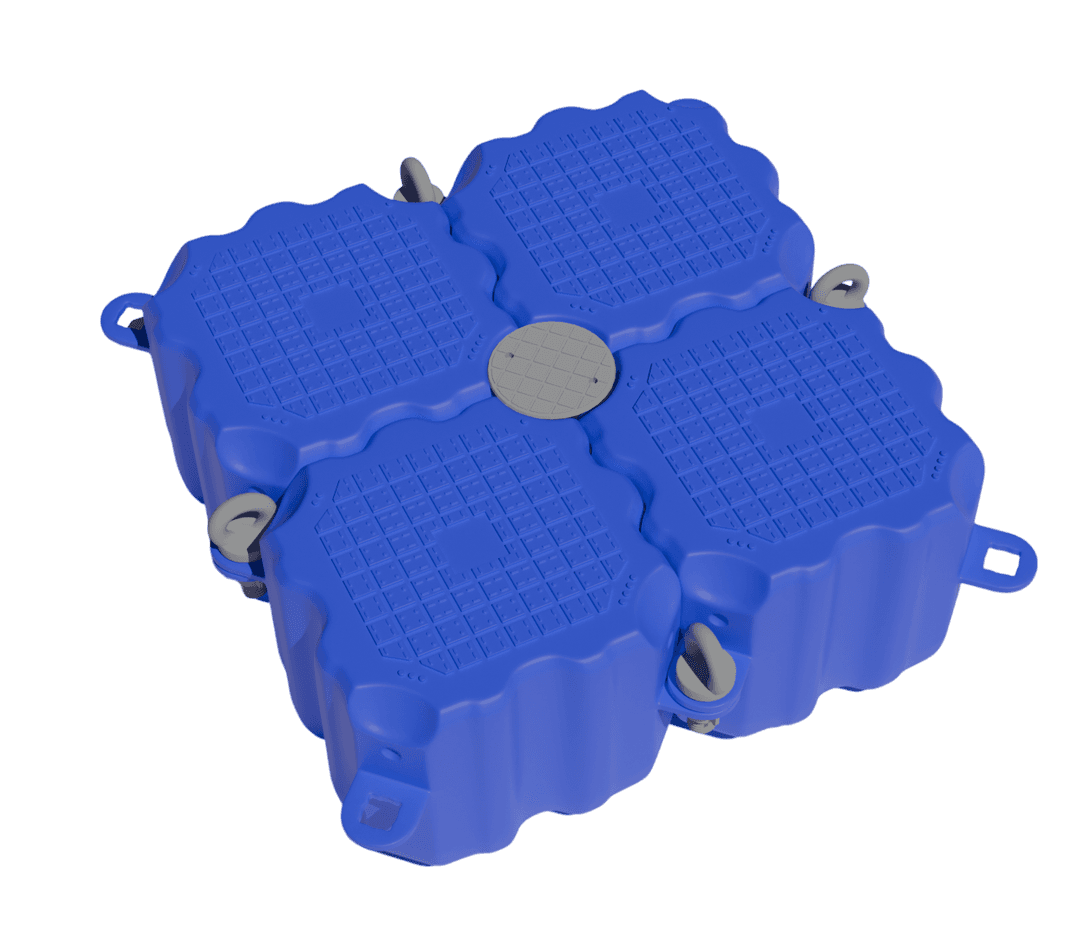
Karpinus Floating Cubes have approximate dimensions of 50 × 50 × 40 cm.
To calculate the number of cubes based on surface area, only the length and width are considered:
0.5 m × 0.5 m = 0.25 m²
This means that one floating cube covers approximately 0.25 m².
Therefore:
1 m² ÷ 0.25 m² = 4 cubes
Geometrically:
1 m² = 4 single-layer floating cubes
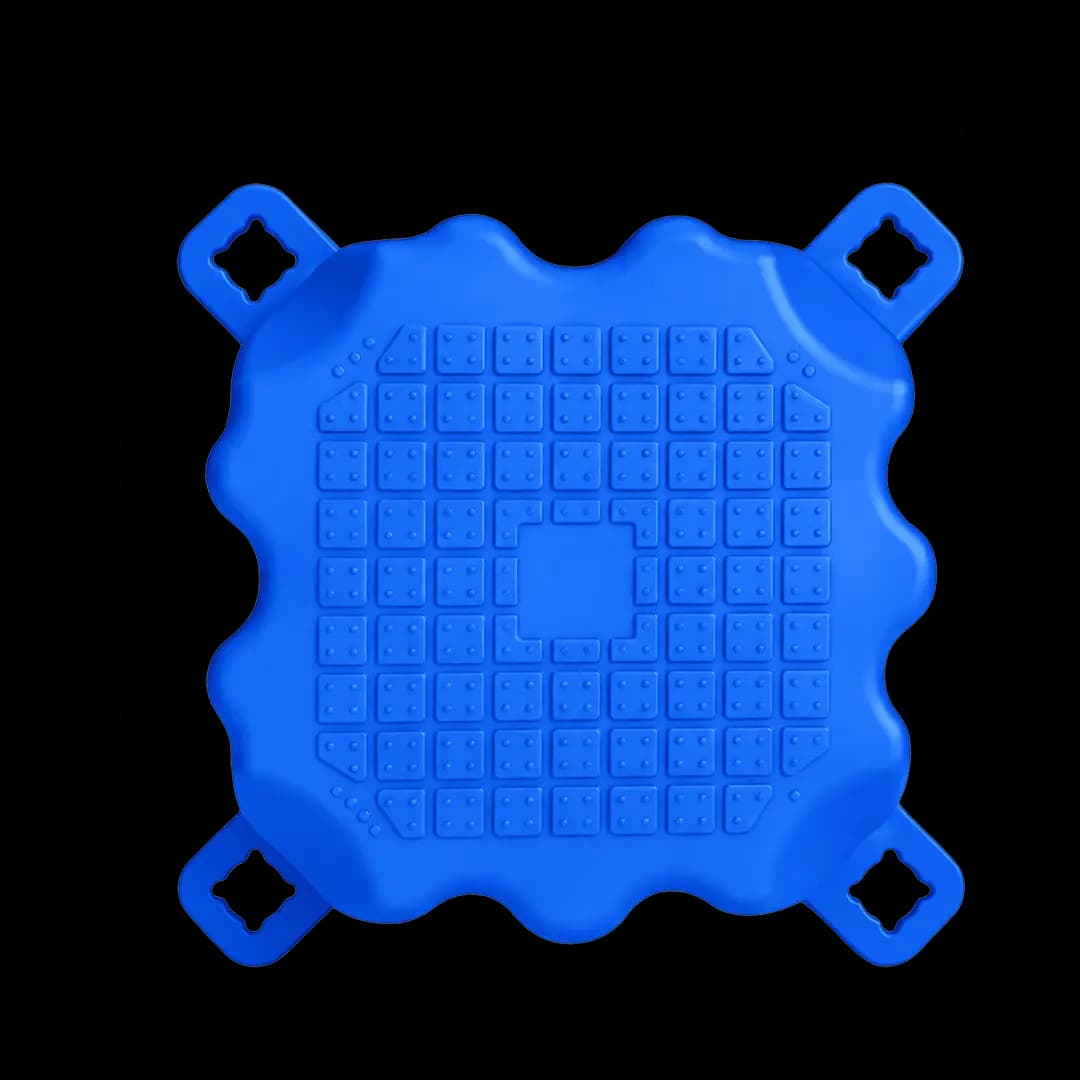
This formula can be used as a starting point for estimating the number of floating cubes required for different floating dock sizes.
Basic Formula for Calculating Floating Cubes Based on Area
The first step is to calculate the total area of the floating dock.
The formula is:
Dock area = Length × Width
Then, calculate the number of cubes using:
Number of cubes = Dock area × 4
For example, a floating dock is planned with dimensions of:
6 m × 2 m
Dock area:
6 × 2 = 12 m²
Number of cubes:
12 × 4 = 48 cubes
Therefore, approximately 48 floating cubes are geometrically required for a single-layer configuration.
Here are several additional examples:
| Dock Dimensions | Area | Single-Layer Requirement |
|---|---|---|
| 1 × 1 m | 1 m² | 4 cubes |
| 2 × 2 m | 4 m² | 16 cubes |
| 3 × 2 m | 6 m² | 24 cubes |
| 5 × 2 m | 10 m² | 40 cubes |
| 6 × 2 m | 12 m² | 48 cubes |
| 6 × 3 m | 18 m² | 72 cubes |
| 9.5 × 2 m | 19 m² | 76 cubes |
| 10 × 3 m | 30 m² | 120 cubes |
| 6 × 6 m | 36 m² | 144 cubes |
As long as the dock's length and width are multiples of 0.5 meters, the area × 4 formula can provide a reasonably accurate calculation.
Dock Dimensions Not Multiples of 50 cm? Don't Rely on Area Alone
There is one important factor that is often overlooked when calculating floating cube requirements.
Each cube has fixed surface dimensions of 50 × 50 cm.
This means that the floating dock arrangement follows a grid with intervals of approximately 0.5 meters.
For example, suppose a floating dock is planned with dimensions of:
5.2 m × 2.2 m
If calculated using surface area alone:
5.2 × 2.2 = 11.44 m²
Then:
11.44 × 4 = 45.76 cubes
When rounded up, the result is approximately 46 cubes.
However, 46 cubes may not be sufficient to form a rectangular platform measuring at least 5.2 × 2.2 meters because floating cubes cannot be cut into partial modules.
For the length:
5.2 ÷ 0.5 = 10.4
Since the result is not a whole number, the number of modules must be rounded up to:
11 cubes
Actual assembled length:
11 × 0.5 = 5.5 meters
For the width:
2.2 ÷ 0.5 = 4.4
Rounded up to:
5 cubes
Actual assembled width:
5 × 0.5 = 2.5 meters
Therefore, the total requirement is:
11 × 5 = 55 cubes
The actual requirement is 55 cubes, not 46 cubes.
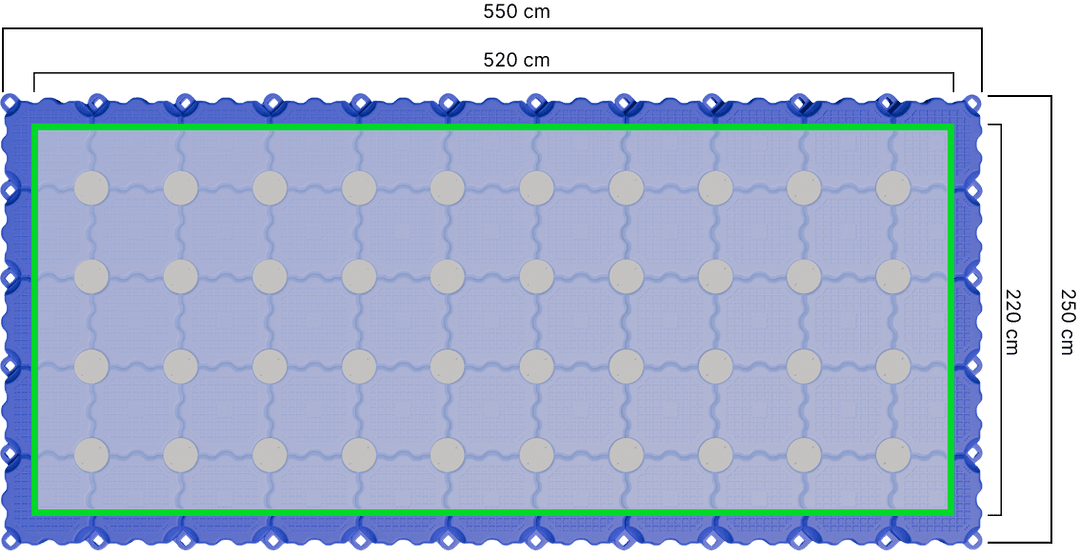
This explains why calculating floating cube requirements based on area alone is not always sufficient.
A More Accurate Formula Based on Length and Width
When the exact dock dimensions are known, a more accurate approach is to calculate the number of cubes required along each side.
Use the following formulas:
Number of cubes along the length = Dock length ÷ 0.5
Number of cubes along the width = Dock width ÷ 0.5
If either result contains a decimal, round it up to the nearest whole number.
Then calculate:
Total cubes = Number of cubes along the length × Number of cubes along the width
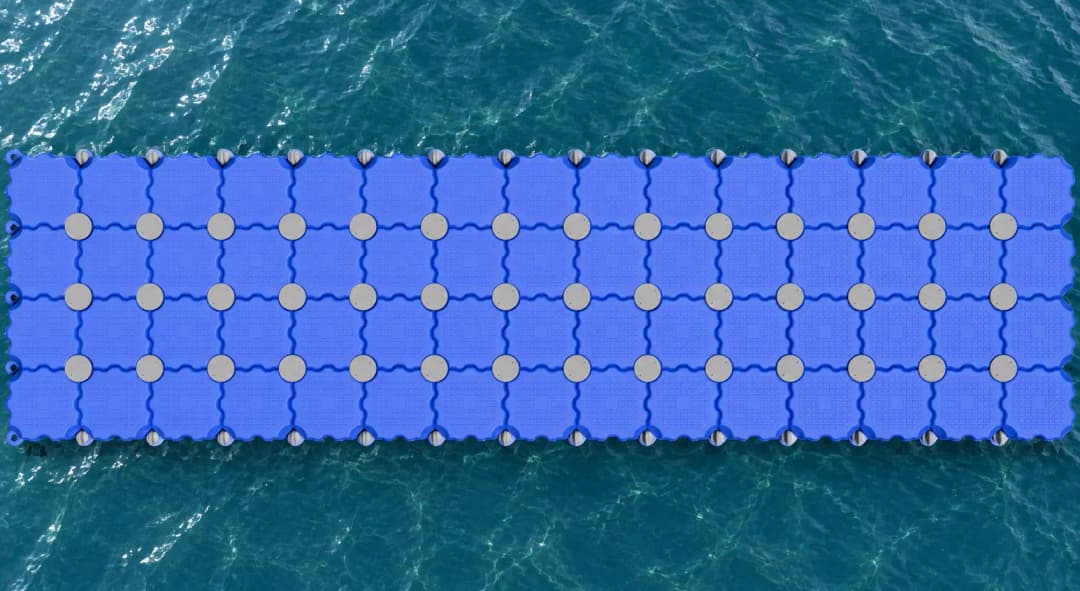
For example, consider a floating dock measuring:
7.5 m × 2 m
Length:
7.5 ÷ 0.5 = 15 cubes
Width:
2 ÷ 0.5 = 4 cubes
Total:
15 × 4 = 60 cubes
Therefore, a floating dock measuring 7.5 × 2 meters requires 60 single-layer floating cubes.
How to Calculate Floating Cubes for L-Shaped, T-Shaped, or Custom Dock Layouts
Not all floating docks are square or rectangular.
Modular floating cube systems allow docks to be assembled into various configurations, including:
L-shaped, T-shaped, U-shaped, extended walkways, platforms, or combinations of multiple sections.
For these designs, avoid calculating the required cubes based solely on the outermost rectangular area, as this may result in an excessive estimate.
A more accurate method is to divide the layout into several simpler sections.
For example, a T-shaped floating dock consists of:
Main section:
6 × 2 m = 12 m²
Cross section:
4 × 2 m = 8 m²
However, there is an overlapping intersection measuring:
2 × 2 m = 4 m²
Therefore, the actual area is:
12 + 8 − 4 = 16 m²
Floating cube requirement:
16 × 4 = 64 cubes
Thus, the T-shaped floating dock requires approximately 64 single-layer cubes.
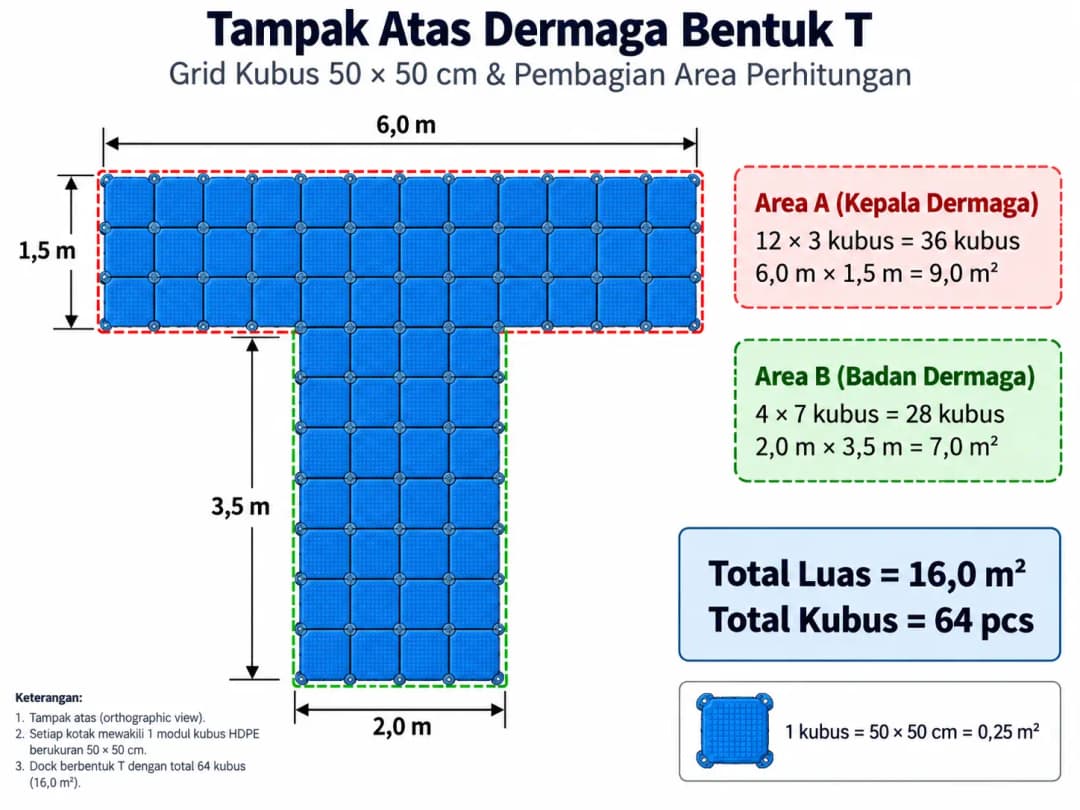
For more complex configurations, the most practical approach is to create a 50 × 50 cm grid on the layout drawing and count the number of modules required.
Calculating Single-Layer and Double-Layer Configurations
The previous calculations use a single-layer configuration, meaning one layer of floating cubes.
Geometrically:
1 m² single layer = 4 cubes
If the entire platform uses a double-layer configuration, the number of cubes doubles:
1 m² double layer = 8 cubes
For example, consider a floating dock measuring:
6 × 2 m
Total area:
12 m²
Single layer:
12 × 4 = 48 cubes
Double layer:
48 × 2 = 96 cubes
Therefore, if the entire platform uses a double-layer configuration, the geometrical requirement becomes 96 cubes.
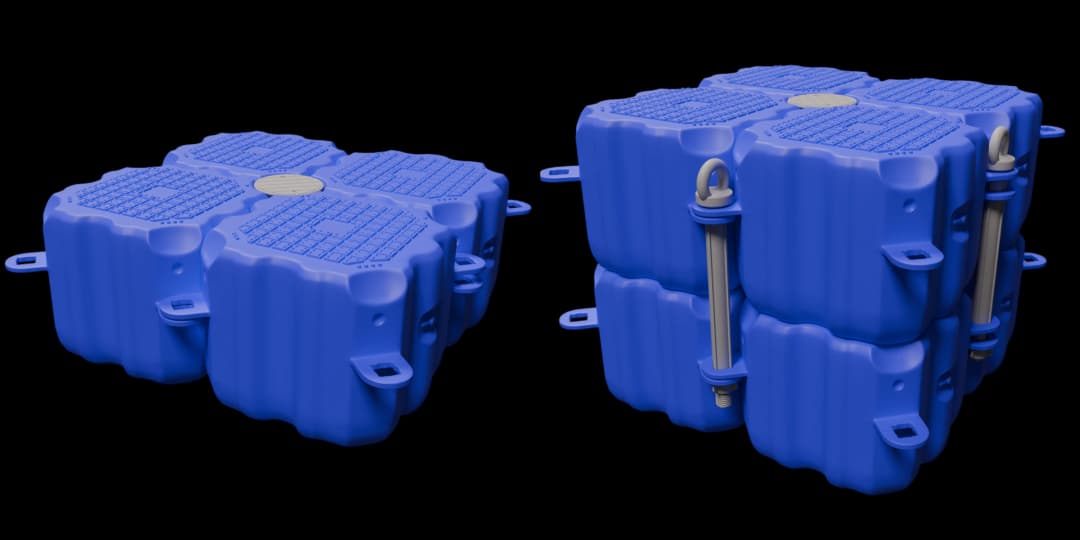
However, selecting a double-layer configuration should not be based solely on the number of cubes or the intention to increase load capacity.
Structural configuration, connections, load distribution, wave conditions, water currents, and stability requirements must also be considered.
Double-layer configurations also require an appropriate locking system designed for two-tier floating cube arrangements.
Can Buoyancy Capacity Be Used Directly as the Maximum Dock Load?
Karpinus Floating Cubes provide buoyancy characteristics based on their product configuration.
However, the stated buoyancy capacity should not automatically be considered the safe working load limit of a floating dock.
A floating dock supports more than just the weight of people.
Loads may come from users standing on the dock, railings, decking, bollards, fenders, goods, machinery, equipment, and additional structural components.
Furthermore, floating docks may experience dynamic forces caused by waves, water currents, wind, user movement, changes in water levels, and vessels docking alongside the platform.
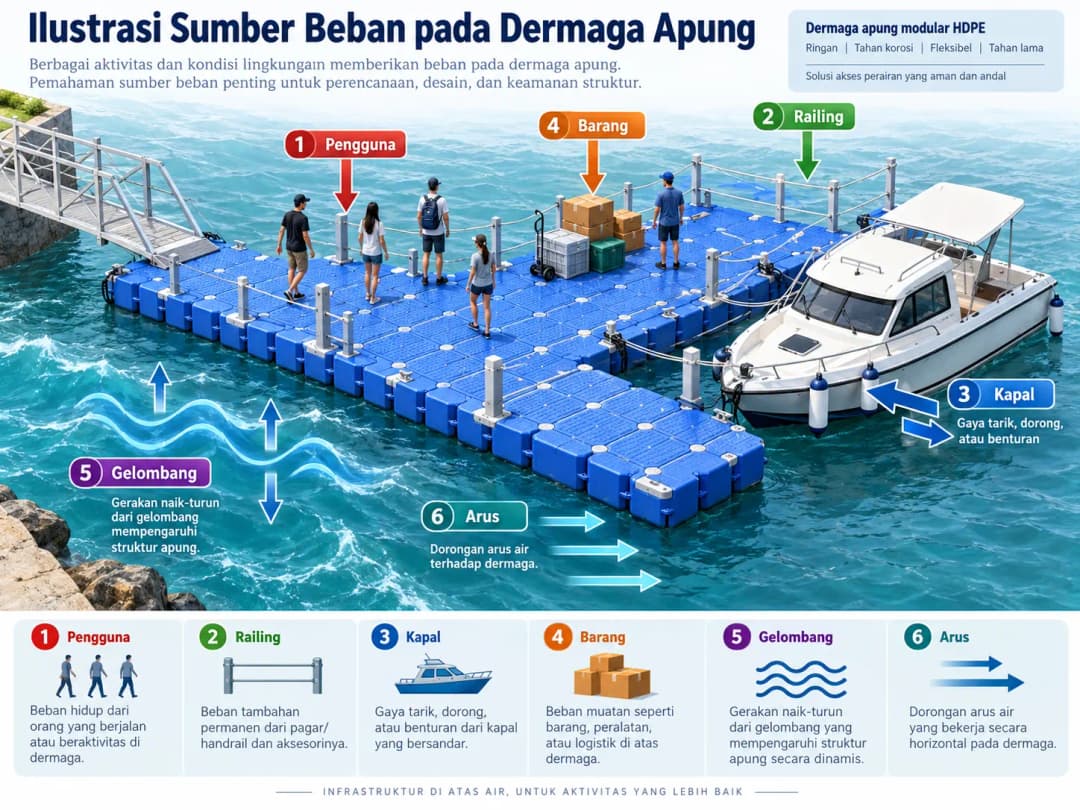
Therefore, two types of calculations should be distinguished:
Floating cube quantity calculation based on area: Used to determine the number of modules required to form the planned layout.
Structural and load capacity calculation: Used to ensure that the floating dock system is suitable for its intended function and actual site conditions.
This article focuses specifically on calculating the number of floating cube modules required based on surface area.
Can the Number of Accessories Be Calculated from the Number of Cubes?
Not necessarily.
The formula of 4 cubes per m² is only intended to estimate the number of main floating cube modules.
A complete floating dock system may include various additional components depending on its design, such as:
Locking pins, bolt nuts, long pins, long bolt nuts, handrails, bollards, fenders, pile guides, and anchoring systems.
The number of accessories required depends not only on the dock's surface area but also on the arrangement of the floating cubes.
For example, consider two floating docks, each with an area of 20 m².
The first dock has a rectangular layout, while the second has a T-shaped design with multiple sections.
Although both docks have the same surface area, their connection points, outer edges, and accessory requirements may differ.
Therefore, the number of accessories should be calculated after the floating cube layout has been finalized.
Example Calculation for a 6 × 6 Meter Floating Dock
Suppose a square floating dock is planned with dimensions of:
6 × 6 meters
Calculate the Dock Area
6 × 6 = 36 m²
Calculate the Number of Cubes Along Each Side
Length:
6 ÷ 0.5 = 12 cubes
Width:
6 ÷ 0.5 = 12 cubes
Calculate the Total Number of Cubes
12 × 12 = 144 cubes
Therefore, to construct a 6 × 6 meter single-layer floating dock, the basic geometrical requirement is:
144 floating cubes
If the entire platform uses a double-layer configuration:
144 × 2 = 288 cubes
This calculation does not include supporting components such as pins, handrails, bollards, fenders, pile guides, gangways, and anchoring systems.
Example Calculation for a 9.5 × 2 Meter Floating Dock
Suppose a floating dock walkway is planned with dimensions of:
9.5 × 2 meters
Number of cubes along the length:
9.5 ÷ 0.5 = 19 cubes
Number of cubes along the width:
2 ÷ 0.5 = 4 cubes
Total:
19 × 4 = 76 cubes
This result can also be verified using the area-based calculation:
9.5 × 2 = 19 m²
Then:
19 × 4 = 76 cubes
Since both the length and width are multiples of 0.5 meters, both calculation methods produce the same result.
How Many Floating Cubes Are Needed for 10 m²?
If all dimensions follow the 50 × 50 cm grid:
10 m² × 4 = 40 cubes
Therefore, the basic requirement is:
40 single-layer cubes
If a full double-layer configuration is used:
40 × 2 = 80 cubes
How Many Floating Cubes Are Needed for 20 m²?
The calculation is:
20 × 4 = 80 cubes
Therefore, the basic geometrical requirement is:
80 single-layer cubes
If a double-layer configuration is used:
80 × 2 = 160 cubes
How Many Floating Cubes Are Needed for 1 m²?
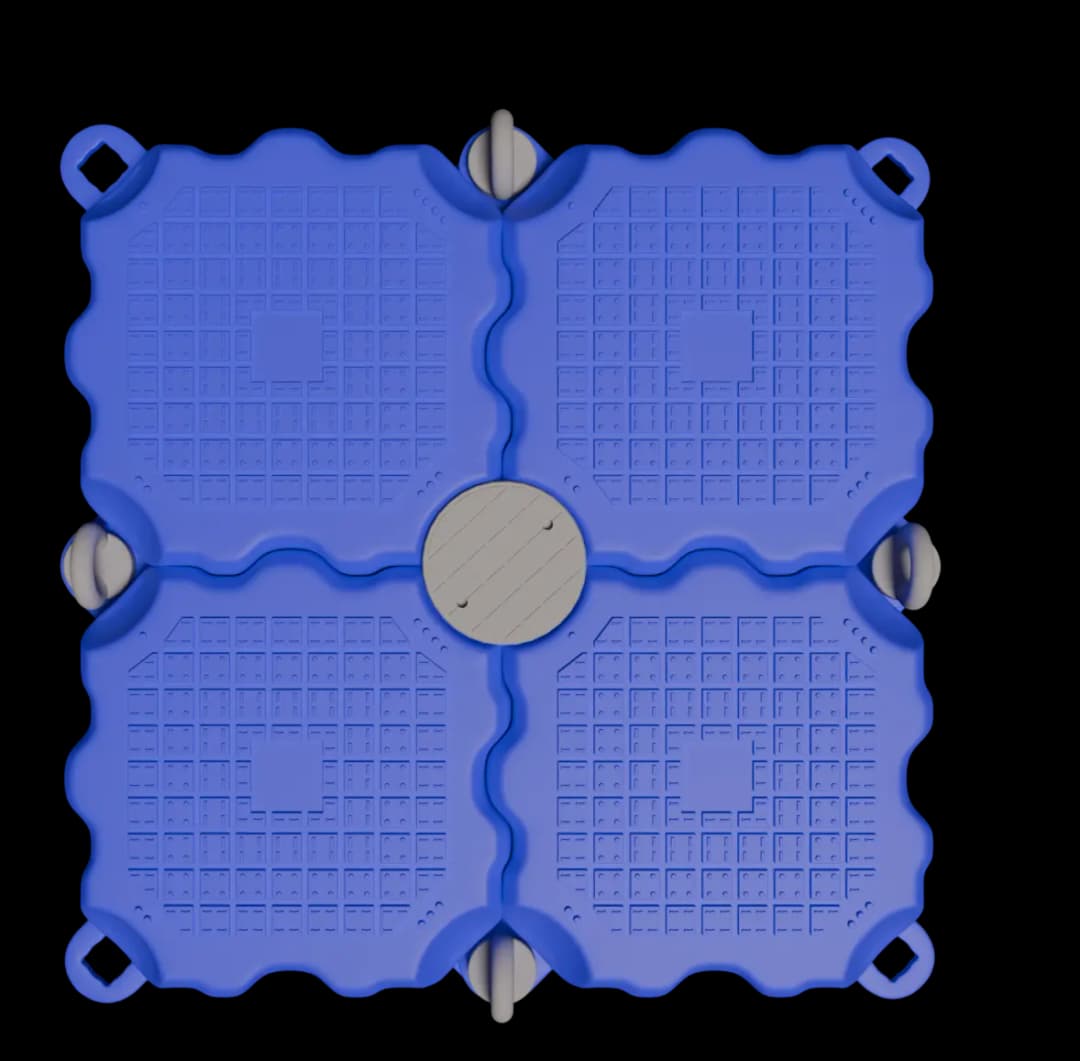
Floating cubes with a surface dimension of 50 × 50 cm require:
4 cubes to form 1 m²
The arrangement is:
2 cubes × 2 cubes = 4 cubes
This creates a surface measuring approximately:
1 × 1 meter
Is the Area × 4 Formula Always Accurate?
The formula:
Area × 4
is very useful for making an initial estimate.
However, it is most accurate when the dock's length and width are multiples of 0.5 meters.
If either dimension is not a multiple of 0.5 meters, calculate the number of cubes along each side separately.
The more precise formulas are:
Number of cubes along the length = Length ÷ 0.5
Number of cubes along the width = Width ÷ 0.5
Round each result up to the nearest whole number, then multiply the two values.
This method ensures that the calculated number of cubes corresponds to the actual physical dimensions of the modules that can be assembled on-site.
Information Required Before Finalizing Floating Cube Requirements
Calculations based on square meters should be used as an initial quantity estimate, rather than the sole basis for determining the final floating dock design.
Before finalizing the quantity and configuration, several important details should be considered, including:
Dock length and width
Layout configuration
Single-layer or double-layer construction
Intended dock function
Expected number of users
Additional loads on the platform
Water conditions
Wave conditions and water currents
Water level fluctuations
Vessel dimensions
Anchoring system requirements
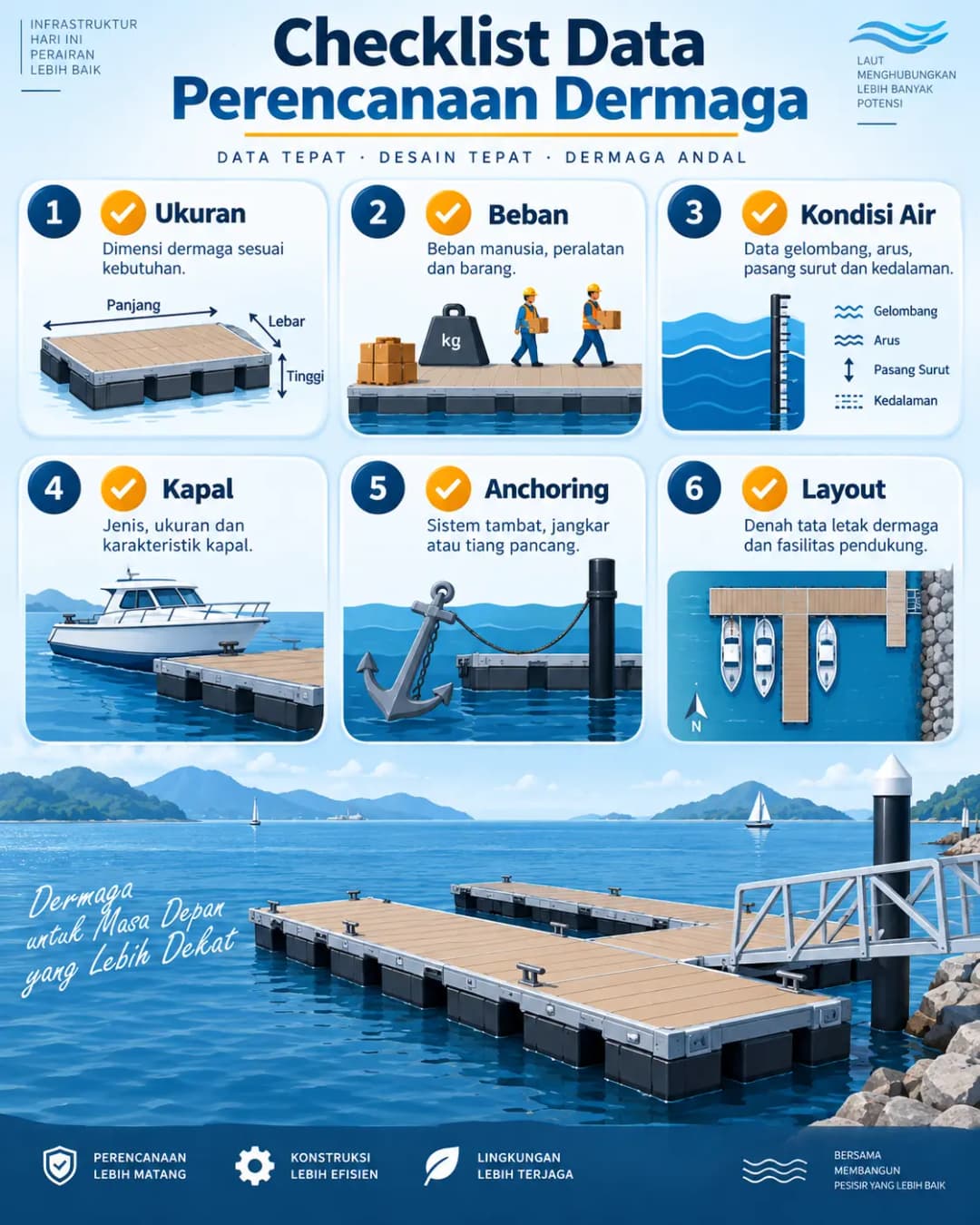
For example, a recreational floating dock installed on a relatively calm lake will have different operating conditions from a floating dock designed for vessels in a coastal area.
Even if both docks have the same surface area, their structural configurations and supporting components may not necessarily be identical.
Conclusion
For floating cubes measuring 50 × 50 cm, each unit covers approximately 0.25 m².
Therefore:
1 m² requires 4 single-layer floating cubes.
The basic formula is:
Number of cubes = Dock area × 4
For example:
10 m² = 40 cubes
20 m² = 80 cubes
36 m² = 144 cubes
However, if the dock's length or width is not a multiple of 50 cm, calculate the number of modules required along each side separately.
Number of cubes along the length = Length ÷ 0.5
Number of cubes along the width = Width ÷ 0.5
Round each decimal result up to the nearest whole number.
Then:
Total cubes = Number of cubes along the length × Number of cubes along the width
For a full double-layer configuration, the geometrical number of cubes is twice that of a single-layer configuration.
Calculating floating cube requirements per square meter provides a useful starting point for estimating the number of modules needed.
However, the final configuration must still consider the dock layout, load requirements, accessories, anchoring system, water conditions, and intended function of the floating dock.